I was ten years old when my grandmother took me to a small countryside clinic to have the orthopedic brace around my torso checked.
I can still remember that place with surprising clarity—the sharp smell of disinfectant, the quiet hum of the overhead lights, and the bitter scent of coffee that had probably been sitting in the machine near reception for hours.
I hadn’t eaten breakfast that morning.
Grandma said I always complained before medical appointments anyway, and eating would only give me another reason to say I wasn’t feeling well.
But hunger wasn’t what bothered me.
It was my ribs.
Every time I tried to take a deep breath, the hard edge of the brace pressed painfully into my side. It had been uncomfortable for days, but I had learned not to complain too much.
There was something else, too.
I couldn’t remove the brace by myself.
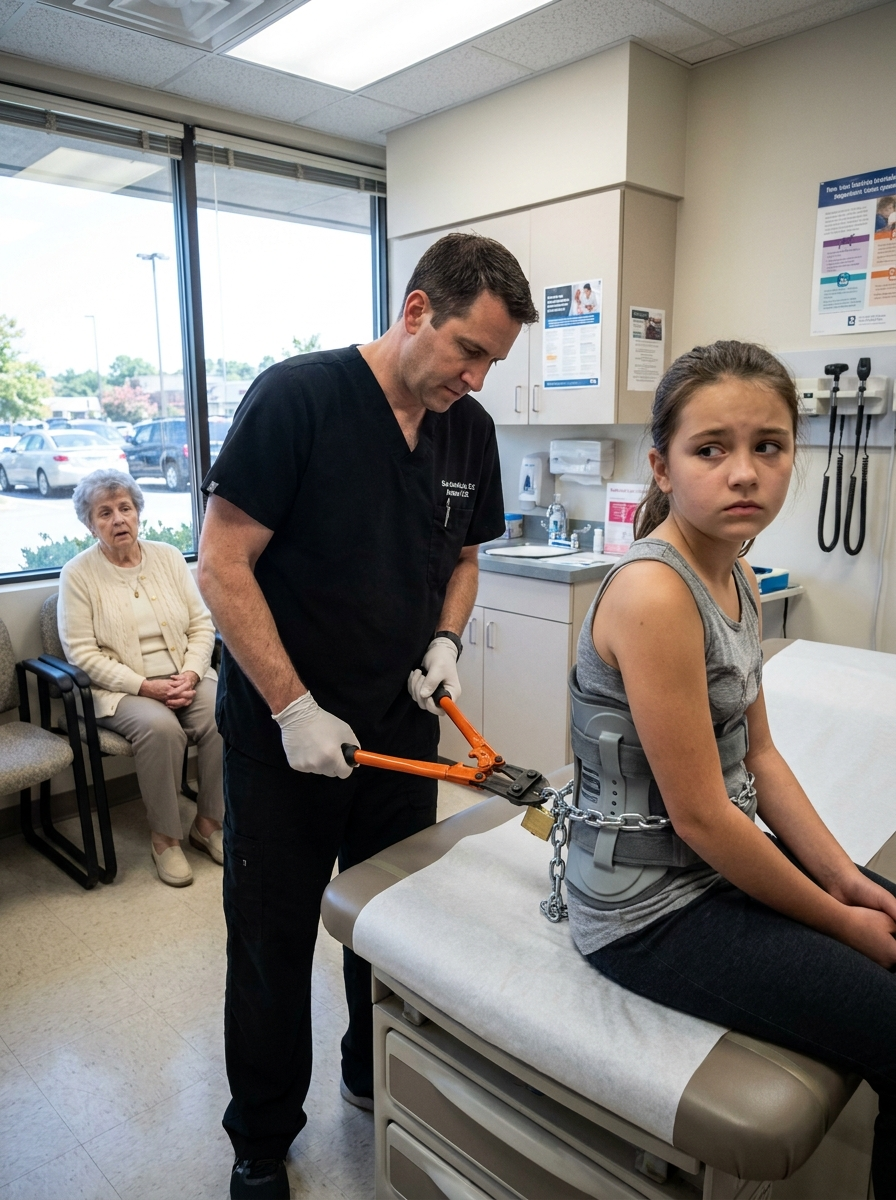
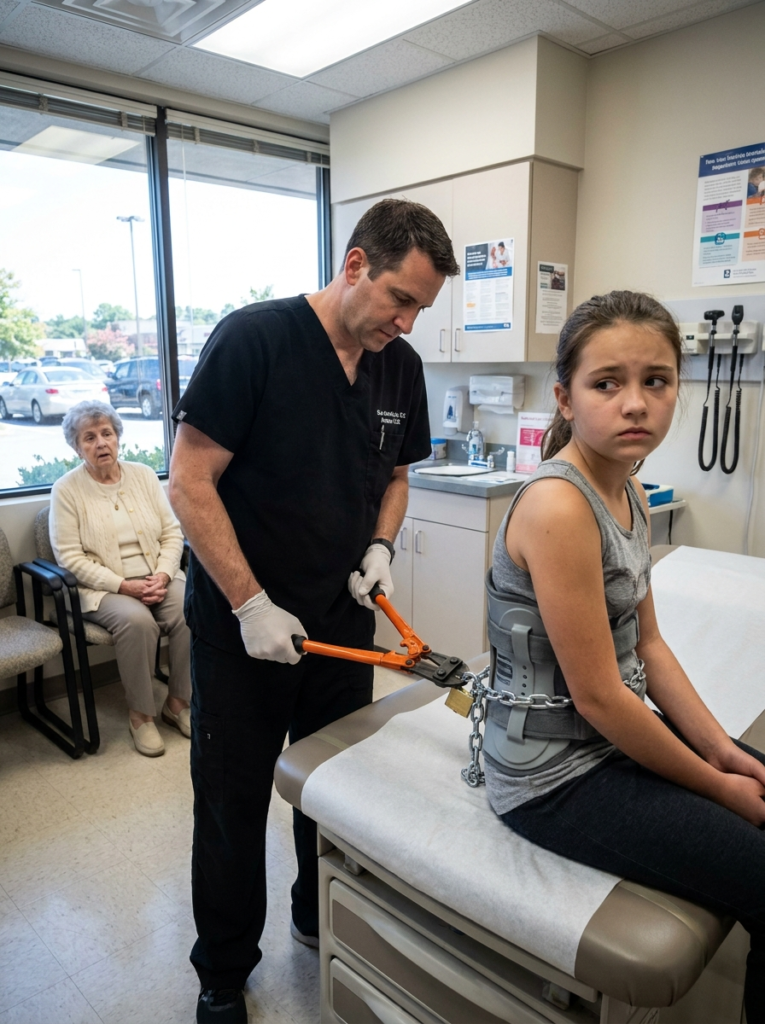
Grandma had added a thin chain around the fastening system and secured it with a small padlock.
According to her, it was for my own protection.
“When a child refuses to listen,” she often told me, “sometimes adults have to find another way to keep her safe.”
I’d heard those words so many times that I’d stopped arguing.
But Dr. Mercer didn’t react the way other adults usually did.
The moment he noticed the chain, he stopped talking.
He examined it carefully for several seconds before pulling his chair closer.
“Who put this here?”
I looked at Grandma.
She smiled calmly.
“I did. It’s nothing serious. It simply keeps her from removing the brace when she’s not supposed to.”
The doctor didn’t answer.
Instead, he gathered a few tools and carefully removed the small locking mechanism.
The chain dropped onto the examination table with a soft metallic clink.
I stayed perfectly still.
Dr. Mercer opened the brace and examined my side.
Grandma picked up my coat and began folding it neatly across her lap.
“The problem,” she explained, “is that she’s constantly trying to take it off. I hate having to be strict, but sometimes children don’t understand what’s best for them.”
The doctor looked at me.
“Is that true? Do you keep trying to remove your brace?”
I slowly shook my head.
Before I could say anything else, Grandma reached over and tucked a strand of hair behind my ear.
“She’s shy,” she said with a smile. “You know how children are.”
Dr. Mercer didn’t smile back.
Slowly, I raised my left arm.
Underneath it, where the brace had been pressing hardest, a red mark was still visible against my skin.
The doctor’s expression changed.
For several seconds, he said nothing.
Then he looked directly at Grandma.
“How long has the brace been secured this way?”
Her posture stiffened slightly.
“I wouldn’t call it secured. I simply make sure it stays where it’s supposed to.”
“How long?”
Grandma opened her handbag.
She took out a tissue.
Folded it carefully.
Then placed it back inside without using it.
“For a while.”
Dr. Mercer stood up.
He called one of the clinic employees and asked her to contact my father.
Grandma’s fingers tightened around my coat.
“There really isn’t any reason to disturb him at work.”
Dr. Mercer met her eyes.
“I think there is now.”
It was the first time I could remember seeing someone challenge my grandmother without raising their voice.
While we waited, she pulled a small packet of crackers from her purse and handed me a few.
I ate them quickly even though my mouth felt completely dry.
Then Grandma started talking.
About laundry.
About Dad’s work schedule.
About the rain expected that afternoon.
About the tomatoes in the garden that might get damaged.
Any subject seemed acceptable as long as nobody mentioned the little chain lying on the examination table.
A few minutes later, she leaned closer to me.
“Your father is going to have to leave work and come all the way here because of this.”
I didn’t answer.
I stared at my shoes.
I’d learned long ago that when Grandma used that particular tone, silence was usually the safest response.
Dad arrived shortly afterward.
He was still wearing his work clothes. Pale sawdust clung to the cuff of his shirt, and one shoelace was much longer than the other.
He looked as though he’d left work so quickly that he hadn’t even stopped to check himself in a mirror.
Grandma immediately stood.
“She’s been very difficult this morning.”
Dad looked at his mother first.
Then at me.
Finally, his eyes settled on the open brace lying on the table.
“What happened?”
I already knew how conversations like this normally worked.
Grandma explained.
I listened.
Dad was usually too exhausted from work to ask many questions.
But that morning, Dr. Mercer spoke before she could.
He picked up the small chain and showed it to my father.
Dad frowned.
“What is that?”
Grandma’s voice suddenly became much softer.
“Just a precaution to keep her from hurting herself.”
Dad rubbed both hands over his face.
I waited.
I was almost certain he would say Grandma had only been trying to do what was best for me.
Instead, he looked at me.
“Where was the key?”
I pointed toward Grandma.
“She had it.”
Grandma gave a small laugh.
“You know how forgetful she is. She’s always losing things.”
This time, I spoke before she could continue.
“I never had the key.”
Dad slowly turned toward her.
For the first time since we’d entered the clinic, Grandma didn’t fix my hair, take my hand, or place a reassuring palm on my shoulder.
Dr. Mercer asked another question.
“Did you know the brace was being kept closed with a padlock?”
Dad hesitated.
“I knew she was supposed to keep it on. I was told she shouldn’t remove it.”
“I understand. But did you know this locking system had been added?”
Dad looked at his mother.
“Mom, you told me this was part of the clinic’s instructions.”
Something shifted in Grandma’s expression.
“I said the clinic wanted the brace to remain in place.”
“That’s not the same thing.”
The room fell silent.
Dr. Mercer placed the chain back on the table.
“We don’t provide braces that are locked this way,” he explained calmly. “And nobody at this clinic instructed anyone to add a padlock.”
Dad kept staring at his mother.
Grandma crossed her arms.
“You’re turning a simple safety precaution into something it isn’t.”
Then she pointed toward me.
“She wandered toward the road by herself once. Someone had to make sure it didn’t happen again.”
Dad turned to me.
“Is that true?”
My stomach tightened.
That was the part of the story I’d never properly explained.
“I went to the mailbox.”
Grandma drew in a sharp breath.
But this time, I kept talking.
“The little flag was still up. I only wanted to see if there was any mail.”
Dad didn’t move.
“You weren’t trying to go into the road?”
I shook my head.
“No.”
For months, I’d allowed him to believe Grandma’s version.
Not because anyone had explicitly ordered me to lie.
It had simply become easier not to contradict her.
Dad looked at the brace again.
Then at the mark on my side.
Finally, at the chain.
“Why didn’t you tell me?”
I didn’t know how to explain it.
So I chose the simplest answer.
“Because you’re always tired when you come home.”
His expression changed.
Those words seemed to hurt him more than any accusation could have.
Grandma immediately interrupted.
“That’s exactly the problem. I’m the one who has to handle everything while you’re working.”
Dad said nothing.
“I’m the one who gets her ready in the morning,” she continued. “I’m the one who takes her to appointments. I’m the one who stays with her when your shift starts before sunrise.”
And she was right.
That was what made everything so complicated.
Dad depended on her.
Without Grandma, he had almost nobody who could help me before school, take me to appointments, or stay with me when he had to start work early.
For several seconds, I could see the conflict clearly on his face.
Then Dr. Mercer stepped in.
“Before anyone decides who’s right, we need to make sure this brace is being used properly and that it isn’t hurting her.”
Dad slowly nodded.
The doctor explained that he would check the fit again and that until everything had been clarified, nobody was to attach any locking device that hadn’t been specifically designed for the brace.
Grandma didn’t answer.
I looked at the open brace resting on the table.
For the first time in months, I could breathe without feeling that same pressure around my ribs.
I took a deep breath.
Then another.
Dad noticed.
“Did it really hurt that badly?”
I looked at him.
I could have said no.
In fact, that was exactly what I’d told the school nurse a few days earlier while Grandma stood behind me with one hand resting on my shoulder.
But that morning, her hand wasn’t there.
“Yes,” I said.
Just one word.
But it was enough.
Dad lowered his eyes.
Dr. Mercer remained silent.
And my grandmother, for the first time I could remember, didn’t answer for me.