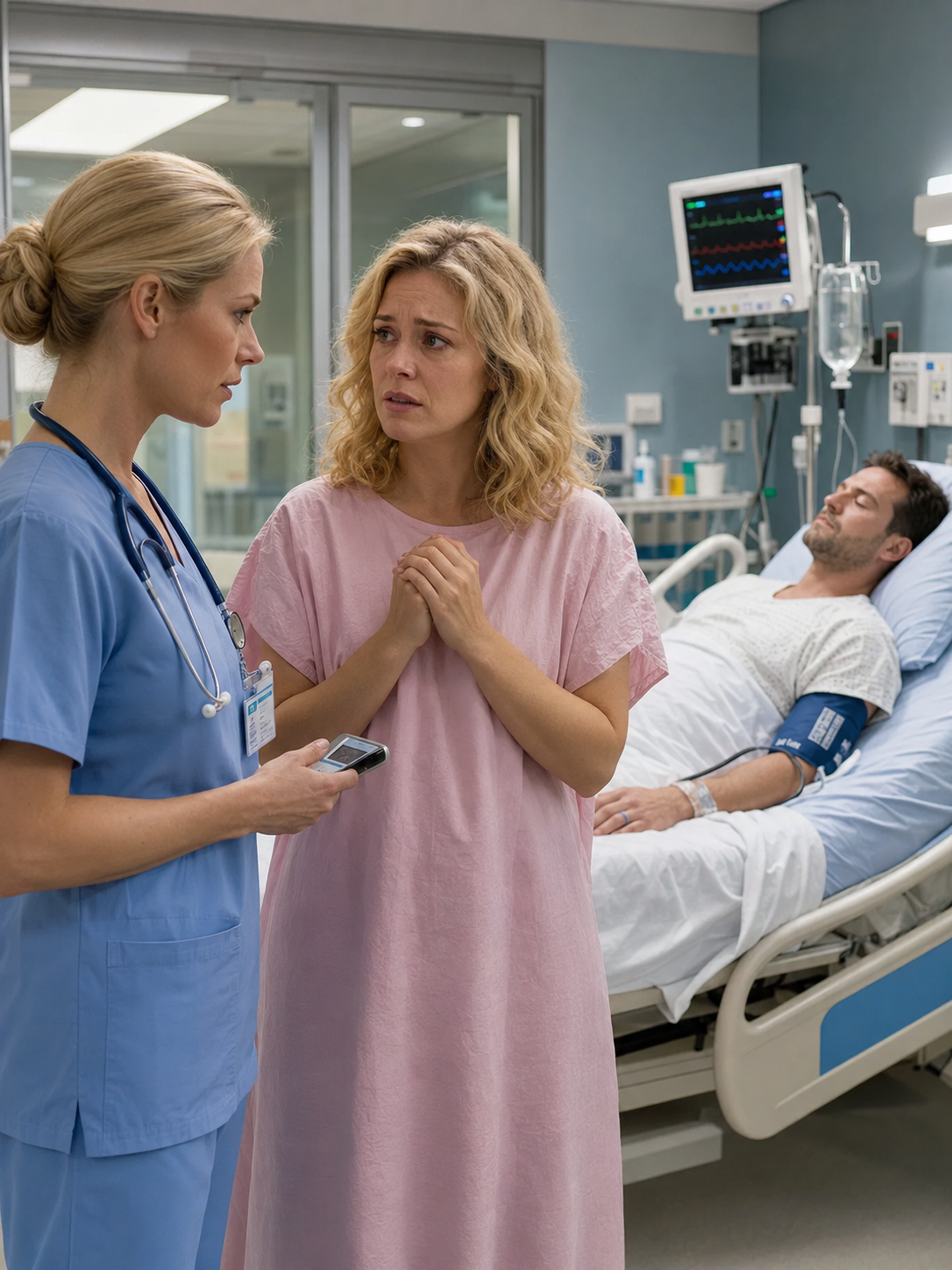
“Watch this when you get home. And after you see it, don’t be alone with your husband until you understand what’s really going on.”
The nurse spoke so quietly that for a moment I wondered if I had heard her correctly.
Before I could ask what she meant, she slipped a small USB drive into my hand.
“Please don’t open it here,” she added. “And don’t tell anyone I gave it to you.”
Her eyes briefly moved toward my husband Gabriel’s hospital room. Then she walked away, continuing down the corridor as though our conversation had never happened.
I stood there staring at the tiny device in my palm.
Gabriel had been in the hospital for almost two weeks following a car accident.
The first examinations had confirmed an injury to his back. Doctors said he needed careful observation, although they remained cautious about some of the symptoms he described.
Gabriel claimed he could barely feel his legs.
He also said the pain in his right arm was so severe that he couldn’t even reach for a glass beside his bed.
I believed him.
Why wouldn’t I?
We had been married for eleven years. We had a seven-year-old son, Liam, and until that accident, I had never imagined that our lives could change so quickly.
I had already started rebuilding our future in my head.
How would I continue working if Gabriel needed constant care?
How would we pay for months—or perhaps years—of rehabilitation?
How could I take care of my husband, our son, our home, and somehow keep myself functioning too?
For several nights, I slept in the uncomfortable chair beside Gabriel’s bed.
His sister Brenda visited almost every day.
“You need to prepare yourself,” she told me repeatedly. “Gabriel might not be able to work again for a very long time. A lot of responsibility is going to fall on you.”
His mother, Beatrice, was even more direct.
“This is when a wife proves how committed she truly is to her husband.”
Every time she said something like that, I felt another invisible weight settle on my shoulders.
It was as if being tired, frightened, or uncertain would somehow make me selfish.
Gabriel rarely said anything during those conversations.
He simply remained in bed while his mother and sister explained everything I should be prepared to sacrifice for him.
And at that point, I probably would have sacrificed almost anything.
Then small things began bothering me.
One night, Gabriel’s phone lit up on the table beside his bed.
A notification flashed across the screen.
It appeared to confirm a food delivery order.
I barely thought about it.
The following morning, however, Gabriel looked toward the same phone.
“Can you hand me that?” he asked. “My arm hurts too much to reach it.”
I gave it to him.
But suddenly I remembered the notification.
Later that day, I casually asked him about it.
“Did you order something last night?”
His expression shifted.
“Me? No. Why?”
“I saw a notification about a food order.”
Before Gabriel could answer, Brenda immediately stepped into the conversation.
“Seriously? You’re questioning him about a phone notification while he’s lying in a hospital bed?”
I said nothing.
Gabriel gave a small shrug.
“It was probably an old notification.”
I decided not to argue.
But from that moment on, I started paying closer attention.
Slowly, I noticed a pattern.
Whenever doctors, nurses, or members of his family entered the room, Gabriel suddenly appeared to be in much greater pain.
His movements became slower.
His face tightened.
He seemed almost helpless.
Yet when we were alone, he sometimes appeared noticeably more comfortable.
I desperately wanted there to be a reasonable explanation.
Then Liam told me something I couldn’t forget.
I had gone home one evening to have dinner with him.
“Mom,” he asked, “is Dad still really sick?”
“Yes, sweetheart. Why?”
Liam stared down at his plate for a few seconds.
“Because I saw him walking.”
My hand stopped.
“What?”
“At the hospital. The other night, when you left the room. Dad got out of bed, walked to the door, and then went back.”
I stared at my son.
“Maybe you were half asleep.”
Liam shook his head.
“No. I saw him.”
I didn’t want to believe it.
I convinced myself that a tired seven-year-old could easily misunderstand something he had seen for only a few seconds.
But three days later, his words were still running through my mind.
And so was the USB drive.
Eventually, I decided to watch it.
I didn’t open it at the hospital.
Instead, I went somewhere public, opened my laptop, and connected the device.
There was only one file.
A video.
The footage showed the hallway outside Gabriel’s hospital room late at night.
For several seconds, nothing happened.
Then the door opened.
Gabriel stepped out.
Standing.
I froze.
He walked into the hallway without showing the severe difficulty he had described for days.
Then I watched him move both arms normally.
I couldn’t look away.
A few moments later, Brenda appeared.
What I heard next changed everything.
Their recorded conversation made one thing clear: Gabriel really had been injured in the accident.
But at least some of the limitations he claimed to have appeared to be deliberately exaggerated.
And there was a reason.
They were talking about me.
More specifically, they were discussing an apartment I had purchased before Gabriel and I got married.
Brenda believed that if they kept me frightened, exhausted, and guilty enough, I would eventually sign documents without asking too many questions.
Gabriel desperately needed money.
Apparently, he had serious financial problems he had never told me about.
Selling my apartment would give him the money he needed to deal with them.
But that wasn’t the worst part.
After getting his finances under control, he was considering ending our marriage.
I felt sick.
Then I heard how they intended to explain everything afterward.
I would become the heartless wife who abandoned her injured husband when he needed her most.
Gabriel would become the courageous victim.
I closed the laptop.
For several minutes, I simply sat there.
I thought about every night I had spent sleeping beside his hospital bed.
Every meal I had skipped.
Every hour of work I had missed.
Every sleepless night spent wondering how I would support our family if my husband needed years of care.
While I had been trying to rebuild our lives around Gabriel’s condition, he had apparently been using my devotion as leverage.
He wanted my fear to become his advantage.
I didn’t return to the hospital immediately.
I didn’t call him and confront him either.
Instead, I contacted an independent attorney.
I explained that I was being pressured to make a major decision involving property while my husband was hospitalized.
The advice I received was simple:
Do not sign anything under pressure.
I also insisted that any major decisions about Gabriel’s future should wait until his condition had been properly and independently evaluated.
That was when I finally understood why my apartment had suddenly become so important to his family.
Gabriel needed money quickly.
The apartment was one of the most valuable things I owned.
And since the accident, Brenda and Beatrice had already mentioned selling it several times, always presenting the idea as a necessary sacrifice for Gabriel’s future care.
The next day, I returned to the hospital.
Brenda was there.
So was Beatrice.
Gabriel once again looked extremely weak.
His mother spoke first.
“We need to have a serious conversation about the future.”
“All right.”
Brenda placed several documents on the table.
“We think we’ve found a way to reduce the financial pressure. About your apartment—”
“No.”
She stopped.
Gabriel slowly turned his head toward me.
“What do you mean?”
“I mean I’m not signing anything involving my apartment.”
Beatrice frowned.
“Your husband may require care for years.”
“Then we’ll make decisions once we have a complete evaluation of his condition.”
Gabriel stared at me.
“You don’t trust the doctors anymore?”
“I want everything properly verified before I make an irreversible financial decision.”
Brenda straightened in her chair.
“Why are you suddenly so suspicious?”
I kept my voice calm.
“Because this affects Liam’s future too. I’m not making a decision this important while I’m being pressured.”
Beatrice shook her head.
“Thinking about property when your husband is lying here like this…”
Only days earlier, those words would have filled me with guilt.
Not anymore.
“Protecting my son’s future isn’t selfish.”
Nobody answered.
Eventually, Brenda and Beatrice left.
For the first time that day, Gabriel and I were alone.
He studied my face.
“There’s something you’re not telling me,” he whispered.
I didn’t mention the video.
Not yet.
“I’m telling you everything you need to know. I’m not signing those documents.”
I picked up my bag.
“And from now on, every major decision will be made carefully and with independent advice.”
As I walked toward the door, Gabriel called my name.
I kept walking.
From that moment forward, I stopped trying to solve everything alone.
The information I had was passed through the appropriate channels, and Gabriel’s condition was reassessed by qualified professionals.
The accident had been real.
His injuries were real.
But that didn’t automatically mean every limitation he described reflected his actual condition.
As for our marriage, I knew it might never return to what it had been.
Strangely, the money wasn’t what hurt the most.
It was the memories.
The nights beside his bed.
The forgotten meals.
The interrupted workdays.
The fear that I might spend years carrying our entire family alone.
Then I thought about Liam.
My son had seen something.
He had told me exactly what he saw.
And I hadn’t believed him.
When I returned home, I sat beside him.
“Do you remember what you told me about Dad?”
He nodded.
“You were right about what you saw.”
Liam became quiet.
Then he asked something I wasn’t expecting.
“Are you mad at me?”
I immediately pulled him into my arms.
“Never for telling me the truth.”
That night, after putting him to bed, I sat alone in the living room for a long time.
I still didn’t know how everything would end.
I didn’t know whether our marriage could survive what had happened.
But I finally understood something important.
My life did not end with my marriage.
I still had my son.
I had my work.
I had the things I had built for myself.
And most importantly, I had regained the right to decide what happened to my own future.
Gabriel had believed fear and guilt would eventually make me agree to whatever he wanted.
He had forgotten something simple.
Trusting someone does not mean surrendering your right to ask questions.
And that tiny USB drive hadn’t destroyed my family.
It had simply revealed a truth that others had hoped I would never discover.