I buried my husband and my seven-year-old daughter on a gray Tuesday in Richmond.
Johnny and Gemma had been the center of my world, and when I stood between their two flower-covered caskets, I felt as though everything that had once made my life recognizable had disappeared.
There were people all around me.
Johnny’s colleagues came.
Neighbors came.
Parents from Gemma’s school came.
People I barely knew stood in line simply to hug me and say they were sorry.
But my own parents were missing.
So was my older brother, Jared.
They were nearly two thousand miles away on vacation.
In Aruba.
The morning of the funeral, my mother sent me a message.
She said changing their flights would cost too much and that everyone had already paid for the trip.
Then came the sentence I would never forget.
She told me there was no reason for three people to ruin an expensive vacation when their presence would not change what had happened.
I read the message twice.
Then I turned my phone off.
Later, someone showed me photographs they had posted online.
My parents were standing beside Jared on a brilliant white beach, smiling beneath palm trees.
One caption talked about how important it was to “make memories with family.”
I had just buried mine.
The people who actually helped me during those first days were not related to me.
Mrs. Forbes, my neighbor, appeared every afternoon carrying something warm.
Soup.
Chicken and rice.
Fresh bread.
She never stayed long.
She simply placed the food in my refrigerator and reminded me to eat.
My pastor visited too.
“You don’t have to be strong every minute,” he told me.
I almost laughed.
Being strong had never felt optional in my family.
I had spent my entire childhood learning that if something went wrong, I was expected to fix it.
Dad made a financial mistake?
I helped.
Mom needed money?
I found it.
Jared launched another brilliant business idea that collapsed six months later?
Somehow the family expected me to rescue him.
Johnny had noticed the pattern long before I did.
“They don’t ask because they trust you,” he once told me.
“They ask because they know you’ll say yes.”
I had defended them.
“They’re my family.”
Johnny had looked at me sadly.
“So are we.”
At the time, I hadn’t understood exactly what he meant.
Three days after the funeral, I finally did.
Someone knocked on my front door just before noon.
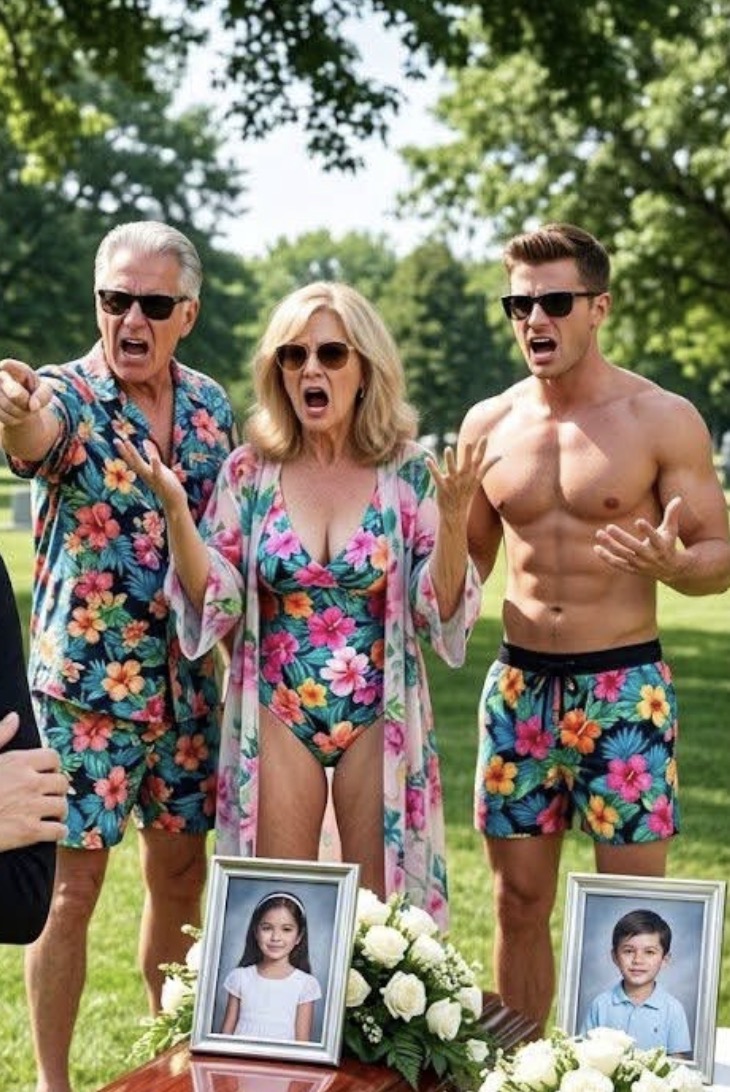
When I opened it, my parents and Jared were standing on the porch.
My mother, Judith, wore an expensive linen outfit and oversized sunglasses.
Dad, Ricky, had a fresh tan.
Jared looked as if he’d come directly from an airport lounge.
They smelled faintly of sunscreen.
For one irrational second, I thought they had come to apologize.
Mom hugged me quickly.
“There she is.”
No tears.
No mention of Johnny.
No mention of Gemma.
Dad stepped inside.
“We need to talk.”
Jared avoided looking toward the framed photograph of my daughter near the stairs.
I was still wearing black.
Gemma’s glitter-covered school backpack remained beside the entryway because I hadn’t found the strength to move it.
Mom sat down.
Then she told me why they had come.
Jared’s restaurant was in serious financial trouble.
There were overdue obligations, unexpected expenses, and a deadline approaching.
They needed $40,000.
I stared at them.
“You came here to ask me for money?”
Dad frowned.
“We came because this is an emergency.”
I looked toward Gemma’s backpack.
“My daughter was buried three days ago.”
Mom’s expression tightened.
“And we’re very sorry. But life doesn’t stop, sweetheart.”
Something inside me changed.
Not anger.
Anger would have been easier.
Instead, I felt completely calm.
Jared leaned forward.
“If I don’t get the money, I could lose everything.”
I looked at him.
Then at my parents.
“You didn’t come to the funeral.”
Dad sighed.
“Don’t start that again.”
“I’m not starting anything.”
Mom crossed her arms.
“We raised you. We sacrificed for you. Surely after everything we’ve done, helping your brother isn’t too much to ask.”
I stood.
For the first time, none of them seemed certain what I was about to do.
I walked to the entryway table and picked up a thick navy-blue folder.
Then I returned to the living room.
“Actually,” I said, “I’m glad all three of you came.”
Jared’s expression changed.
“What is that?”
I placed the folder on the table.
“Something Johnny left unfinished.”
Months before the accident, a letter had arrived at our house concerning a large commercial loan.
It had been addressed to me.
The problem was simple.
I had never applied for it.
At first I assumed it was an administrative error.
Johnny didn’t.
He was a corporate attorney and understood financial documents far better than I did.
He spent several evenings reviewing what we had received and then encouraged me to obtain my own credit reports and speak with the appropriate professionals.
What we discovered disturbed both of us.
Financial accounts and business obligations appeared to have been created using my personal information without my genuine authorization.
The trail repeatedly led back toward businesses associated with Jared.
Johnny insisted that we handle everything formally.
No private confrontation.
No accusations we couldn’t support.
He helped organize copies of the records, disputed questionable accounts through proper channels, and consulted independent financial and legal professionals.
Then another document appeared.
This time, Johnny’s name had been connected to a business obligation involving Jared.
Johnny denied ever authorizing it.
That was when he stopped treating the situation as a family problem.
He began treating it as a legal one.
The navy folder contained copies of everything he had gathered.
Financial records.
Disputed documents.
Correspondence.
Professional assessments questioning several signatures.
And records showing where some of the disputed money had gone.
I looked at Jared.
His face had lost its vacation color.
“You knew?” he whispered.
“Johnny knew enough to start documenting it.”
Mom immediately stood.
“This is ridiculous.”
“No,” I said. “What’s ridiculous is coming to my home three days after I buried him and asking me for another forty thousand dollars.”
Dad reached toward the folder.
I placed my hand over it.
“Don’t.”
His hand stopped.
There was something else in the file.
Something I had discovered only after Johnny and Gemma died.
Two days before the funeral, someone had contacted Johnny’s law firm claiming to speak on my behalf.
The message suggested that I was too emotionally overwhelmed to manage certain financial matters and asked about redirecting communications connected to Johnny’s estate and insurance.
The firm did not make any changes.
Instead, they contacted Johnny’s probate attorney.
That was how I learned about it.
I looked directly at my mother.
“Do you want to explain why someone tried to interfere with communications concerning Johnny’s estate?”
Her face changed.
“I was trying to help you.”
“By pretending to speak for me?”
“You were barely functioning.”
“I was grieving.”
“You weren’t thinking clearly.”
“And yet I was clear enough to tell you I didn’t authorize it.”
Dad stood.
“This conversation is over.”
“No,” I said. “For once, it isn’t.”
Jared looked toward the front door.
That was when I told them the file they were staring at wasn’t the only copy.
Johnny had arranged for relevant records to be preserved with the professionals already helping us.
After his death, I had continued the process.
The disputed transactions and documents had been reported through appropriate legal and financial channels.
Nobody in that living room was going to destroy the evidence by grabbing one folder.
Dad sat down again.
For the first time, he looked worried.
Then I opened the final section.
And told them about Grandma Rosemary.
My grandmother had died ten years earlier.
I had always been told she left me very little.
Some jewelry.
A few photographs.
A handwritten recipe book.
That wasn’t true.
She had also established money intended for education and future family needs.
I had never known the full details.
Johnny found references to the arrangement while reviewing old financial documents.
With professional help, we learned that a significant portion of those funds had been removed years earlier.
The transactions required investigation, but records indicated that money had been redirected toward expenses connected to my parents and, repeatedly, Jared’s failed ventures.
My mother stared at me.
“Your grandmother wanted us to use that money for the family.”
“Then there should be documents showing that.”
“There were circumstances you don’t understand.”
I almost smiled.
That sentence had protected my family for years.
You don’t understand.
It’s complicated.
We’re family.
Don’t make trouble.
Help your brother.
I closed the folder.
“I understand enough to let professionals determine the rest.”
A vehicle pulled up outside.
Mom looked through the window.
A man in a dark suit stepped out accompanied by another official.
Johnny’s probate attorney, Mr. Fletcher, had arrived for a meeting we had scheduled earlier.
He entered carrying his own documents.
He greeted me quietly.
Then he turned toward my parents and Jared.
His presence changed the room instantly.
There was no dramatic shouting.
No movie-style confrontation.
He simply explained that several matters involving disputed financial activity were already being reviewed and that formal notices would be delivered through the proper process.
My father began arguing.
Jared insisted everything had explanations.
Mom accused me of destroying the family.
I listened.
Then I looked at Gemma’s backpack.
“No,” I said quietly.
“This family was already broken. I just stopped paying to pretend it wasn’t.”
The legal process that followed took months.
It was not quick.
It was not simple.
And there was nothing satisfying about watching people I had once loved face the consequences of choices they had made.
Investigators reviewed records.
Financial institutions examined disputed transactions.
Attorneys handled the property and estate issues.
I gave statements when required.
Where wrongdoing could be proven, the courts dealt with it.
Some losses were recovered.
Others never were.
My parents’ finances deteriorated badly as liabilities and disputed obligations were sorted out.
Jared lost the restaurant.
There were legal consequences for conduct authorities were able to establish.
I testified when asked.
Not because I wanted revenge.
Because I finally understood that protecting someone from consequences is not always the same as loving them.
Sometimes it simply gives them another opportunity to hurt someone.
Months later, part of the money connected to Grandma Rosemary’s original fund was recovered.
For several weeks, I didn’t know what to do with it.
Spending it on myself felt impossible.
Then I remembered Gemma.
She loved school.
She loved books with glittering covers, blueberry pancakes shaped like hearts, and asking questions adults couldn’t always answer.
So I created something in her name.
A small memorial foundation.
Its purpose was simple: educational assistance for local children who had lost a parent or primary caregiver and whose families were struggling financially.
The first time we awarded a scholarship, I cried harder than I had expected.
But they were different tears.
Not because the grief was gone.
It never completely leaves.
They came because something gentle had grown from a place that had once contained nothing but pain.
The following spring, I visited the cemetery.
I brought fresh flowers.
And because Gemma would have found it funny, I also brought a small container of blueberry pancakes.
Johnny’s headstone stood beside hers.
I sat between them beneath the warm afternoon sun.
For a long time, I said nothing.
Then I told Johnny about the foundation.
I told Gemma about the children who would attend school because her name was attached to something good.
The breeze moved softly through the trees.
For most of my life, I had believed family loyalty meant endlessly fixing other people’s mistakes.
Johnny had tried to teach me otherwise.
I finally understood.
Love does not require surrendering your boundaries.
Grief does not make you weak.
And saying no does not make you cruel.
I had lost the two people I loved most.
There was no happy ending that could change that.
But I still had a life.
And for the first time in thirty-two years, that life belonged entirely to me.