Warm music floated through the garden while hundreds of tiny lights glowed above the guests.
Children chased one another between the tables. Couples filled the dance floor, and laughter carried through the evening air.
But near the edge of the celebration, eight-year-old Elena sat quietly in her wheelchair.
Her pale-blue dress shimmered whenever the lights caught it. A delicate silver bracelet circled her wrist, and her dark hair had been carefully arranged for the occasion.
She looked beautiful.
But she also looked invisible.
Her father, Daniel, noticed the way she watched the other children dancing.
He knew that expression.
Elena wasn’t angry.
She wasn’t even crying.
She had simply learned not to expect anyone to invite her.
Daniel hated that more than tears.
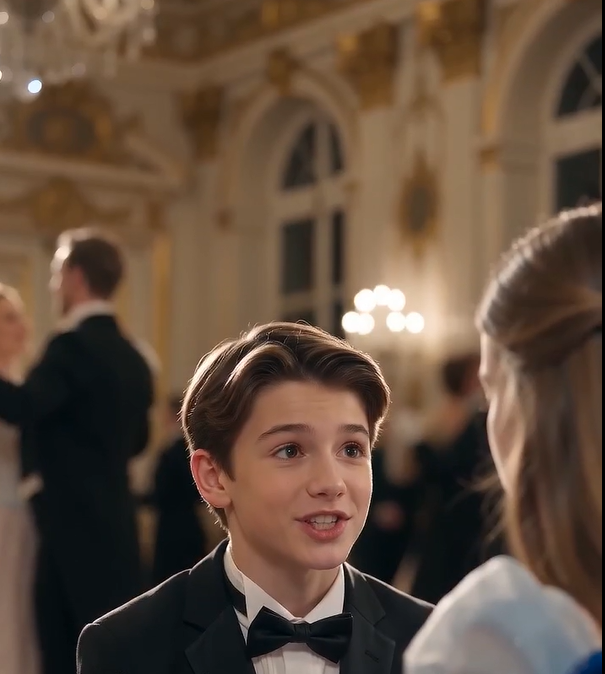
Then a boy appeared beside her.
His name was Lucas.
He looked about Elena’s age and wore a small dark jacket that seemed slightly too formal for him.
For several seconds, he simply stood there.
Elena finally looked up.
“Hi.”
“Hi,” Lucas answered.
He glanced toward the dance floor.
Then back at her.
“Do you want to dance with me?”
Elena blinked.
She wasn’t sure whether she had heard him correctly.
“What?”
“Dance.”
He held out his hand.
“With me.”
Elena looked down at her wheelchair.
Her expression changed.
“I can’t.”
Lucas frowned, not because he was disappointed, but because he genuinely didn’t understand the answer.
“Why?”
Daniel had been watching from nearby.
He stepped closer.
“She means she can’t walk like the other children.”
Lucas looked at Daniel.
Then he looked back at Elena.
For a moment, nobody spoke.
Finally, Lucas shrugged.
“I didn’t ask if you could dance like everyone else.”
Elena stared at him.
“I asked if you wanted to.”
Something changed in her face.
She looked toward the dance floor again.
Then she whispered:
“Yes.”
Lucas smiled.
“Okay.”
It was such a simple answer that Daniel almost laughed.
But Elena surprised both of them.
She placed one hand against the armrest of her wheelchair.
Then the other.
Daniel immediately understood what she intended to do.
“Elena, sweetheart, you don’t have to—”
“I want to try.”
Her voice was quiet but determined.
Daniel moved closer, ready to support her safely.
Elena pushed against the chair.
Nothing happened.
She tried again.
Her arms began trembling.
Lucas didn’t rush her.
He didn’t pull her upward.
He simply stood in front of her with his hand extended.
“Take your time.”
Elena breathed deeply.
Then she tried once more.
Slowly, with her father close enough to support her, she lifted herself.
Her knees trembled.
Her balance was uncertain.
But for one extraordinary moment, Elena was upright.
Daniel stared at his daughter.
His first instinct was to reach for her.
Then he saw her face.
She was smiling.
Not because she had suddenly overcome everything that had happened to her.
Not because one moment could erase years of rehabilitation or the challenges she still faced.
She was smiling because she had made the choice herself.
“Dad?”
Daniel swallowed.
“I’m right here.”
Elena looked toward the people dancing beneath the lights.
“I remembered something.”
“What?”
She smiled.
“Your feet.”
Daniel didn’t understand.
Then the memory hit him.
Years earlier, before the accident that changed Elena’s mobility, she used to stand on top of his shoes while he slowly carried her around their living room.
She would wrap her arms around his waist and laugh.
“Faster, Daddy!”
Daniel hadn’t thought about those evenings in a long time.
Apparently, Elena hadn’t forgotten them either.
“You remember that?” he asked.
Elena nodded.
“We used to dance.”
Daniel’s eyes filled with tears.
“Yes.”
“I thought I forgot.”
“You didn’t.”
Elena looked at him.
“Can we do it again?”
Daniel could barely answer.
He moved carefully beside her and offered his hands.
“We can dance however you want.”
Lucas stepped aside with a grin.
Daniel helped Elena move safely and slowly.
There were no dramatic leaps.
No impossible transformation.
Just a father supporting his daughter while music played beneath a ceiling of golden lights.
One careful movement.
Then another.
Elena laughed.
It was a sound Daniel hadn’t realized how desperately he had missed.
People nearby began noticing.
A few conversations stopped.
Then more guests turned toward them.
But Elena wasn’t looking at the crowd.
She was looking at her father.
For those few minutes, the wheelchair beside them didn’t represent something she needed to defeat.
It was simply part of her life.
And dancing didn’t need to look the same for everyone.
After a little while, Elena returned safely to her chair.
She was tired.
But her smile remained.
Then she looked around.
“Lucas?”
The boy had been standing several feet away.
He approached.
Elena held out her hand.
“Now it’s your turn.”
Lucas laughed.
He took her hand.
This time Elena didn’t try to stand.
Lucas simply moved beside her while she turned her wheelchair gently with her father’s assistance.
They swayed their arms with the music.
Soon both children were laughing.
Daniel watched them and finally understood what had made the moment so meaningful.
Lucas hadn’t “fixed” Elena.
He hadn’t rescued her.
And he certainly hadn’t performed a miracle.
He had done something much simpler.
He had looked at a girl sitting away from the dance floor and seen Elena before he saw her wheelchair.
Everyone else had quietly decided what she probably couldn’t do.
Lucas had asked what she wanted to do.
That difference mattered.
Years later, Elena would remember that evening for reasons that had little to do with the few moments she spent standing.
She remembered the music.
She remembered her father’s hands.
She remembered dancing from her wheelchair afterward.
But most of all, she remembered one small question from a boy who refused to decide her limits for her.
“Do you want to dance?”
Sometimes changing someone’s evening doesn’t require doing something extraordinary.
Sometimes it begins by giving them the freedom to answer that question for themselves.
And sometimes the most meaningful kind of encouragement isn’t telling someone that nothing can limit them.
It’s reminding them that they still deserve to choose how they want to participate in the world.