For nearly three decades, I had lived with a question no one could answer.
What happened to my sister Rose?
There had been searches, conversations, theories, and years of waiting. Eventually, most people around me stopped expecting an answer.
I never completely did.
Then, on an ordinary morning in a hotel lobby, an eight-year-old girl walked up to me carrying a basket of roses.
And everything changed.
My name is Elena.
That morning, I had arrived early for a business meeting and taken a seat near the tall windows overlooking the hotel garden.
I remember checking the time, answering a few messages, and thinking about nothing more important than the meeting ahead.
Then I heard a small voice.
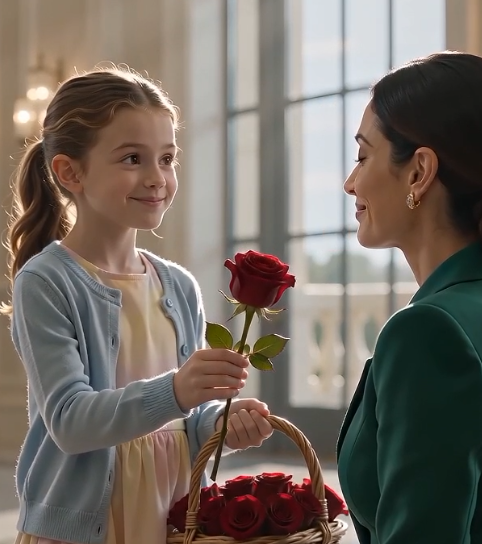
“Would you like a rose?”
I looked up.
A little girl stood beside my chair.
She had dark hair pulled back from her face and carried a basket filled with red and pink roses.
I smiled.
“I’d love one.”
She carefully searched through the basket before choosing a red rose.
“This one,” she said.
“Why this one?”
She considered the question seriously.
“Because it looks like it belongs to you.”
I laughed softly.
“That’s a very good reason.”
She handed it to me.
But instead of walking away, she remained where she was.
Her attention had shifted to my left hand.
More precisely, to the old gold ring on my finger.
It was not especially valuable.
Its design was simple: a tiny rose surrounding a small red stone.
But to me, it was irreplaceable.
I had worn it since childhood.
The girl leaned closer.
“My mom has one like that.”
For a moment, I thought I had misunderstood her.
“What did you say?”
She pointed at my ring.
“My mom. She has almost the same one.”
My smile disappeared.
There must have been thousands of rings decorated with flowers.
It could easily have been a coincidence.
Then the girl added something that made every rational explanation vanish.
“Hers has writing inside too.”
I stared at her.
“What writing?”
She frowned as she tried to remember.
“I think it says Rosewood.”
The hotel lobby seemed to disappear around me.
Rosewood.
I had not heard a stranger say that word in years.
Rosewood was the name of the country house where my sister and I had grown up.
Our mother had given us matching rings when we were children.
Mine had remained with me.
Rose had been wearing the other one when she disappeared.
Inside both rings were the same words:
Rosewood — always together.
I leaned forward.
“What’s your name?”
“Sofia.”
“And your mother’s name?”
Before she could answer, someone called from across the lobby.
“Sofia!”
The girl turned.
“Mom!”
I followed her gaze.
A woman had just entered through the main doors.
She looked to be in her early forties. Her brown hair fell over the shoulders of a beige coat, and she was searching the room with the unmistakable concern of a parent who had briefly lost sight of her child.
Then she saw me.
She stopped.
I stopped breathing.
Nearly thirty years had changed her face.
But not enough.
There was still a faint scar beside one eyebrow.
Rose had gotten it when we were children after falling from an old wooden fence behind our house.
I had been standing beside her when it happened.
My hands began to tremble.
“Rose?”
The woman covered her mouth.
Her eyes filled with tears.
“Elena?”
I stood so quickly that my chair moved behind me.
Neither of us seemed to know what to do for the next second.
Then Rose ran toward me.
I met her halfway.
We held each other in the middle of that hotel lobby while Sofia stood nearby, completely confused.
There were almost thirty missing years between us.
Yet for a few seconds, I was no longer an adult.
I was a girl again, holding onto my sister.
When we finally stepped apart, I touched Rose’s face as if I needed proof that she was real.
“I thought you were gone.”
“I know.”
“Where have you been?”
Rose looked down.
“I didn’t know how to come back.”
Her answer made no sense to me.
Not yet.
We found a quiet place to sit.
Sofia stayed beside her mother.
I kept looking from Rose to the little girl and back again.
Sofia was my niece.
I had discovered that fact only minutes earlier.
Rose removed a ring from her hand and placed it on the table.
I immediately recognized it.
The tiny flower.
The red stone.
She turned it over.
Inside were the words I already knew.
Rosewood — always together.
“I never understood what it meant when I was younger,” Rose said.
“What do you mean?”
She looked at me.
“I didn’t remember Rosewood.”
That was when she began explaining what had happened.
Rose had been a teenager when she left home after a painful argument with our father.
She had not intended to disappear.
She expected to return after she had calmed down.
But before that happened, she was involved in a serious accident.
Her physical recovery took time.
The greater problem was her memory.
Large parts of her earlier life had become fragmented or inaccessible.
She remembered images without knowing what they meant.
A large garden.
Two girls running between rosebushes.
A house.
A red stone inside a gold flower.
And one word that repeatedly appeared in her thoughts.
Rosewood.
But she did not know whether Rosewood was a place, a person, or something her confused memory had invented.
People who helped her during her recovery eventually became an important part of the new life she built.
Years passed.
Rose learned to live without knowing exactly where she had come from.
She married.
Later, Sofia was born.
And slowly, fragments of the past began returning.
“Why didn’t you find us when you started remembering?” I asked.
“Because remembering something and understanding it are different things.”
She explained that the memories came without context.
A smell could remind her of a garden.
A song could make her think of two children sitting beneath a tree.
The sight of roses sometimes gave her an overwhelming feeling of homesickness for a home she could not identify.
Then, several years earlier, she had discovered an old photograph among belongings that had survived from the period before her accident.
It showed two little girls standing together in a rose garden.
On the back were two names.
Elena and Rose.
And beneath them:
Rosewood.
“That was when I finally understood that Rosewood had been real,” she said.
I struggled to understand what I was hearing.
“Then why didn’t you search for me?”
Rose hesitated.
“Eventually, I did.”
“And?”
“I found enough to know you had built a life.”
She looked away.
“I became afraid.”
“Afraid of me?”
“No.”
She paused.
“Afraid that after so many years, there would be no place for me anymore.”
I reached across the table and took her hand.
“You had a place every day.”
Rose looked at me.
“I never stopped waiting for you.”
Neither of us said anything for several moments.
Then Sofia placed another rose on the table between us.
“I think you both need this one,” she said.
Rose laughed through her tears.
So did I.
That afternoon, I canceled my meeting.
There was somewhere far more important I wanted to go.
“Come with me,” I told Rose.
“Where?”
“Home.”
The drive to Rosewood took more than an hour.
Rose became increasingly quiet as we approached.
I wondered what she was feeling.
For me, every road was familiar.
For her, they were simultaneously new and strangely recognizable.
When the house finally appeared beyond the old gate, Rose stared through the car window.
The property was not exactly as we remembered it.
Time had left marks everywhere.
The gate needed repair.
Parts of the house had faded.
Several rooms had been closed for years.
But behind the house, the garden remained.
And the roses were still blooming.
Rose stepped onto the path.
She walked slowly.
I stayed behind with Sofia.
I did not want to tell my sister what she was supposed to remember.
This had to belong to her.
She stopped beside an old rosebush.
Then she crouched.
Hidden beneath its leaves was a small metal marker.
Rose brushed away the dirt.
Her name appeared.
Rose.
She covered her face.
“You kept this?”
“I kept everything I could.”
She looked back at me.
“Why?”
The answer had been waiting almost thirty years.
“Because some part of me always believed you might come home.”
Sofia approached us carrying the red rose she had given me at the hotel.
She looked at the old rosebush.
Then at the empty patch of soil beside it.
“Can we plant another one?”
Rose wiped her eyes.
“For what?”
Sofia thought carefully.
“For people who are still waiting for someone.”
Rose looked at me.
I nodded.
That afternoon, the three of us planted a new rosebush near the old bench.
When I asked Sofia what we should call it, she did not hesitate for long.
“Hope.”
It was exactly the right name.
Reuniting with Rose did not magically restore the decades we had lost.
There were difficult conversations.
There were things she remembered differently from me.
There were things neither of us could remember clearly anymore.
Our father was no longer there to answer the questions we wished we had asked him.
Our mother was gone too.
Some parts of our family history would remain incomplete.
At first, I wanted answers to everything.
I wanted a perfect timeline.
I wanted to know exactly what had happened on every missing day.
Eventually, I understood that rebuilding our relationship mattered more than reconstructing every hour of the past.
Rose and I had both changed.
We could not simply return to being the girls we had once been.
So we did something harder.
We learned who we had become.
I learned about Rose’s marriage, her work, her friends, and the life she had built while I was searching for her.
She learned about my career, my failures, the people I had loved, and all the years I had spent believing she might someday walk through the door.
And I got to know Sofia.
She loved the Rosewood garden almost immediately.
Whenever she visited, she checked on the rosebush she had named Hope.
“Do you think it remembers that I planted it?” she once asked.
“I think gardens remember everything,” I told her.
She seemed satisfied with that answer.
Over time, Rose began spending more time at Rosewood.
One evening, while we were sitting outside, she told me about something she had dreamed of as a child.
“I wanted this house to be full of people.”
“It was full of people.”
“No,” she said. “I mean people who needed somewhere to go.”
She imagined Rosewood as a welcoming place where families could spend time together, where people could talk, share meals, walk through the garden, and feel less alone.
The idea stayed with us.
Slowly, we began restoring the property.
We did not try to turn it into something extravagant.
That would have felt wrong.
We repaired what needed repairing.
We reopened the rooms.
We restored the garden paths.
And we planted more roses.
Eventually, Rosewood became the kind of place Rose had imagined.
A place filled with conversations, children, families, flowers, and second chances.
Near the entrance, we placed a simple message.
Some doors remain closed for years and still find a way to open.
Sofia’s rosebush grew beside the old bench.
Every spring it produced new flowers.
And every spring, Sofia proudly reminded us that she had chosen its name.
Years later, people sometimes asked me whether I regretted all the time Rose and I had lost.
Of course I did.
Nothing could return those decades.
There were birthdays we never celebrated together.
Holidays we missed.
Ordinary afternoons we would never get back.
But regret was no longer the only thing I felt when I looked at the ring on my finger.
Once, that ring represented absence.
It reminded me of a sister who had vanished and a promise that seemed impossible to keep.
Now I saw something else.
Rose sitting beneath the old tree.
Sofia running through the garden.
Two matching rings.
And a rosebush called Hope.
Sometimes I still think about the extraordinary chain of coincidences that brought us back together.
If I had arrived at the hotel later…
If I had sat somewhere else…
If Sofia had chosen another person to offer a rose…
If she had never looked at my hand…
Rose and I might have remained strangers living separate lives.
But Sofia did notice.
She saw an old ring decorated with a tiny flower and said the simplest thing imaginable:
“My mom has one like that.”
That sentence returned my sister to me.
For almost thirty years, I believed the final page of our story had already been written.
I was wrong.
Sometimes the story is still there.
You simply haven’t found the missing page yet.