My father believed two empty chairs would be enough to teach me a lesson.
He was wrong.
The chairs stood in the front row, decorated with small olive branches and two carefully printed name cards.
Patricia Sterling.
Robert Sterling.
My mother and father.
Neither of them came.
My name is Maya Sterling, and I was thirty-one when I finally understood that a family doesn’t have to throw you out to make you feel as though you’ve always come second.
Sometimes, they simply choose someone else over you again and again.
In my family, that person had always been my younger sister, Chloe.
On my wedding day, the gardens of a beautiful Napa Valley estate were filled with relatives and friends. The music began, the guests rose, and I waited behind the doors for several seconds.
A ridiculous part of me was still listening for the sound of a car arriving outside.
Maybe Dad would appear at the last minute.
Maybe Mom would hurry inside with an apology.
Maybe they had finally understood.
Nobody came.
So I tightened my grip on my bouquet, lifted my head, and walked down the aisle alone.
Julian was waiting for me at the other end.
The moment our eyes met, I could tell he was struggling to contain his anger.
Not for himself.
For me.
Everything had started three months earlier.
Chloe was twenty-seven, and ever since we were children, our family seemed to operate according to one unwritten rule:
If Chloe needed something, everyone adjusted.
If she had a problem, somebody solved it.
If she changed her plans, ours were expected to change too.
And whenever I objected, my father always ended the conversation the same way.
“You’re the older sister, Maya. Act like it.”
For years, I confused being the older sister with being the person who always had to give in.
Then came my wedding.
Julian and I had chosen the date more than a year in advance.
The venue was reserved.
Vendors were booked.
Deposits had been paid.
Relatives from several states had already arranged flights and hotels.
Chloe had known the date from the beginning.
Yet three months before the ceremony, she announced in our family group chat that she had booked a luxury trip to Bali with several friends.
For the exact week of my wedding.
At first, I assumed she would change her travel plans.
That same evening, my mother called.
“Maya, we have a problem.”
“What happened?”
“Chloe already paid for Bali.”
I waited for the rest.
“And?”
“We want you to move the wedding.”
For a moment, I genuinely thought I had misunderstood her.
“You want me to change my wedding date?”
“There are still three months.”
“Mom, we’ve been planning this for over a year.”
“Plans can be changed.”
“So can vacations.”
Then I heard my father in the background.
“Put me on speaker.”
Mom did.
“Maya,” he began, “being part of a family means knowing when to make sacrifices.”
Julian was sitting across from me at the kitchen table.
He heard every word.
“I agree,” I replied. “So Chloe can sacrifice Bali.”
Dad didn’t appreciate that answer.
“Don’t be immature.”
I almost laughed.
“I’m immature because I won’t cancel my own wedding?”
Mom tried to soften things.
“We’re only asking you to be flexible.”
“Why does flexibility always have to come from me?”
Neither of them answered.
So I asked the question that actually mattered.
“Is my wedding less important than her vacation?”
Dad explained that Chloe’s trip might help her professionally. She worked as a social media content creator, and one of the women traveling with her apparently had connections in the international hotel industry.
To him, that transformed the vacation into an opportunity the entire family was expected to protect.
“Then she should go,” I said. “But I’m getting married on the date we chose.”
Silence.
Then Dad delivered the threat he apparently believed would make me surrender.
“If you keep that date, your mother and I won’t attend either.”
I saw Julian tense across the table.
“You’re going to miss your daughter’s wedding because Chloe wants to go to Bali?”
“Maybe then you’ll understand that your decisions have consequences.”
“What exactly am I supposed to learn?”
His answer came immediately.
“Respect. And some humility.”
I waited for Mom to tell him he had gone too far.
She didn’t.
Before ending the call, she simply said:
“Think carefully, Maya.”
I did.
For twelve weeks.
But I never changed the date.
I also never removed their seats.
Their names remained on the guest list.
Their places stayed on the seating plan.
When the coordinator asked the day before the wedding whether she should remove the two front-row chairs, I shook my head.
“Leave them.”
Some part of me still believed they might come.
Even on the morning of my wedding, I checked my phone far too many times.
Nothing.
My maid of honor, Sarah, noticed while helping me into my dress.
“You’re allowed to be upset.”
“Later.”
“Maya…”
“If I start crying now, I don’t want that to become the memory I carry from my wedding.”
So I took a breath and walked outside.
I went down the aisle alone.
But when I reached Julian, he took my hands and whispered:
“You’re not alone.”
Those four words were enough.
We married.
We took photographs.
We laughed with our friends.
We danced.
For several hours, I managed to forget those two empty chairs.
Then dinner began.
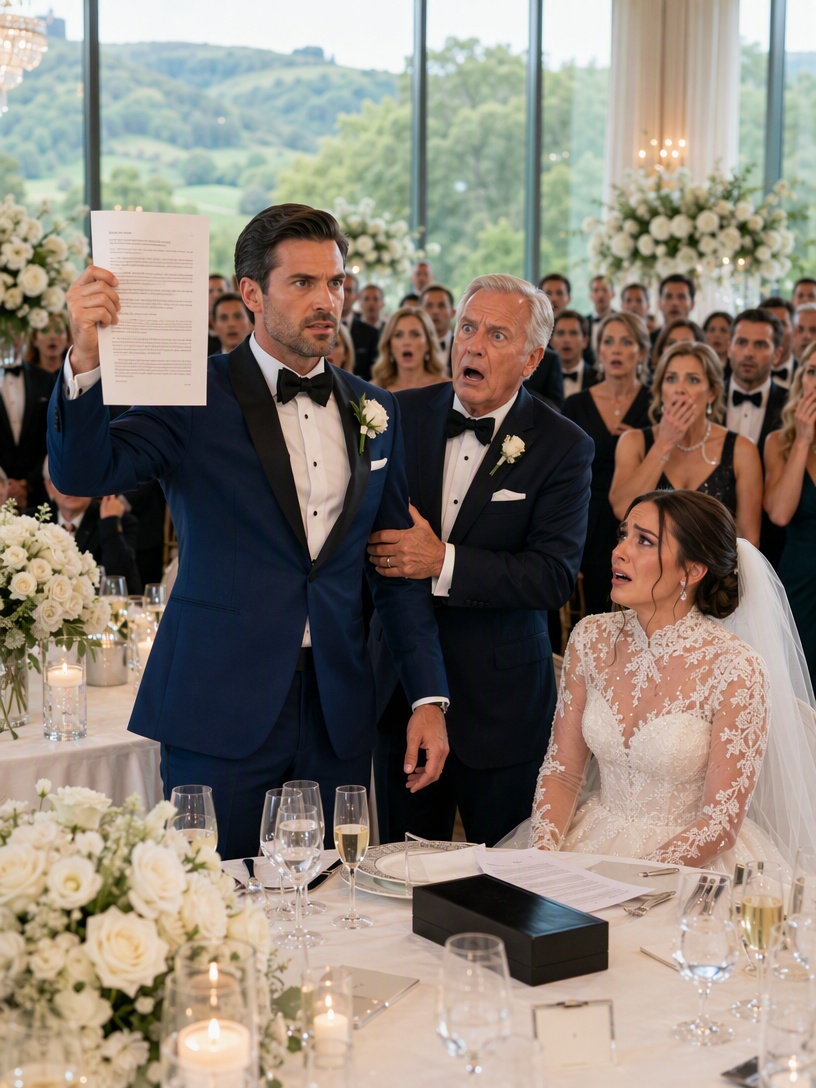
Nearly two hundred guests were seated inside the reception hall when Julian stood.
He lifted his glass.
“Before we continue, I want to say something about my wife.”
The room gradually became quiet.
I smiled, assuming he was about to give the usual groom’s speech.
Then he reached into the inside pocket of his jacket.
He pulled out a folded sheet of paper.
My smile disappeared.
I recognized it immediately.
“Julian…”
He looked at me.
“I think you’ve protected enough people today.”
My stomach tightened.
The paper contained a copy of a message my father had sent after our argument.
Julian was the only person I had ever shown it to.
Not because it was a secret.
Because admitting how much those words hurt me had felt humiliating.
Julian faced our guests.
“Everyone saw two empty chairs in the front row today. Some of you probably wondered why.”
The room went completely still.
“Maya didn’t want to discuss it because she refused to turn our wedding into a family dispute.”
He glanced at the paper.
“But there’s a difference between staying quiet with dignity and allowing someone else to rewrite what happened.”
Tears gathered in my eyes.
Julian didn’t reveal private details or turn the moment into a spectacle.
He simply told the truth.
My parents had chosen not to attend after I refused to move a wedding that had been planned for more than a year to accommodate my sister’s vacation.
Then he lifted the paper slightly.
“And after Maya refused, she received this message.”
I remembered every word.
My father had written that one day I would understand that “family must come before personal events,” and that perhaps seeing those empty chairs would force me to reconsider my priorities.
Julian placed the paper on the table.
“I want to say something about that.”
He looked at me.
“A wedding lasts one day. A marriage, hopefully, lasts a lifetime. But making someone feel less important for years creates memories that can last just as long.”
Nobody spoke.
“Maya didn’t need a lesson in humility today.”
He reached for my hand.
“She needed people who chose to show up.”
Applause began at one table.
Then another.
Soon the entire room joined in.
But Julian wasn’t finished.
“And Maya, I want you to remember one more thing.”
His eyes stayed on mine.
“You never have to keep a chair empty for someone who has already decided not to sit in it.”
That was when I finally cried.
I stood and wrapped my arms around him.
For years, I had believed keeping my family together meant accepting just a little more.
One more disappointment.
One more comparison.
One more reminder to “be the adult.”
That night, I understood that setting boundaries could also be an act of maturity.
But the story didn’t end with Julian’s speech.
Close to midnight, as we prepared to leave the reception, my phone vibrated.
It was Chloe.
For the first time since the argument began, she had sent me a private message.
I opened it expecting a photograph from Bali or perhaps some late explanation.
It was neither.
She had written only one sentence:
“Maya, Mom and Dad didn’t tell you the real reason they missed your wedding.”
There was a photograph underneath.
I opened it.
And for several seconds, I forgot how to breathe.
My parents weren’t where they had told me they would be.
More importantly, what I saw behind them in that photograph made the entire argument about Bali suddenly seem insignificant.
I turned toward Julian.
“We have a problem.”
He looked at the screen.
His expression changed immediately.
And that was when I realized those two empty chairs had never been only about teaching me a lesson.
My parents were hiding something.
Something that had started long before my wedding.
The full story continues in the first comment.