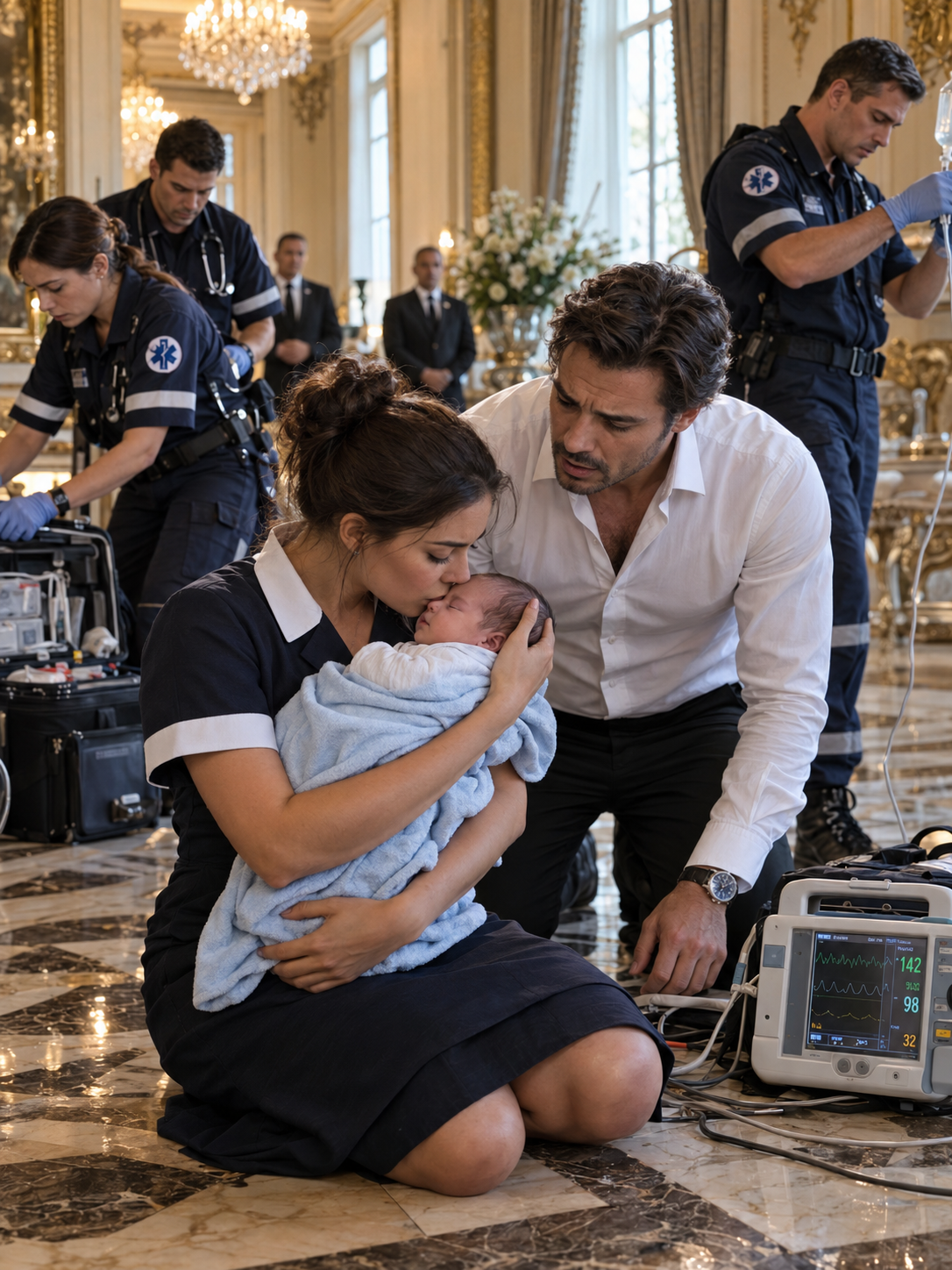
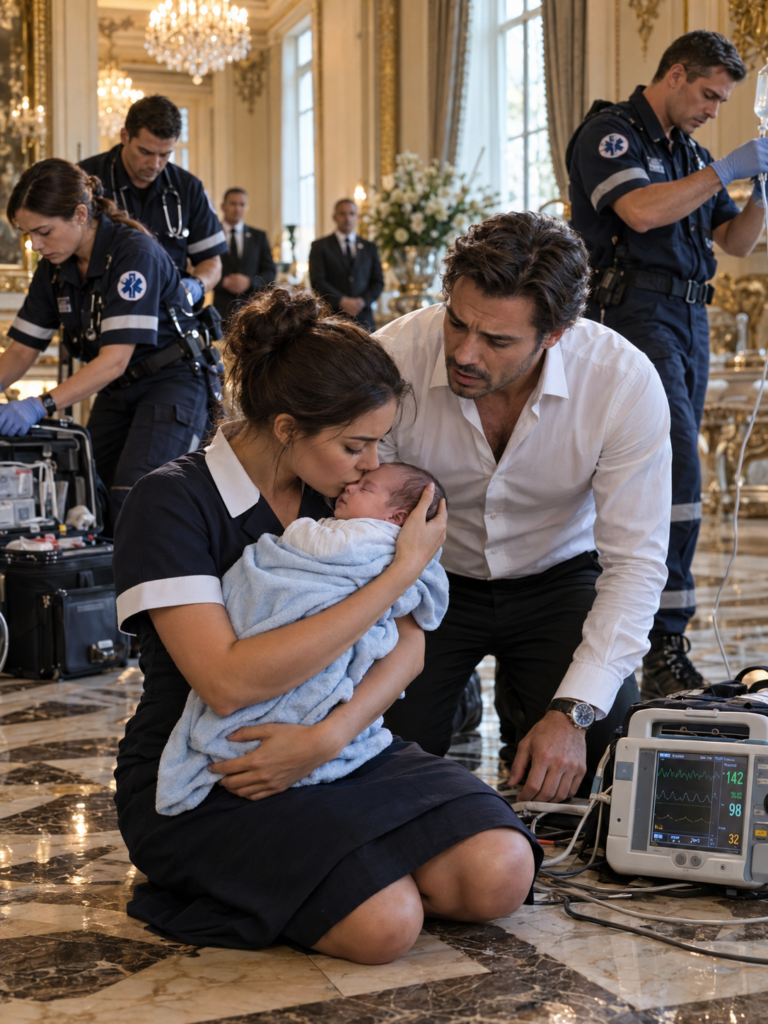
Emily remained beside Noah for a few more seconds. While everyone else focused on the baby’s breathing, the monitors, and the paramedics’ instructions, she kept watching something that worried her.
Then she stepped forward.
“Could you uncover him for a moment? I want you to check his skin.”
One of the paramedics turned toward her. Michael looked up as well. He had no idea what Emily had noticed, but the certainty in her voice made everyone pay attention.
Noah had been wrapped in several blankets to keep him warm. When the medical team pulled them back and carefully opened his pajamas, the atmosphere in the room changed at once.
Large red patches had appeared across the little boy’s chest and stomach.
The team leader leaned closer to examine them.
Emily explained that she had also noticed a slight swelling around Noah’s eyes earlier. At first, she thought he was simply tired. But then she heard him cough, and she began to wonder whether all the signs were connected.
The paramedics considered another possibility: a severe allergic reaction.
The room filled with movement again, but this time there was no confusion. Every action had a clear purpose.
Michael stood near the changing table, unable to follow all the medical terms being exchanged around him. He could only see experienced hands moving quickly, equipment being prepared, and Noah being watched without pause.
Then one of the monitors changed.
It was a tiny shift. Almost impossible to notice.
The paramedic closest to Noah stared at the screen, then checked the baby again.
“His heart is still showing activity,” he said.
It was weak, but it was there.
Michael felt his entire body go rigid.
“Does that mean…?”
“It means we keep fighting,” the paramedic replied.
There was no dramatic awakening. Noah did not suddenly open his eyes or begin crying like in a movie.
But his chest moved slightly.
Then it moved again.
For Michael, that was enough.
Soon afterward, the order was given to transfer Noah to the hospital immediately. Later, Michael would remember those minutes as a blur of disconnected images: the stretcher rushing down the hallway, Margaret clutching one of Noah’s stuffed animals without even remembering picking it up, Frank on the phone trying to organize everything that could still be organized.
Outside, the rain continued to fall.
Emily followed the paramedics to the entrance. She was shaken, with loose strands of hair escaping from her tied-back bun.
Michael climbed into the ambulance. Just before the doors closed, he looked back toward the house.
Emily stood beside Margaret.
For months, that young woman had walked through the same hallways as he had, and Michael would barely have been able to describe her.
But that night, he finally saw her.
Truly saw her.
“Frank,” he said before the doors shut. “Bring Emily too.”
Frank looked at him in surprise.
“To the hospital?”
Michael nodded.
“The doctors may need to know exactly what she noticed.”
Then the ambulance drove away.
In the middle of the night, the hospital seemed strangely ordinary.
Michael had imagined that a place where his son was fighting to recover would feel different from the rest of the world. Instead, he found brightly lit corridors, vending machines, staff members walking back and forth, and exhausted people sitting with paper cups of coffee in their hands.
It seemed unfair that life could continue so normally.
His phone was still receiving work messages. Matters he would have considered urgent only a few hours earlier kept appearing on the screen.
He did not open a single one.
He placed the phone face down on the table.
At that moment, only one thing mattered: the door behind which Noah was being treated.
When Dr. Lena Shah finally appeared, Michael stood so quickly that his chair slid backward.
The doctor looked calm without seeming distant.
“Noah is stable,” she told him.
Michael stared at her. He had heard the words clearly, but he needed time to understand that they were real.
“Stable?”
Dr. Shah explained that Noah was breathing with assistance, that his heart condition had improved, and that the team would continue monitoring him closely while treatment continued.
Michael placed one hand against the wall.
“So it really was an allergic reaction?”
“Everything points to a very serious reaction. We still need to determine what triggered it.”
Michael lowered his gaze. A short time earlier, he had believed he was about to lose his son. Now he heard the word stable, but the fear would not leave him.
“Can I see him?”
“As soon as possible. But first, we need to reconstruct Noah’s day. What he ate, what products were used on him, whether he had any medication, new clothes, cleaning products, or anything else unusual.”
Michael opened his mouth.
Then he realized he had no answer.
“I don’t know.”
The words weighed more heavily on him than he expected.
Michael Carter understood numbers, contracts, investments, and major business plans. He was used to entering a room believing he understood the most important issue at hand.
But standing before the doctor caring for his son, he could not say what Noah had eaten that afternoon.
“I don’t know,” he repeated, this time almost in a whisper.
Not long afterward, Margaret arrived with Emily and Frank.
Margaret was able to reconstruct the day far better than Michael. She listed Noah’s meal times, his bath, his bottle, and the vitamins he usually took. She could not remember any new product or obvious change in his routine.
Dr. Shah took notes and turned to Emily.
“Were you the first person to notice the red patches?”
Emily nodded.
“At first, they were barely visible near his collar. I didn’t think it was serious. Later, I noticed his eyelids looked swollen.”
The doctor studied her for a moment.
“Have you seen symptoms like that before?”
Emily hesitated. Margaret and Frank turned toward her. Michael remained silent.
“My younger brother has a severe peanut allergy,” Emily explained.
“Is that why you recognized some of the signs?”
Emily lowered her eyes slightly.
“Not only because of that.”
A brief silence followed.
“I studied nursing.”
Margaret looked at her in surprise.
“Nursing?”
“For two years. I also completed practical training in pediatrics, but I never finished my studies.”
Michael could not hide his shock. Emily had lived and worked under his roof for months, and he knew almost nothing about her.
“Why did you stop?”
The moment he asked, Michael realized how personal the question was. Still, Emily answered.
Her mother had developed serious health problems, and Emily had returned home to care for her. By the time the family situation improved, it had become financially impossible for her to continue her studies.
Frank looked at her.
“And that is how you started working here?”
Emily nodded gently.
“I needed a steady job.”
No one said anything else.
Dr. Shah asked Emily a few more questions about what she had seen that night, then returned to the unit. Michael remained deep in thought.
Until that night, he had been used to sorting people by the jobs they performed.
Driver.
Assistant.
Cook.
Housekeeper.
Nanny.
Simple, practical words—enough to know who to call when he needed something.
But those words said almost nothing about the people behind them.
Emily was not simply the young woman who worked in his home.
She had a family. She had begun building a different future. She had given up part of her dreams to care for her mother. And that night, she had watched Noah closely enough to notice details that helped the paramedics understand what was happening.
Margaret sank into the chair beside her.
“I should have noticed it sooner.”
Emily sat down next to her.
“You couldn’t have seen everything. His pajamas covered most of the red patches.”
Margaret shook her head.
“But I’m the one who takes care of him.”
Emily answered softly.
“That is exactly why you know better than anyone how quickly a baby’s condition can change. You could not have known in advance what was going to happen.”
Margaret did not seem completely convinced, but she stopped blaming herself.
Michael watched the two women.
That night, he discovered not only how little he knew about Emily, but also how much he did not know about his own son’s daily life.
For years, he had believed that being responsible meant making sure everything worked: hiring the right people, organizing the house, and making certain nothing was missing.
Now he understood that being present was something else entirely.
It required time.
Attention.
A real understanding of another person.
It meant knowing what made Noah smile, what he ate, when he was tired, and which small changes could mean something was wrong.
Michael had built a life in which almost every problem could be handed over to someone else. Sitting in that waiting room, he understood that some things should never have been completely delegated.
When the unit door opened again, he stood up without even looking at his phone.
This time, he was not thinking about his company.
He was not thinking about the meetings scheduled for the next morning.
He was thinking only about Noah—and about all the people who had been close to him for so long without Michael ever taking the time to truly know them.