The divorce became official on a quiet Tuesday afternoon.
I had imagined that moment many times during the final months of my marriage to Christopher Lawson. I expected anger, sadness, perhaps even relief.
What I didn’t expect was a photograph.
It arrived on my phone only minutes after I signed the last document.
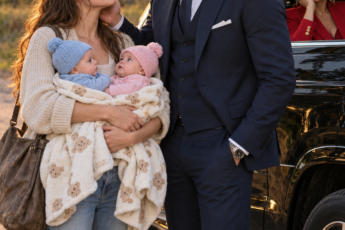
Christopher stood beside Michelle, the woman who had once been one of my closest friends. She was holding two newborn babies while he leaned proudly toward them, smiling as though he had just been handed everything he’d ever wanted.
A boy and a girl.
Beneath the photograph was a short message.
He said the babies were doing well, that he and Michelle were beginning a new chapter, and that he hoped I would eventually do the same.
Then he called.
I almost ignored it.
Almost.
When I answered, Christopher didn’t bother with small talk.
“You don’t have to act like this doesn’t affect you,” he said. “Michelle and I finally have the family I’ve always wanted.”
His meaning was obvious.
For years, our marriage had carried the weight of unanswered questions about whether we would ever become parents. We had spoken with doctors, gone through evaluations, and spent countless evenings discussing possibilities that never became reality.
Neither of us had ever received a simple explanation.
But after our marriage began falling apart, Christopher rewrote that history.
In his version, I alone had failed him.
Now Michelle had given him twins, and he wanted me to know it.
I sat silently at my desk while he waited for a reaction.
He expected tears.
Instead, I said, “Then I hope the children grow up surrounded by people who put them first.”
The line went quiet.
That wasn’t what he had wanted to hear.
“You always do this,” he said. “Everything has to sound like a business meeting with you.”
I nearly laughed.
Christopher had spent years criticizing the same practical side of me that had repeatedly helped keep his business stable during difficult periods.
When his company struggled, I helped reorganize budgets.
When financing became uncertain, I connected him with advisers.
When he needed capital for expansion, I invested money of my own.
None of that mattered now.
In Christopher’s new story, I had simply been the distant wife who cared more about work than marriage.
Michelle, meanwhile, had become the woman who supposedly understood him.
The next morning, Christopher arrived with his attorney to complete the remaining financial paperwork from our separation.
He walked into the conference room looking unusually confident.
That confidence lasted until the documents were reviewed.
During our marriage, Christopher had often spoken about his ownership stake in his company as though every share had been entirely his.
The records told a more complicated story.
Several investments had been funded through assets that legally remained mine under our agreement.
The paperwork wasn’t dramatic.
It wasn’t revenge.
It was simply documentation.
Once everything was reviewed, the division was far less favorable to Christopher than he had expected.
He stared at the pages for several seconds.
“You planned this.”
“No,” I replied. “I kept accurate records.”
His expression hardened.
Then the conversation stopped being about contracts.
“At least I have something you don’t,” he snapped. “I have a family now.”
His attorney shifted uncomfortably.
Christopher continued anyway.
“I have Michelle. I have two children. And you’re going to be left alone with your work.”
For the first time that morning, I felt genuinely sorry for him.
Not because he had moved on.
Because he still seemed to believe that hurting me somehow proved he had won.
I closed the folder in front of me.
“There was never a competition, Christopher.”
He stared at me.
Then I added quietly, “And you might want to stop pretending you know every answer about the past. Neither of us ever received the certainty you’re claiming now.”
That remark changed his expression.
Only for a second.
But I noticed.
He quickly gathered his things and left.
That evening, I sat at home thinking about something else entirely.
Christopher’s mother, Evelyn, had called me several days earlier.
Our relationship had always been complicated. She cared deeply about appearances, family traditions, and the Lawson name. But during that particular conversation, she had seemed less judgmental than anxious.
She kept asking questions about Michelle.
Not insulting questions.
Specific ones.
Had Michelle traveled anywhere unexpectedly during the year before the pregnancy?
Had she spent time with anyone else connected to the Lawson family?
Had Christopher ever mentioned receiving unusual medical advice?
I found the questions strange and told Evelyn I knew very little about Michelle’s private life anymore.
Before ending the call, Evelyn said something I couldn’t forget.
“There are things Christopher may not know.”
I asked what she meant.
She refused to explain.
A few days after the divorce, I learned Christopher planned to take Michelle and the twins to the Lawson family home so everyone could meet the babies.
I hesitated before sending Evelyn a message.
“Christopher is bringing the twins to see you this weekend. I thought you’d want to know.”
Her answer arrived almost immediately.
“That confirms what I was afraid of.”
I read the sentence twice.
Then three times.
I considered calling her.
Before I could, another message appeared.
“Please don’t ask me anything yet. I need to see the children myself.”
That weekend, Christopher arrived at his mother’s home feeling triumphant.
At least, that’s what I later heard.
Several relatives had gathered there. Michelle carried the little girl while Christopher held the boy.
For a few minutes, everything seemed normal.
Then Evelyn asked to hold her grandson.
Christopher handed him over.
The moment she looked closely at the baby’s face, her expression changed.
She became completely still.
Christopher noticed.
“Mom?”
Evelyn looked at the child again.
Then she raised her eyes toward her son.
“Christopher,” she said carefully, “did anyone ever speak to you about a resemblance in our family?”
He frowned.
“What resemblance?”
Evelyn didn’t answer immediately.
Michelle, standing nearby, suddenly looked uneasy.
That was when Christopher began to realize that his mother wasn’t admiring the baby.
She was recognizing something.
Or someone.
Evelyn handed the child back gently.
Then she asked everyone except Christopher and Michelle to leave the room.
“What is going on?” Christopher demanded.
His mother looked directly at Michelle.
“I think there is information this family should have discussed before anyone started making assumptions.”
Michelle said nothing.
Christopher turned toward her.
For the first time since the twins had been born, the certainty he had carried everywhere seemed to disappear.
No accusation was made that afternoon.
No conclusion was treated as fact.
But Evelyn revealed that she had recently learned of circumstances involving someone else in the extended family that raised questions Christopher had never considered.
She urged both of them not to speculate and to seek proper professional guidance before drawing any conclusions about the children’s parentage or family history.
Christopher’s expression changed completely.
The man who had spent weeks boasting that the twins proved something about me suddenly had no simple explanation for anything.
And when Evelyn later called me, her voice sounded exhausted.
“You were right about one thing,” she said.
“What?”
“That nobody should have treated unanswered questions as certainty.”
I sat quietly after the call ended.
I didn’t feel victorious.
The children had done nothing wrong, and whatever happened next belonged to the adults responsible for protecting them.
But one truth had become impossible to ignore.
Christopher had spent months using the twins as proof that I had been the problem in our marriage.
Now even he had to admit that life was far more complicated than the cruel story he had created.
The divorce had ended our marriage.
But the assumptions Christopher had built around it were only beginning to unravel.