My daughter was eight when she told me something that changed the way I looked at our home.
Sonia was never dramatic. She didn’t invent frightening stories or exaggerate small things for attention. She was the kind of child who could spend half an hour watching rain slide down a window and then quietly return to her coloring book.
So when she spoke from the back seat during our drive to school, I listened.
“Dad, someone comes into your bedroom at night.”
For a second, I thought I’d misunderstood her.
I glanced at her through the mirror.
“What do you mean, someone?”
She kept looking out the window.
“A man. He comes in after you’re asleep.”
My hands tightened around the steering wheel.
“Are you sure you weren’t dreaming?”
Sonia shook her head.
“I’ve seen him more than once.”
Her voice wasn’t frightened.
That bothered me more than fear would have.
“What does Mom do?”
Sonia thought for a moment.
“She stays quiet.”
I wanted an easy explanation.
A dream.
A shadow.
A late-night television scene she’d misunderstood.
Anything.
But Sonia continued.
“He carries a little case. He goes to Mom’s side of the bed.”
I didn’t ask anything else.
When we reached school, she kissed my cheek, adjusted her backpack, and ran through the gate as though she’d just told me something completely ordinary.
I sat in the car long after she disappeared inside.
Then I drove home.
My wife, Emily, was standing in the kitchen when I arrived.
Coffee was brewing. Morning light filled the room. She looked exactly as she had almost every morning of our marriage.
Yet suddenly I noticed details I had been overlooking.
She looked exhausted.
Her hands trembled slightly when she lifted her cup.
She was wearing a long-sleeved shirt even though the house was warm.
When I entered unexpectedly, she startled.
“You’re back early,” she said.
“I forgot something.”
It was a weak excuse, but she didn’t challenge it.
I wanted to tell her what Sonia had said.
Instead, I watched.
That decision made me ashamed later.
At the time, suspicion had already taken hold.
For the rest of the day, ordinary things began to look suspicious simply because I was searching for meaning in them.
Emily checked her phone several times.
She stepped into another room to take one call.
As I passed nearby, I heard only a fragment.
“Yes. Tonight should work.”
That was enough for my imagination to do the rest.
By dinner, I had convinced myself there was something she wasn’t telling me.
Maybe another relationship.
Maybe a secret she’d been hiding for months.
I hated myself for thinking it, but I couldn’t stop.
That night, Sonia talked about school while Emily served dinner. Nothing about the scene looked broken.
That somehow made it worse.
Before putting Sonia to bed, I sat beside her.
“About the man you mentioned…”
She looked up.
“Has he come a lot?”
She nodded.
“What does he do?”
“I don’t really know. He opens his case. Mom looks sad when he comes.”
“Does he ever bother you?”
“No.”
That answer mattered.
I should have paid more attention to it.
Instead, I asked one final question.
“Does Mom seem scared of him?”
Sonia shook her head.
“No. Just tired.”
Later, Emily came to bed.
She asked whether I had taken the medication my doctor had prescribed to help me sleep during a stressful period.
I told her I had.
In reality, I decided to remain awake.
I lay still beside her, breathing slowly and pretending to sleep.
Emily wasn’t asleep either.
I could tell from the way she shifted every few minutes.
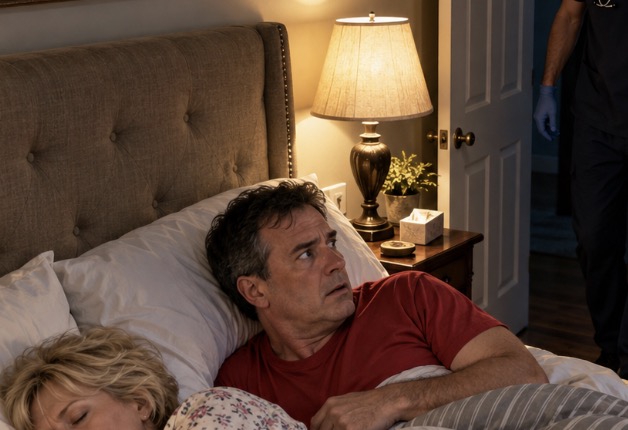
Sometime after one in the morning, the bedroom door opened.
Very quietly.
A man stepped inside.
He was carrying a compact medical-style case.
My heart began pounding.
He moved directly toward Emily.
She opened her eyes.
Neither of them seemed surprised to see the other.
“Are you ready?” he whispered.
Emily nodded.
I was seconds away from sitting up when the man opened his case.
Inside were sealed medical supplies.
Gloves.
Dressings.
Small packets.
Nothing about it matched the scene I had constructed in my head.
He washed his hands, put on gloves, and spoke softly.
“How was the pain today?”
Emily answered so quietly that I almost couldn’t hear her.
“Worse.”
Everything inside me stopped.
The man wasn’t a stranger meeting my wife in secret.
He was a healthcare professional.
I switched on the bedside lamp.
Both of them froze.
Emily stared at me.
The man stepped back immediately.
“What is going on?” I asked.
There was anger in my voice, but beneath it was fear.
Emily looked down.
For several seconds, she said nothing.
Then she began crying.
Not loudly.
Just silently, as though she had been holding it in for a very long time.
The man removed his gloves.
“I think you two should talk,” he said.
Emily finally looked at me.
“I didn’t know how to tell you.”
“Tell me what?”
She took a long breath.
Several weeks earlier, she had begun experiencing symptoms she had initially dismissed.
After medical appointments and further evaluation, doctors had found a condition that required ongoing treatment and monitoring.
It was serious enough to frighten her.
But it was also something her medical team was actively treating.
She had arranged some care at home because she didn’t want Sonia repeatedly seeing her leave for appointments.
More importantly, she hadn’t told me because she knew what the last year had done to me.
I had lost my father.
Work had nearly consumed me.
I had been struggling with anxiety and sleep problems.
Emily had convinced herself that protecting me meant carrying her own fear alone.
“You should have told me,” I said.
“I know.”
“Why would you think I’d rather not know?”
Tears filled her eyes.
“Because every time something happened this year, you were the one holding everyone else together. I couldn’t stand the idea of becoming one more thing you had to worry about.”
I sat beside her.
“You are not something I have to deal with.”
She looked away.
“You’re my wife.”
That was when Sonia appeared at the bedroom door.
The light must have awakened her.
She looked at the three of us and asked, “Is Mom okay?”
Emily opened her arms.
Sonia climbed onto the bed.
The healthcare worker quietly packed his supplies while we sat together.
And suddenly everything Sonia had told me made sense.
The late-night visits.
The case.
Emily’s exhaustion.
Her long sleeves.
The sterile scent I’d occasionally noticed without understanding.
Even her sadness.
There had never been a betrayal.
There had been fear.
And instead of trusting each other with it, Emily and I had both chosen silence for different reasons.
She had hidden her illness because she thought she was protecting me.
I had hidden my suspicion because I thought I was protecting myself from humiliation.
Both of us had been wrong.
The next morning, we spoke openly for the first time in weeks.
Emily explained what her doctors had told her and what the next months might look like. I asked questions, listened, and resisted the temptation to pretend I wasn’t afraid.
We also spoke with Sonia in words appropriate for an eight-year-old.
We told her Mom was getting treatment, that adults were helping her, and that she could always ask us questions instead of carrying worries alone.
Her response was simple.
“I knew the man was helping.”
I looked at her.
“How?”
She shrugged.
“Because Mom always looked less scared after he left.”
Children notice more than adults like to believe.
Months later, I still thought about that night whenever fear tempted me to invent an answer before asking a question.
I had spent an entire day convincing myself my marriage was falling apart.
The truth was very different.
My wife wasn’t hiding another life from me.
She was trying to survive a frightening chapter without becoming a burden to the people she loved.
And the lesson that stayed with me had nothing to do with jealousy.
It was much simpler.
Sometimes the most dangerous thing in a family isn’t the truth.
It’s the silence everyone creates while trying to protect each other from it.