I knew I was in trouble before I even reached my desk.
The office was unnaturally quiet.
A presentation I had spent most of the previous night preparing was still projected on the conference-room screen, but the chairs around the table were empty.
Our prospective clients had already left.
Nick, my manager, was waiting outside the room.
“Sebastian, where have you been?”
I was still catching my breath after running from the parking lot.
“There was an emergency on the way here.”
His expression didn’t change.
“What kind of emergency?”
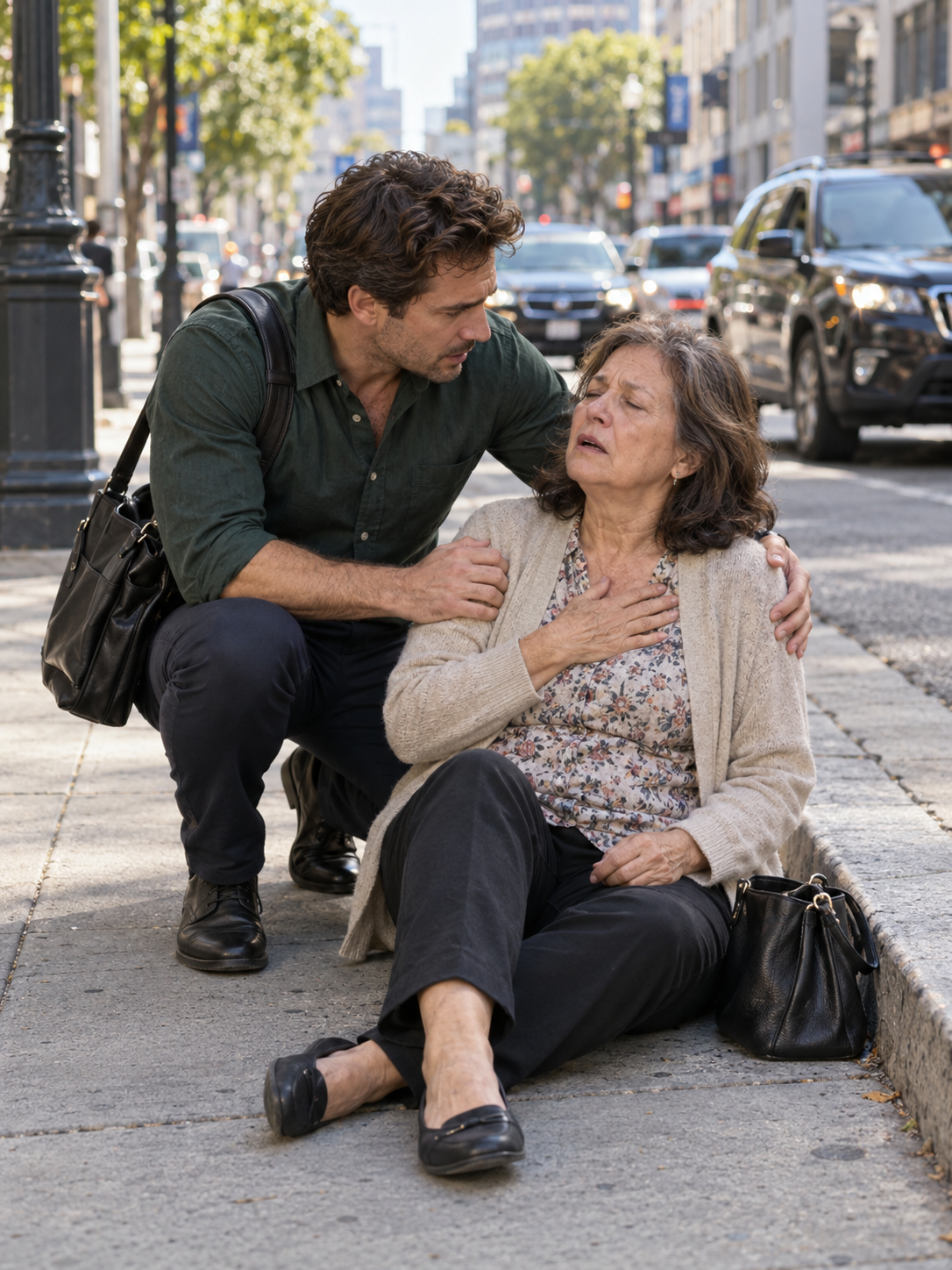
“A woman collapsed near the road. I stopped to help.”
Nick stared at me.
“You missed the most important presentation we’ve had in months because of someone you don’t even know?”
I couldn’t believe the question.
“She suddenly became unwell. I stayed with her until help arrived.”
Nick looked toward the empty conference room.
“The clients waited. Then they left.”
My stomach sank.
I knew how important the meeting had been.
Our small marketing firm had been trying to secure that account for months, and I was supposed to lead the presentation.
But when I had seen the woman sitting near the curb, visibly struggling, none of that had mattered.
Several cars had passed.
I couldn’t.
I pulled over, called for emergency assistance, and stayed nearby until professionals arrived.
I had called the office too, but apparently the message hadn’t changed anything.
“I’m sorry the meeting fell apart,” I told Nick. “But I couldn’t leave someone who clearly needed help.”
He stepped closer.
“Was she a relative?”
“No.”
“A friend?”
“No.”
“Then someone else could have handled it.”
“There wasn’t anyone else stopping.”
Nick shook his head.
“You had a responsibility here.”
“So what exactly are you saying I should have done?”
His answer came without hesitation.
“Come to work.”
For a moment, I thought I’d misunderstood him.
I looked around.
Several coworkers were pretending not to listen.
I had worked beside some of them for nearly three years.
They knew how many weekends I had spent fixing campaigns that weren’t mine.
They knew how often I had taken calls after hours.
They knew I had trained new employees, calmed frustrated clients, and stepped in whenever someone else missed a deadline.
But nobody spoke.
Nick continued.
“We run a business, Sebastian. People were counting on you this morning.”
“I understand that.”
“No, you don’t.”
He pointed toward the conference room.
“That account could have changed this company.”
I felt my frustration rising.
“And the woman on the roadside could barely stay upright. What would you have had me do—ignore her?”
Nick exhaled sharply.
“I’m not discussing this anymore.”
Something in his tone made my stomach tighten.
Then he said it.
“Clear out your desk.”
I stared at him.
“What?”
“You’re done.”
The words didn’t feel real.
I had expected anger.
Maybe a warning.
Perhaps even losing the account would cost me a promotion.
I hadn’t expected to lose my job before I’d even taken off my bag.
“Nick, I’ve given this company almost three years.”
“And this morning you weren’t here when we needed you.”
That was apparently all that mattered.
I looked toward my coworkers again.
A few avoided my eyes.
One woman gave me a sympathetic glance but said nothing.
I wanted to make some perfect final speech.
I wanted to tell Nick that one missed presentation couldn’t erase years of work.
Instead, my throat tightened.
I turned away before anyone could see how badly the moment had hit me.
Outside, the morning sun felt almost offensively bright.
I sat in my car and locked the doors.
For several minutes, I simply stared through the windshield.
Then the anger came.
Not because the client had left.
Not even because I’d been fired.
What hurt was realizing that the place I had treated like a second home could reduce every late night and every sacrifice to one morning.
I called my wife.
She answered immediately.
“How did the presentation go?”
I couldn’t speak at first.
“Sebastian?”
“I got fired.”
There was a pause.
“For being late?”
“For stopping to help someone.”
She was quiet again.
Then she asked the only question that mattered.
“Is the woman okay?”
I closed my eyes.
“I think so. The paramedics took over before I left.”
“Then you made the right decision.”
I wanted to believe her.
But doing the right thing didn’t make unemployment less frightening.
We had two daughters.
A mortgage.
Bills that didn’t care whether I had acted compassionately.
When I got home, I spent the afternoon updating my résumé and calculating how long our savings might last.
The next morning, Nick emailed me.
I could return after lunch to collect the belongings from my desk.
Nothing more.
No apology.
No conversation.
Just a time window.
When I arrived, the receptionist barely looked at me.
My access badge had already been disabled.
Someone escorted me upstairs.
My desk looked exactly as I’d left it.
Family photographs.
A coffee mug my daughters had decorated.
Two notebooks.
A small plant I’d somehow managed to keep alive for three years.
I found an empty cardboard box and began packing.
Halfway through, I heard voices near reception.
At first, I ignored them.
Then I heard Nick.
His tone was completely different from the one he’d used with me the previous morning.
Polite.
Nervous.
Almost desperate.
I kept packing.
A few seconds later, the office became unusually quiet again.
Someone was walking toward my desk.
I looked up.
A woman in her sixties stood at the end of the aisle.
I recognized her immediately.
She looked healthier than she had beside the road, but there was no mistaking her face.
It was the woman I had stopped to help.
Beside her stood a younger woman carrying a leather portfolio.
The older woman smiled when she saw me.
“There you are.”
I slowly put down the framed photograph in my hand.
“What are you doing here?”
“I wanted to thank you properly.”
“You didn’t have to come all this way.”
“Yes,” she said. “I did.”
Nick hurried up behind her.
His face had gone pale.
“Sebastian, perhaps we should all use the conference room.”
The woman turned toward him.
“I don’t think that’s necessary.”
Then she looked back at me.
“My name is Eleanor.”
She explained that after receiving medical care, she had asked the emergency responders whether they knew anything about the stranger who had stayed with her.
Eventually, she managed to identify the company where I worked.
“I called this morning,” she said.
I glanced at Nick.
That explained his expression.
Eleanor continued.
“When I asked to speak with the employee who helped me, I was told you no longer worked here.”
Her smile disappeared.
“I found that surprising.”
Nick stepped forward.
“There were circumstances surrounding Sebastian’s employment that aren’t relevant—”
Eleanor raised a hand.
“I didn’t come here to interfere in your personnel decisions.”
That sentence seemed to give Nick a moment of relief.
It didn’t last.
The younger woman beside Eleanor opened the portfolio she was carrying.
Eleanor looked at me.
“Do you remember telling me yesterday that you were late for an important presentation?”
I nodded.
“Unfortunately.”
“Which company were you presenting to?”
I told her.
She exchanged a glance with the woman beside her.
Then something unexpected happened.
Eleanor laughed softly.
Not mockingly.
Almost in disbelief.
Nick looked increasingly uncomfortable.
“What?” I asked.
Eleanor explained that she served on the board of an investment group whose portfolio included the very company my agency had been trying to win as a client.
She wasn’t the sole decision-maker.
She couldn’t simply award contracts because someone had helped her.
And she made that clear immediately.
But she could ask questions.
So she had.
She had learned that the prospective client hadn’t rejected our agency because I was late.
They had left because the meeting had been poorly handled after my absence.
They had also learned why I wasn’t there.
“The people you were supposed to meet weren’t angry that you helped me,” Eleanor said.
“They were impressed.”
I turned toward Nick.
He said nothing.
Eleanor continued.
“The account hasn’t been awarded to anyone yet.”
Nick suddenly found his voice.
“That’s excellent. We’d be happy to reschedule.”
Eleanor looked at him.
“That decision belongs to the client.”
Then she turned back toward me.
“But there’s another reason I’m here.”
The younger woman handed me a business card.
Eleanor’s organization was looking for someone with experience in client strategy and communications.
She wasn’t offering me a job on the spot.
There would be interviews.
References.
A normal hiring process.
But she wanted me to apply.
“I asked several people about your work before coming here,” she said. “Your reputation appears to be considerably better than yesterday made you feel.”
I looked down at the card.
Twenty-four hours earlier, I had sat in my car believing one compassionate decision had destroyed my career.
Now a door I hadn’t even known existed had opened.
Nick cleared his throat.
“Sebastian, maybe you and I should talk before you make any decisions.”
I looked at him.
Yesterday, I would have wanted that conversation desperately.
Today, I didn’t.
“I think we’ve already said everything we needed to say.”
I finished packing my box.
A month later, after several interviews, I accepted a position with Eleanor’s organization.
It wasn’t a reward for helping her.
That mattered to me.
I earned the job through the same process as the other candidates.
But she was the reason I had been given the opportunity to walk through the door.
As for my old agency, I later heard that the major account went elsewhere.
Not because Eleanor demanded it.
Not because anyone sought revenge.
The client simply chose another firm after completing its evaluation.
Nick had once told me that business had no room for compassion.
I eventually learned something different.
Professionalism matters.
Deadlines matter.
Responsibilities matter.
But there are moments when another human being needs help more urgently than a calendar needs obedience.
I lost one job because I stopped my car that morning.
For a few terrifying hours, I thought that decision had ruined my life.
Instead, it showed me exactly what kind of life I wanted to build next.