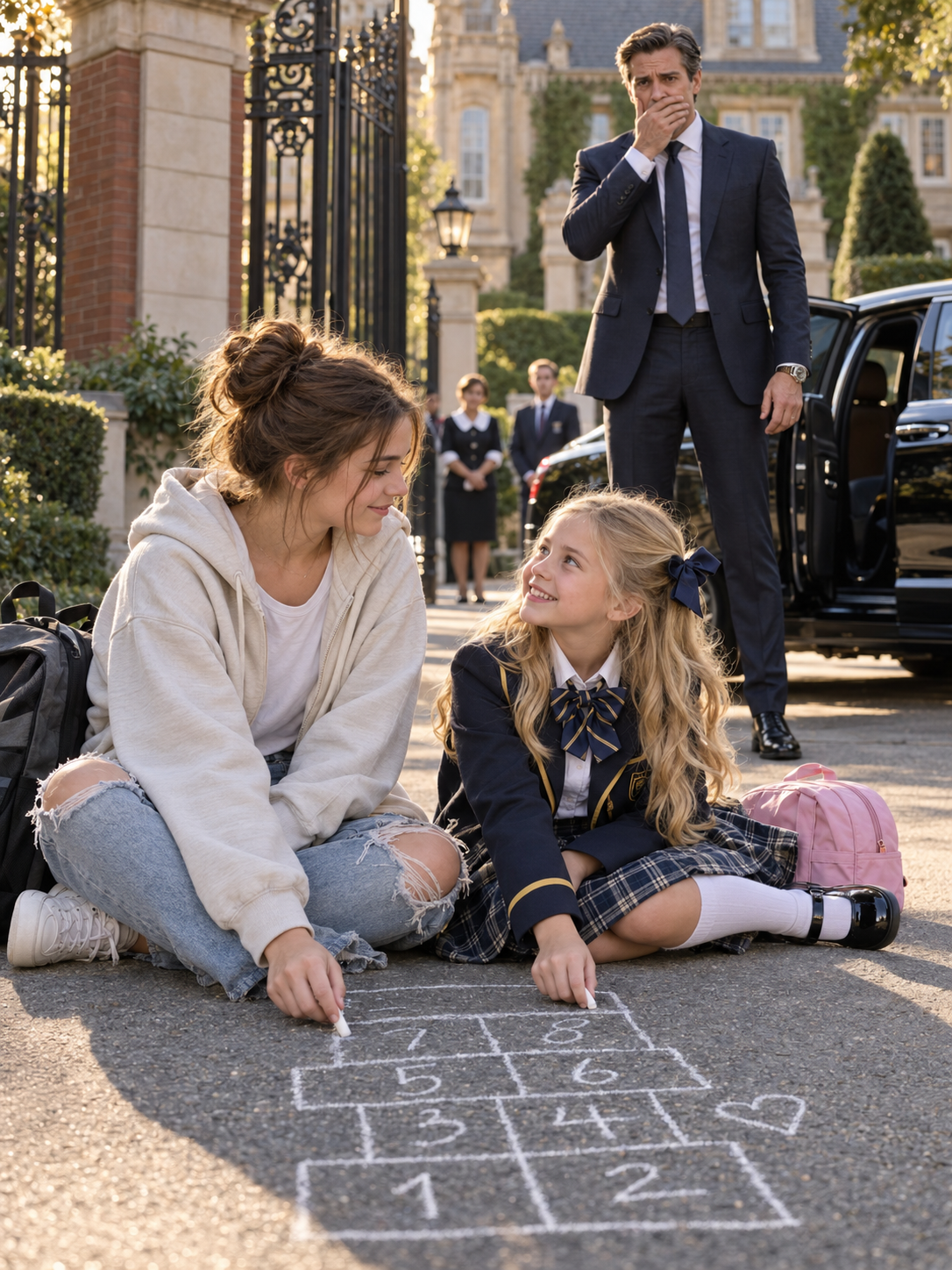
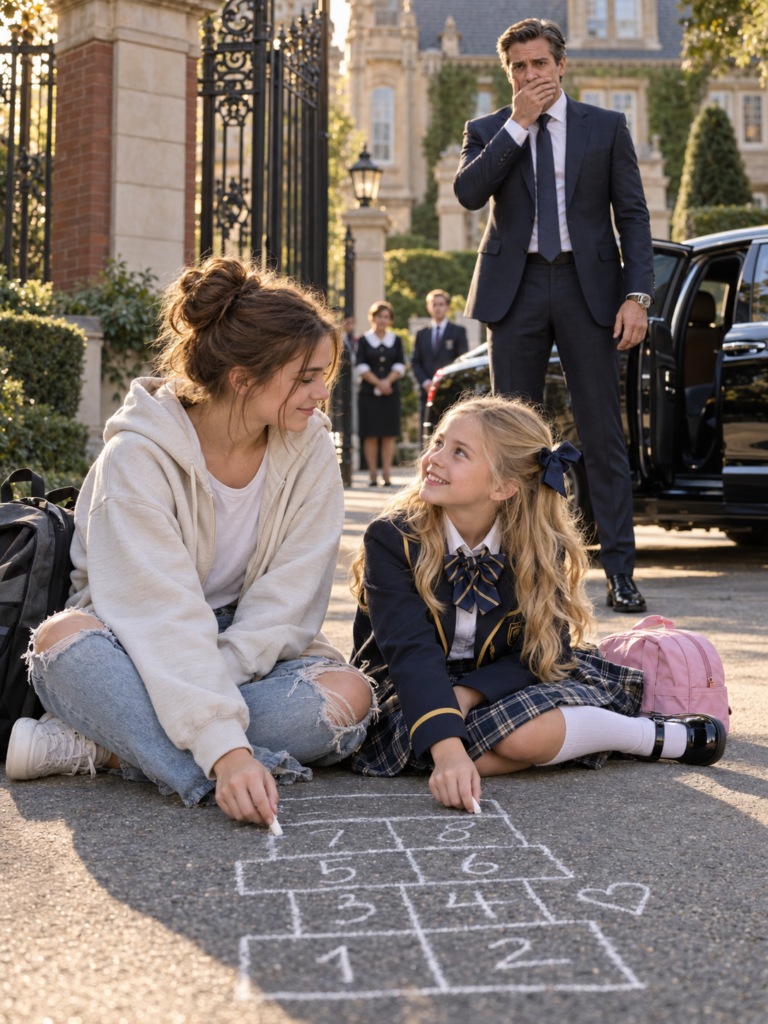
I couldn’t take my eyes off the paper sticking out of the teenage girl’s bag.
At the top of the page was the academy’s emblem: a silver oak tree surrounded by a dark-blue circle.
I knew that symbol perfectly.
It was the same one printed on Sophie’s uniform and on every official letter from her school.
But the logo wasn’t what took my breath away.
It was the name written beneath it.
Claire Harrison.
My wife’s name.
For several seconds, all the sounds around me seemed to disappear—the cars slowly leaving the parking lot, parents talking, students’ footsteps, a supervisor’s whistle.
Everything felt far away.
The girl noticed me staring at the document and quickly pushed it back into her bag.
“What is that?” I asked.
She stiffened.
“Nothing.”
Sophie looked at me with concern.
“Dad?”
I took a breath and tried to remain calm.
“I just saw Claire’s name on that paper.”
The girl lowered her eyes.
She didn’t seem frightened anymore. She looked uncertain, as if she were trying to decide whether she could trust me.
Finally, she looked up.
“Did you know Claire Harrison?”
Hearing my wife’s name from a stranger’s mouth stirred something strange inside me.
“Claire was my wife.”
The girl’s expression shifted slightly. She looked at Sophie.
“Are you Claire’s daughter?”
Sophie nodded.
“Yes.”
The girl slowly sat down on the edge of the curb.
“My name is Leah,” she said.
“Leah what?”
“Leah Bennett.”
The name meant nothing to me. Still, I searched my memory.
Claire had always been surrounded by people. She volunteered with charities, attended fundraisers, took part in school programs, and supported projects for children. It was possible she had known Leah’s parents.
“How did you know Claire?” I asked.
Leah opened her bag. After a short hesitation, she pulled out the paper.
It had been folded many times, its corners slightly worn, as if she had kept it safe for a long time.
“You can read it,” she whispered.
I took the document.
It had been written nearly three years earlier, with the school’s emblem at the top.
Several paragraphs described a student named Leah Bennett.
And at the bottom of the page was Claire’s signature.
I recognized it immediately.
Even after all that time, that signature brought back an avalanche of memories: the little notes she slipped into my suitcase before I traveled, the lists she left on the kitchen table, the messages she wrote beside my coffee cup.
And one sentence she often repeated:
“Never forget that someone is waiting for you at home.”
I needed a few seconds before I could continue reading.
The letter was addressed to the academy’s admissions committee. Claire described Leah as an exceptionally bright, curious, and determined young girl. She wrote that Leah had a remarkable talent for mathematics and, more importantly, a rare quality: she knew how to help others without making them feel less capable.
One sentence caught my attention.
“Abilities can grow over time. But the patience needed to give others confidence is much rarer. Leah has that quality.”
I lowered the paper.
“When did you first meet Claire?”
Leah nervously ran her finger along the strap of her bag.
“At the library.”
“Which library?”
“The one near Sheridan.”
I knew the place. Claire went there every Saturday. She had told me she volunteered in a program for children, but I had never bothered to ask for more details.
At the time, I had treated it as just another activity in her busy life.
Now, that indifference made me ashamed.
“I was thirteen,” Leah continued. “I went there after school. It was warm, there were computers, and no one told me to leave as long as I stayed quiet.”
She paused.
“Claire volunteered with a homework-help group. I wasn’t part of it. I was too old.”
A small smile appeared on her face.
“But I spent my time correcting everyone else’s math problems.”
Sophie laughed.
Leah looked at her.
“One day, your mom caught me.”
“And what did she say?” Sophie asked.
Leah smiled wider.
“She said, ‘If you think the problem is wrong, then you should be able to explain how you would solve it better.’”
Sophie laughed again.
I stayed silent.
That sounded exactly like Claire. She had always known how to challenge people without putting them down. She never simply told someone they had potential.
She found a way to make them discover it for themselves.
“What happened after that?” I asked.
“She started giving me harder problems.”
“She tutored you?”
Leah shook her head.
“Not exactly. She said we were working together.”
Of course.
That was so like Claire.
She hated making anyone feel indebted to her.
I remembered so many small details about my wife: the soft clinking of her bracelets as she lifted a cup, the way she sat with one leg folded beneath her while reading, the fresh flowers she placed around the house—even in rooms no one ever used.
But standing outside that school, listening to Leah, I understood something painful.
I thought I knew Claire.
In truth, I only knew the part of her life that she shared with me.
There were places she went without me. People she helped without telling me. Stories I never even knew existed.
She had not necessarily hidden them from me.
Maybe I was the one who had never taken the time to ask the right questions.
Leah carefully folded the letter.
Then she hesitated.
“There’s something else.”
I looked at her.
“What?”
This time, her expression turned serious.
“Claire didn’t only help me with school.”
Sophie stopped smiling.
I felt my heart begin to race.
“Then why did she help you?”
Leah pressed the paper against her chest. She looked around before answering.
“Because there was something in my life she wanted to protect.”
I went still.
“What do you mean?”
Leah looked at Sophie for several seconds. Then she looked at me.
“I don’t think Claire told you the whole story.”
A cold wind swept across the sidewalk.
Maybe this was the first clue to a secret my wife had taken with her.
And Leah seemed to be the only person who could still reveal the rest.