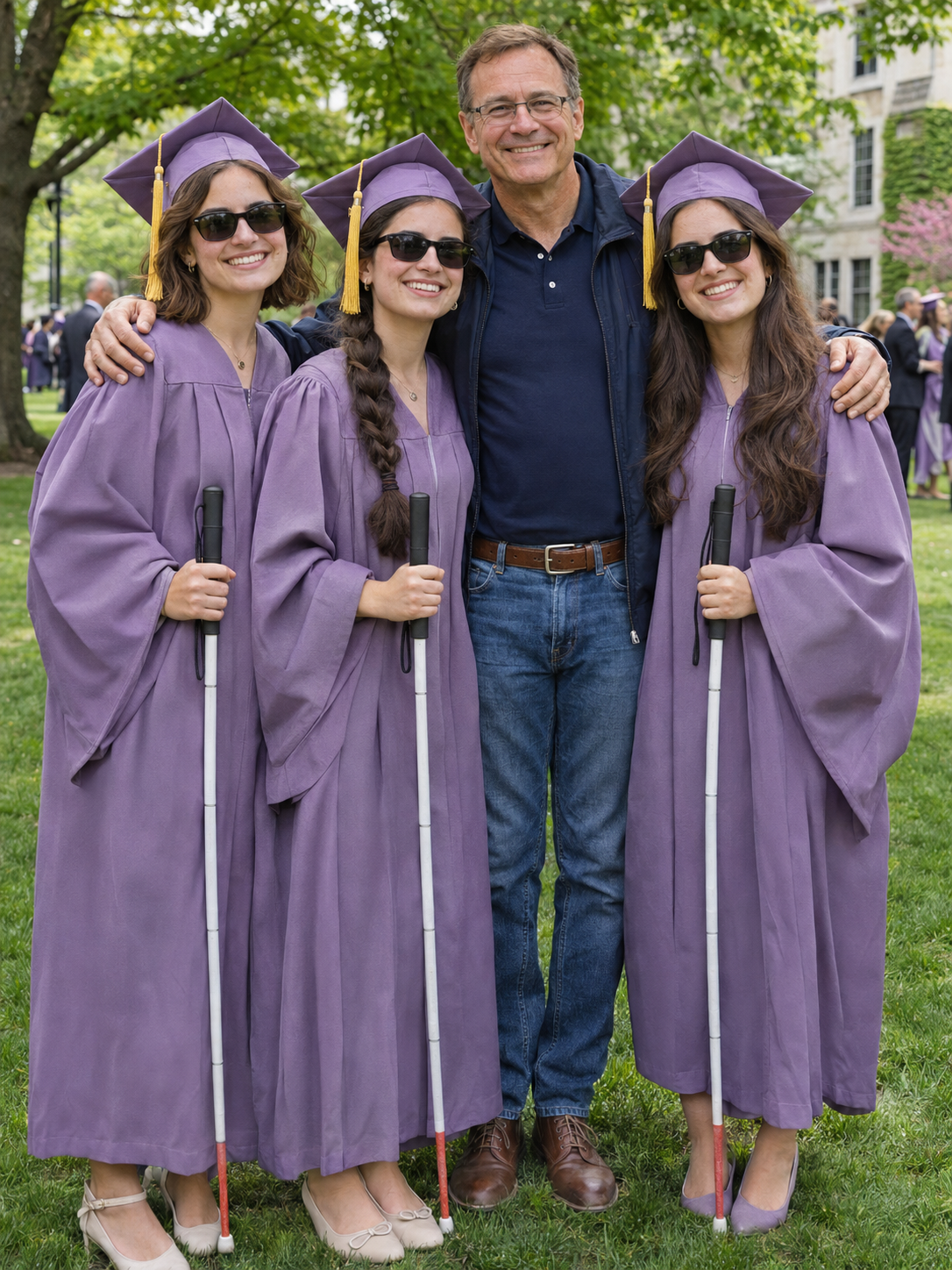
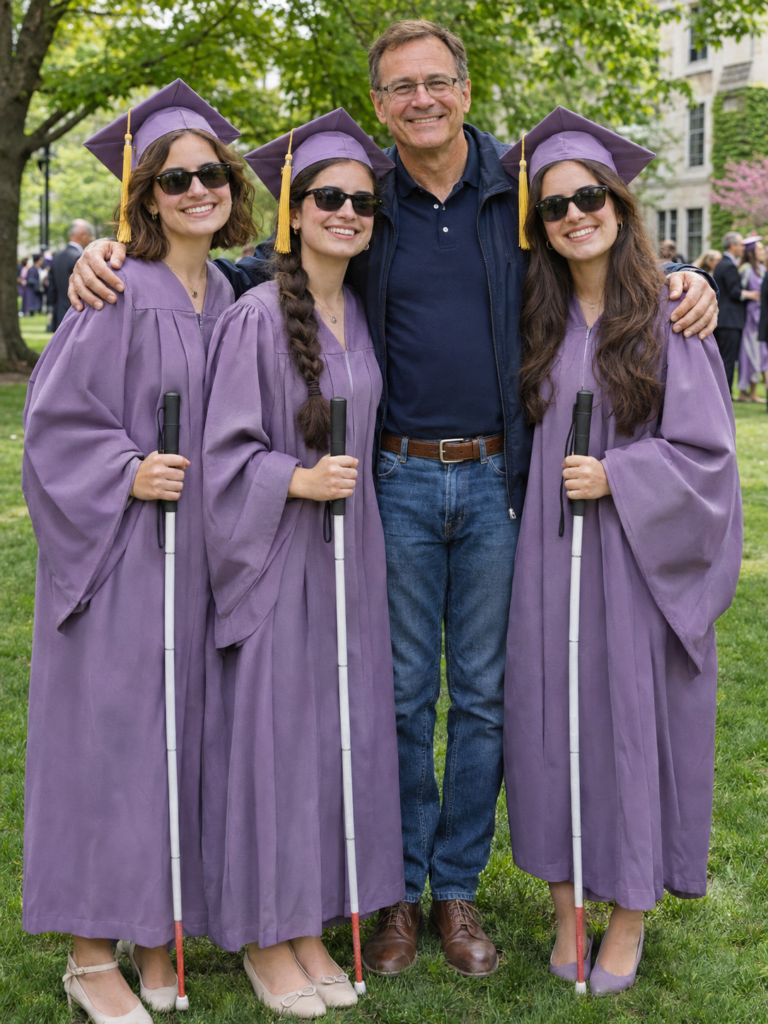
I had imagined my daughters’ graduation day hundreds of times. I pictured them crossing the stage, smiling for the cameras and holding the diplomas they had worked so hard to earn.
But I never imagined that on such a joyful day, I would discover how close I had come to losing them.
My name is Samuel.
Eighteen years ago, I became the father of three premature baby girls: Callie, June and Mara. Their mother, Audrey, left us while they were still in the neonatal intensive care unit.
From then on, I learned to prepare three bottles at once, survive on only a few hours of sleep and recognize each of their cries in the dark. I gave up my studies in wood restoration because I had to work. I never regretted it.
But on graduation day, Audrey appeared again, elegant as ever, as if the years had simply passed her by. She told the girls about an inheritance their maternal grandmother had left them.
Then Callie looked down at her phone. Her expression was unlike anything I had seen before.
“Dad, before we talk to her, you need to hear something.”
We went into an empty classroom. Audrey followed us but stayed near the door. June closed the curtains, and Mara pulled up a chair for me.
“It’s a recording from Grandma,” Callie explained. “The lawyer gave it to us yesterday.”
I had never been close to that woman. After Audrey left, her mother disappeared from our lives too.
Callie pressed play.
An elderly voice filled the room.
“Samuel, if you’re hearing this, it means I finally found the courage I lacked for eighteen years.”
I went still.
“When the girls were born, Audrey admitted that she didn’t want to be a mother. I thought about our family’s reputation instead of what you were going through. I had papers prepared to place the girls in a private institution. They were presented to you along with the forms for taking them home after their hospital stay.”
At once, I remembered the hospital’s administrative office: a table that seemed too large, a cup of cold coffee and a pen that wouldn’t write. I also remembered a young nurse wearing purple glasses.
“Read everything, Mr. Samuel,” she had whispered. “Even the last pages.”
I still remembered her name: Elena.
The recording continued.
“That nurse stopped you from signing without understanding what the papers said. You went back into the office and told them your daughters were coming home with you, no matter how difficult it would be.”
I struggled to breathe. I had thought those papers were only about the care the girls would need at home. I had never known who had arranged that plan.
“After Audrey left, she told me you wanted nothing more to do with our family. I believed her because it was easier for me.”
Mara squeezed my hand.
“When I found an article about three sisters who had been accepted into university, I saw your photograph. Samuel, you kept a promise we had tried to make impossible.”
The grandmother’s voice began to tremble.
“I left my granddaughters an inheritance to be managed by professionals. No one should use that money to buy their affection. The evidence and the original documents have been given to the lawyer.”
The recording ended.
I sat there without moving. For years, I had thought Audrey had simply run away. Now I knew someone had also made plans to separate us.
I looked at the woman standing by the door.
“Did you know those papers existed?”
Audrey lowered her eyes.
“Yes.”
“And you let me believe I had misunderstood what they were?”
“I was scared, Samuel. I wasn’t ready to raise three children.”
“Neither was I.”
My voice was calm, though my hands were shaking.
“I didn’t even know how to hold a baby that small. But I learned.”
Audrey began to cry.
“I made terrible mistakes.”
June stepped forward.
“Why did you come back today, of all days?”
Audrey hesitated. Then she admitted that her second marriage had fallen apart and she had built up a lot of debt. When she learned about the inheritance, she hoped she could have a role in managing the money.
Callie slowly shook her head.
“You didn’t come back to get to know us. You came because you thought we had something you could use.”
“I wanted to see you, too.”
“Then you could have written us a letter,” Mara replied.
Audrey fell silent.
I moved closer to my daughters.
“You don’t have to make any decisions today.”
Callie rested her head on my shoulder.
“We know, Dad.”
June took my hand, and Mara wrapped her arms around us. For a moment, I saw three tiny babies again, bundled in hospital blankets. I had spent so many nights wondering whether I could be a good enough father.
Now these three young women were holding me as if I had always been their safe place.
Then Callie checked the time.
“If we don’t get back to the ceremony, we’re going to miss our diplomas!”
We laughed through our tears.
Before we left, Audrey stopped us.
“Could I see you again someday?”
Mara answered gently.
“Maybe. But we don’t want promises or conversations about the inheritance. And you’ll have to respect whatever decision we make.”
Audrey nodded. For once, she didn’t push.
The following week, we met with the lawyer who handled their grandmother’s estate. I brought a folder full of questions. June arrived with an even longer list.
The lawyer explained that the inheritance belonged to the girls and that Audrey couldn’t take control of it simply because she was their mother. Any responsibility would require specific checks and legal approvals.
My daughters decided to place the money under the care of an independent administrator. They also asked me to be part of the important decisions.
“I don’t want to control your money,” I said.
June smiled.
“Dad, for eighteen years, all you did was make sure we had enough to eat and got to school on time. We think we can trust you.”
Those words meant more to me than any fortune could have.
A few days later, we decided to look for Elena, the nurse who had told me to read the hospital papers carefully.
We found her in a small house surrounded by rose bushes. She was retired. When I told her my name, she studied me for a moment, then looked at the girls.
“Don’t tell me you’re those three little ones from the hospital!”
Callie laughed.
“We’ve grown a lot since then!”
Elena invited us inside. We made tea and talked for hours. At last, I told her what the recording had revealed.
“Without you, I might never have understood what I was about to sign.”
She shook her head.
“I only told you to read the papers. You were the one who chose to take your daughters home.”
Mara gently took her hand.
“Thank you for giving Dad the chance to choose.”
Elena was deeply moved. So was I.
Summer passed far too quickly. Mara was going to study law, June was going to study computer science, and Callie was going to study music. Three different universities. Three distant cities.
For the first time, our house was about to become almost silent.
The night before the girls left, I found the garden lit with little strings of lights. They had prepared dinner, and there was an envelope with my name on it.
“We have a gift for you,” Callie said.
Inside was a confirmation for an evening course in wood restoration. It was the program I had given up when the girls were born.
“How did you find this?”
June smiled.
“You kept the old course brochure under a mountain of bills.”
“But I’m fifty years old!”
“So what?” Mara replied. “We’re starting university. You can do it too.”
I stared at the paper, unable to speak. For eighteen years, I had built my whole life around what my daughters needed. Now they were reminding me that I was allowed to have a future of my own.
Callie put on an old song—the one I used to play when they were little and refused to go to sleep.
“One last dance before dinner, Dad?”
I danced with all three of them. I kept getting the steps wrong, and they burst out laughing, just as they had when they were children.
When the music ended, we stood together beneath the garden lights, holding one another.
For a long time, I believed that raising three daughters alone meant giving up on my own dreams forever.
But that night, I understood something no one had ever taught me: being a father hadn’t erased my life. It had given it meaning. And now, thanks to my daughters, I could finally begin living for myself, too.