The night Lorenzo Valenti invited me to dance in front of all his guests, he thought he was about to embarrass me. He had no idea that the music would bring a fifteen-year-old secret back to the surface.
My name is Elena Ricci, and I worked as a housekeeper at Lorenzo’s enormous estate near Milan.
Lorenzo ran the powerful business empire he had inherited from his father, Vittorio. He was used to getting whatever he wanted, surrounded by people who rarely dared to disagree with him.
I was just another employee.
I had taken the job to help my sister Chiara, who was raising her two children alone after a difficult divorce. Each month, I gave her nearly all my savings to help cover their everyday expenses.
At a reception celebrating the company’s anniversary, Lorenzo decided to make me the evening’s entertainment.
One of the guests had accidentally spilled wine on my uniform. As I tried to clean the stain, Lorenzo called me into the middle of the room.
“Elena, can you dance the tango?”
Everyone turned to look at me.
“A little, sir.”
Lorenzo smiled at his friends.
“Then let’s make a bet. If you manage to impress me, I’ll ask you to marry me.”
A few guests burst out laughing. His fiancée, Valeria, gave me a look of contempt.
My cheeks burned with embarrassment. I wanted to leave, but losing my job would put my sister and her children in an even harder position. So I lifted my chin.
“I have no interest in marrying you, Mr. Valenti. But I can dance, if that’s what you want.”
My answer stirred a murmur through the room.
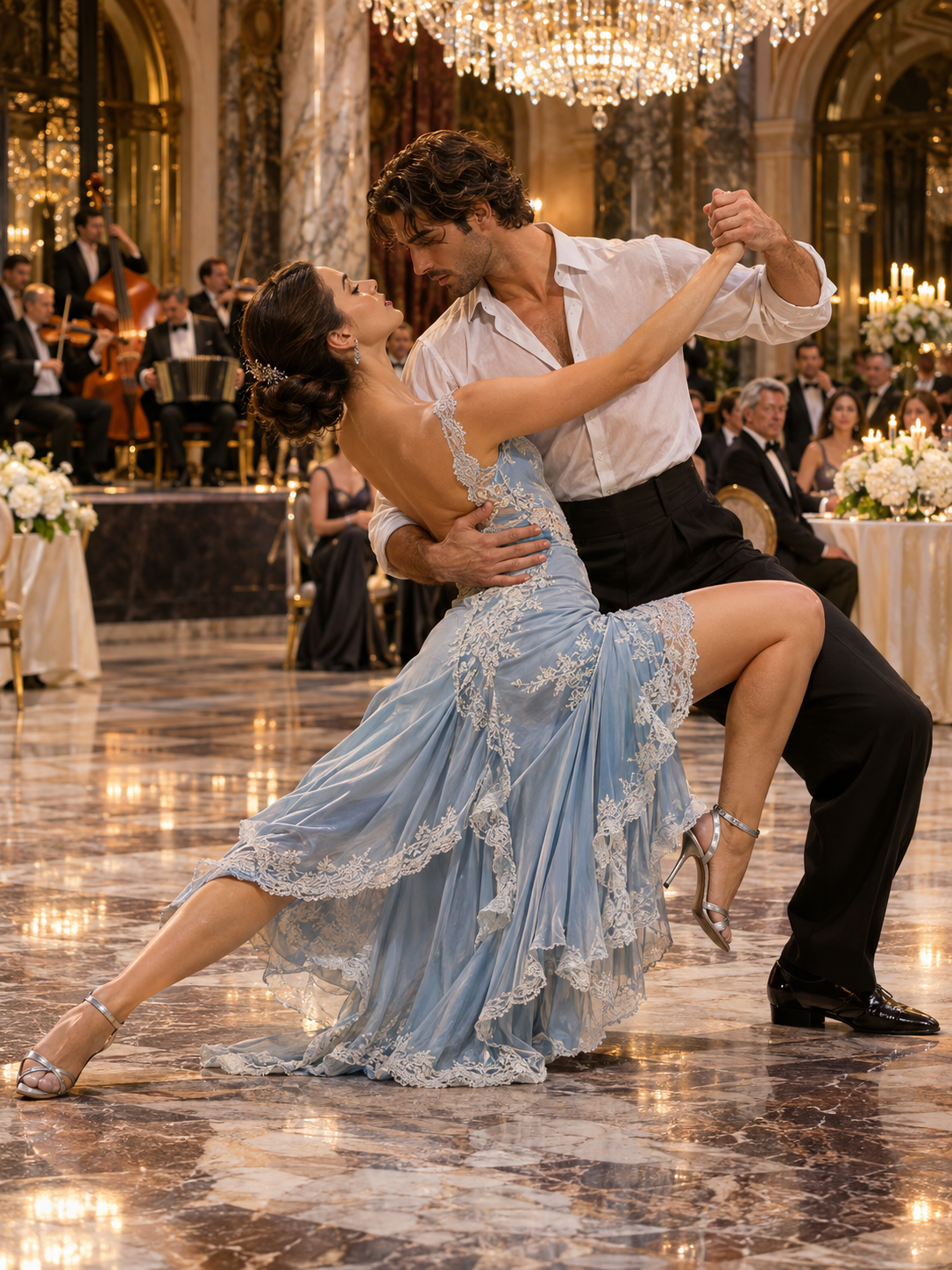
The orchestra began to play, and I recognized the melody at once. It was my father’s favorite tango.
When I was little, he played it every Saturday morning at the modest dance school he ran with my mother. He taught me my first steps when I was still too small to reach his hands properly.
Then, fifteen years ago, he disappeared. We were led to believe he had died far away from home. After that, I never danced in front of an audience again.
But that night, my body remembered what grief had failed to erase.
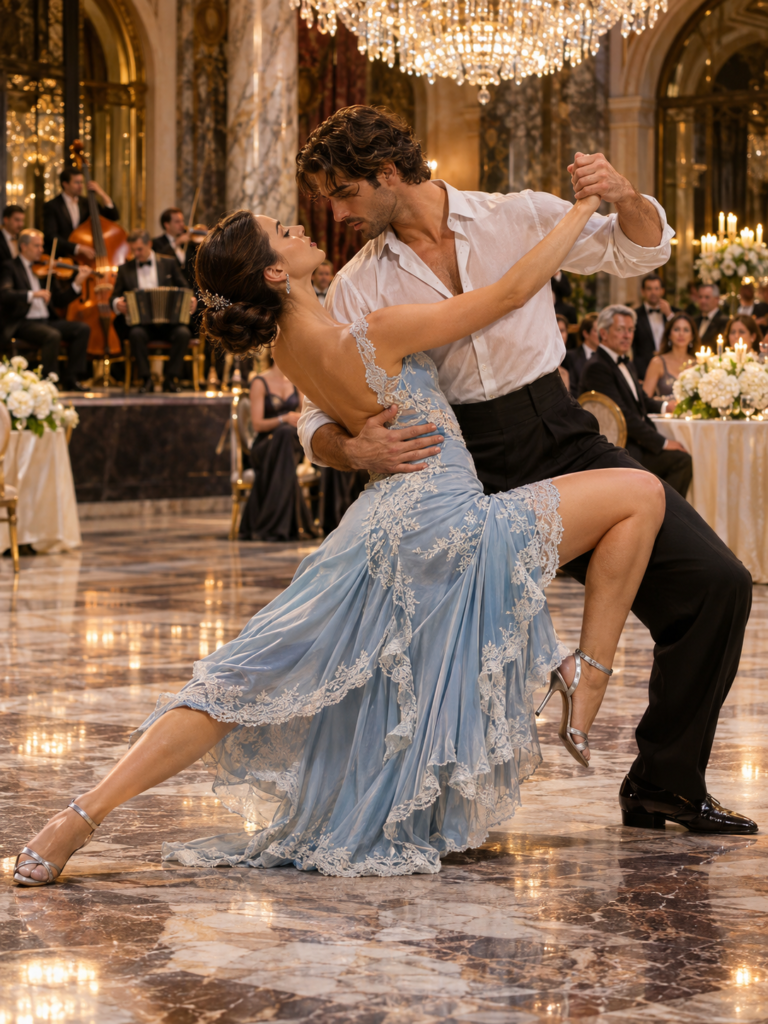
I followed the rhythm, moving smoothly across the floor. Lorenzo’s amused smile slowly faded.
When the music ended, the guests applauded. I stood still, trying to steady my emotions.
Then an older woman rose from her seat. It was Adelaida Valenti, Lorenzo’s mother. Her face had gone pale.
“Elena,” she whispered, “who taught you to dance like that?”
“My father.”
“What was his name?”
“David Ricci.”
Adelaida pressed a hand to her chest. Before she could say anything else, Lorenzo’s phone rang. He listened for a few seconds, then looked at his mother.
“We’ve just received information about David Ricci.”
I turned to him.
“What does that mean?”
Lorenzo hesitated.
“Elena, it appears your father is still alive.”
It felt as if the world had stopped.
At first, I refused to believe him. For fifteen years, I had imagined hearing my father’s voice again. I had revisited his smile in my memories and felt the ache of every birthday he had missed. Now a man I barely knew was telling me my life could change with a single sentence.
“I want to know where he is,” I said.
Adelaida stepped closer.
“Your father once worked with my husband, Vittorio. The two of them founded the company Lorenzo runs today.”
I stared at her in disbelief.
“My father was a dance teacher.”
“He was also a businessman. He helped build the commercial network that allowed the company to grow.”
Adelaida explained that after several years, the business partners began to argue over how the company should be run. David wanted to end their partnership, but Vittorio opposed him. Disputes followed over the company’s accounts and the ownership of its shares.
“And then my father disappeared?”
Adelaida lowered her eyes.
“I don’t know every detail. But I’m afraid I chose to ignore some things.”
Before I could respond, the doors to the ballroom opened. An older man entered, accompanied by a lawyer. He was thin, his hair was gray, and his steps were unsteady.
At first, I didn’t recognize him. Then he looked up.
I would have known those eyes anywhere.
“Elena?”
I could barely breathe.
“Dad?”
He opened his arms. I crossed the room and threw myself into them. For several long seconds, neither of us could speak.
“Forgive me,” he whispered. “I wish I’d come back much sooner.”
I held him tighter.
“Where were you?”
“I lived far away, trying to resolve a situation that cost me everything. I thought I was protecting you by staying away. I made mistakes I can never undo.”
His words didn’t answer all my questions. But my father was there. For that night, it was enough.
I took him straight to Chiara’s home. When my sister opened the door and recognized him, she froze. Then she rushed into his arms, crying.
We spent the rest of the night around the kitchen table. Dad told us about his old business partnership with Vittorio. They had started with a small warehouse, a handful of employees, and big plans.
David handled relationships with suppliers and customers. Vittorio managed the investments.
The company grew quickly, but their friendship slowly fell apart. When Dad asked to leave the business, documents appeared that seemed to accuse him of financial misconduct—something he always denied.
“I couldn’t defend my name anymore,” he explained. “I left to find help and rebuild my life. As the years went by, coming back became harder and harder.”
“But why didn’t you ever contact us?” Chiara asked.
Dad lowered his head.
“I was afraid of what might happen. I convinced myself—wrongly—that staying away was the best thing for you.”
He didn’t try to make himself sound like a hero. He admitted that he had hurt us. We couldn’t get those lost years back, but we decided to listen to one another without pretending every wound would heal at once.
Then Dad mentioned something he had kept before we were separated.
“Do you remember my record collection?”
Chiara nodded.
“Mom kept it. It’s still in the storage room.”
“Look for the old tango record with the red cover.”
We opened a box and found it. Hidden behind the sleeve was a yellowed envelope.
Inside were copies of a business agreement and a letter addressed to me.
The papers showed that Dad had helped found the company and owned a significant share of it. But the letter spoke of something far more valuable.
It reminded me that a person’s worth has nothing to do with their money, their name, or other people’s judgment. It ended with advice I recognized immediately:
“Never let anyone convince you that you don’t belong on the dance floor.”
I broke down in tears.
The next day, we contacted an independent lawyer. We weren’t looking for revenge or making promises we couldn’t keep. We wanted to understand what had really happened.
Lorenzo agreed to cooperate and allowed the company’s old records to be reviewed. Over the following weeks, several inconsistencies emerged in the documents used to change the ownership of the company. Some signatures were disputed, and several financial transactions needed further explanation.
Lorenzo also found old payments whose origins no one could immediately account for.
The review was long and difficult. In the end, with help from their respective lawyers, the parties reached an agreement recognizing my father’s role as a founder and providing financial compensation.
Lorenzo also had to face the consequences of decisions made by the company’s former leadership.
One afternoon, he called me into his office in the library.
“Elena, I owe you an apology.”
I stood in front of his desk.
“For what?”
“For the reception. I acted as if my money gave me the right to treat you like entertainment.”
I looked at him without answering.
“I didn’t know anything about your story,” he continued.
“You didn’t need to know my story to treat me with respect.”
Lorenzo nodded.
“You’re right. I can’t change what happened that night, but I can make sure I don’t repeat the same mistake.”
I accepted his apology, though I didn’t pretend everything was forgotten.
We never spoke about his marriage proposal again. I had never wanted to be his wife. I had only wanted to be treated with dignity.
With part of the compensation, my father decided to help me fulfill a dream we shared: reopening our old dance school.
The building had been closed for years. The windows needed repairs, the wooden floor was damaged, and the mirrors showed the marks of time. Still, when I stepped into the empty studio, I felt something I thought I had lost—the feeling of finally being home.
Chiara took charge of the administration. Her children helped us decorate, and Dad personally supervised the renovation, remembering every corner of the building.
We decided to offer classes to people of all ages and skill levels. No one would be embarrassed for missing a step. No one would feel inferior because they couldn’t afford elegant clothes. Dancing would be a way to bring people together, not a competition to measure anyone’s worth.
On opening day, the studio filled with families, students, and old friends. Dad stood near the window, watching the children move across the floor.
I went over to him.
“What are you thinking about?”
“Your mother. She would have loved seeing this place full of life again.”
I took his hand.
“I wish she were here.”
He pulled me close. We couldn’t get back the time we had lost, but we could still make new memories.
After the last guests left, Dad switched on the old record player. The familiar melody filled the room. Then he turned to me and held out his hand.
“May I have this dance, Elena?”
I smiled through my tears.
“Always, Dad.”
We began slowly: one step, a pause, a turn. His hands had grown older, and his movements weren’t as steady as they used to be. But I knew the way he guided me. It was the same man who had taught me to dance when I was little.
For a few moments, I didn’t think about the mansion, the documents, or the money. I thought only about how lucky I was to have him in my arms again.
When the music stopped, Dad kissed my forehead.
“I’m proud of you.”
“And I’m proud of you.”
Ever since that day, we’ve played the old record every Saturday morning. Sometimes we dance together. Other times, we teach children their first steps.
People still ask me whether Lorenzo Valenti kept his promise.
The answer is no. I didn’t marry him. I received no ring, and I never wanted to live in his grand estate. I gained something far more valuable to me: the chance to rebuild my relationship with my father and choose my own future.
That night, in front of a ballroom full of guests, a powerful man thought marrying him would be the greatest reward a woman like me could imagine.
He was wrong.
My happiness didn’t depend on his name, and my dignity had never been for sale.
Life had taken many years with my father away from me, but it couldn’t stop me from enjoying the years we still had. Now, when the music begins, I no longer think about the laughter at that reception. I look at my father, smile, and hold out my hand.
Our real victory wasn’t watching someone lose his fortune.
It was finding the joy of being together again.
And continuing to dance.