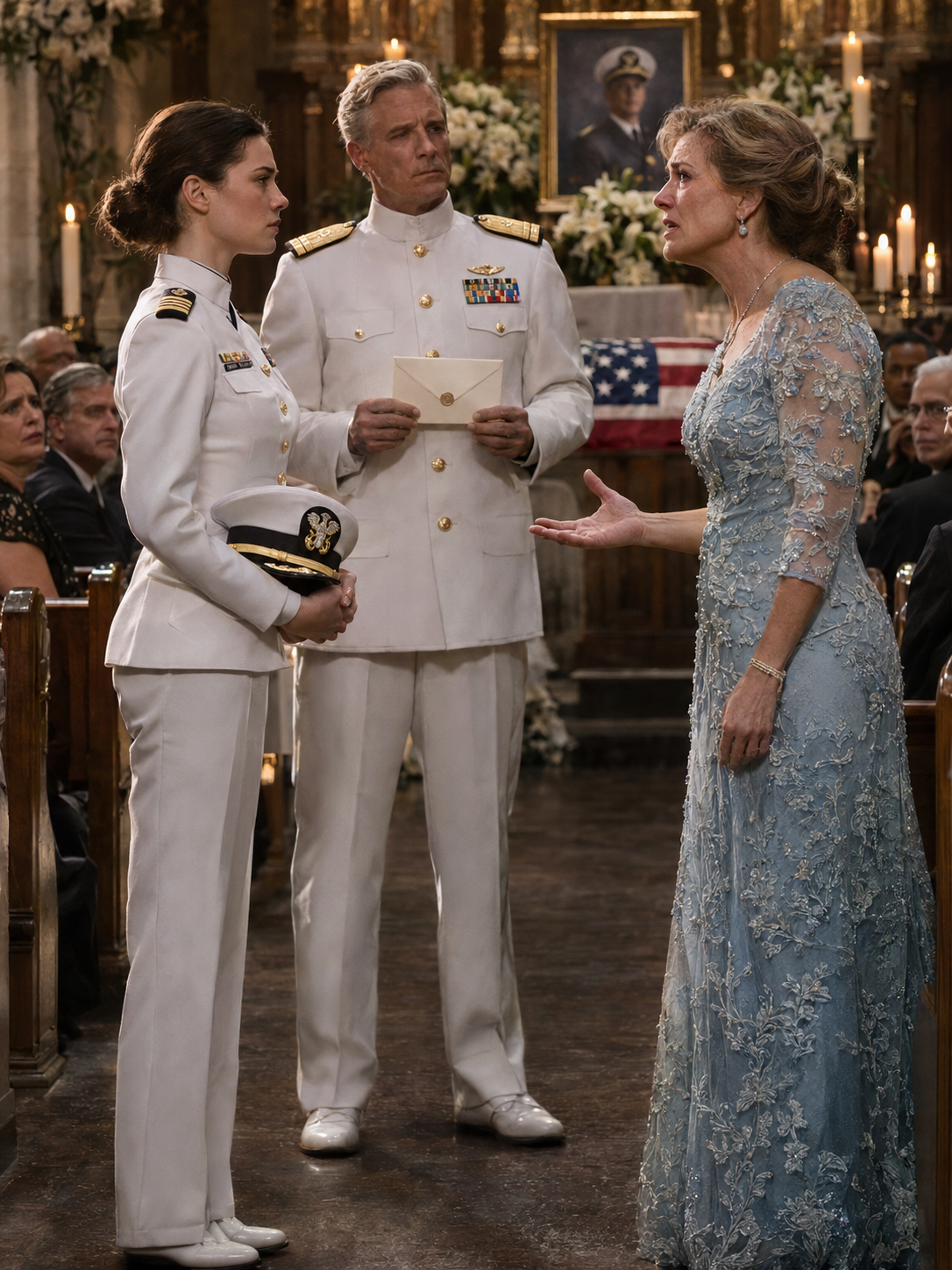
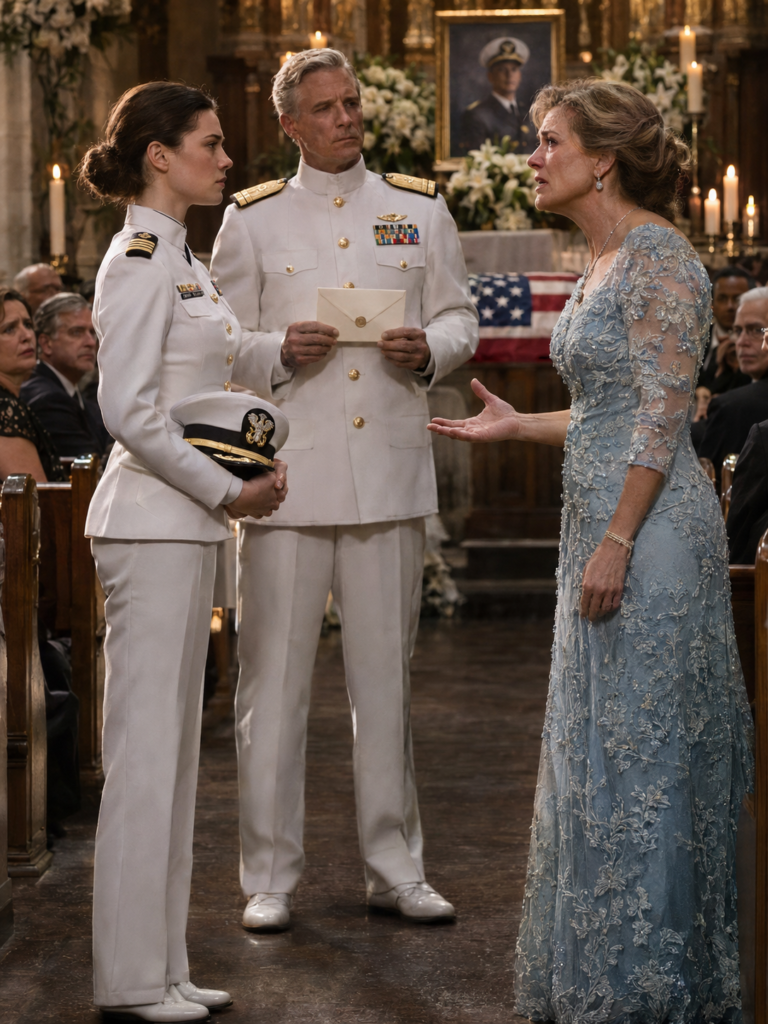
“Rachel, your father asked me to give you this letter. He also asked me to tell the truth if anyone ever lied about you again.”
Retired General Arthur held out an old envelope.
I was still standing in the church, dressed in my white Navy uniform, my eyes full of tears. Just minutes earlier, my mother, Helen, had humiliated me in front of everyone. Once again, she accused me of abandoning our family to pursue my military career.
For twelve years, she had told that story to our relatives, our neighbors, and even my sister, Chloe.
And now, at my father’s memorial service, she had demanded that I take off my uniform.
But Arthur knew the truth no one else had been willing to hear.
“This letter belongs to you, Rachel,” he said. “You can decide whether you want to read it in front of everyone.”
I looked at the envelope. On the back was a little anchor drawn in pen.
I recognized it immediately. It was just like the one I had drawn on my father’s palm the day I left for the Navy.
He had joked that he was going to get it tattooed. Mom had told him that at fifty-six, he ought to have a little more sense.
It was one of the last memories of the three of us laughing together.
I carefully opened the letter.
Rachel,
Yesterday, you asked whether I remembered the last words your mother said to you before you left.
I remember them perfectly.
She told you that if you got on that bus, you would have to fend for yourself for the rest of your life.
You were so young, holding your suitcase with both hands. I was the one who slipped your ticket into your coat pocket.
That night, when the neighbors asked where you were, your mother told them you had left without even saying goodbye to us.
I was there. I could have corrected her with one sentence.
But I stayed silent.
I stopped reading.
For twelve years, everyone had believed I left without caring about my family.
The truth was different.
My mother had asked me to give up my future. And when I chose to leave, she turned that decision into a betrayal.
“Rachel,” Helen interrupted, “we can talk about this at home.”
Before I could answer, Chloe stepped forward.
“What part do you want to talk about at home, Mom? The bus or the funeral?”
Mom stared at her, taken aback.
Then Arthur revealed another truth.
When my father died, I was in a military hospital in Germany. I had been badly injured in an accident while on duty, and I was still unconscious.
Arthur had been authorized to update my family about my condition. He wrote to Helen and explained why I couldn’t attend the funeral. He even offered to help arrange a trip to Germany as soon as visits were allowed.
“Your mother wrote back that she understood,” Arthur said.
Then he looked at Helen.
“But at the funeral, I heard you tell Chloe that Rachel had chosen to stay on base.”
My sister covered her mouth with one hand.
“Mom… you told me Rachel didn’t want to come.”
Helen lowered her eyes.
Chloe turned to me.
“I wrote that I would never forgive you.”
I nodded. I remembered that message clearly. I read it when I woke up in the hospital. My hands were shaking so badly I had to hold my phone with both of them.
I tried to answer three times.
Then I gave up.
“I read your message when I woke up,” I told her.
Chloe’s eyes filled with tears.
“I should have called you.”
I took her hand.
“I wish you had.”
I picked up my father’s letter again.
For years, I called you every Sunday night. You told me about your days in the service, and I told you about my garden. It was enough to know that things were all right between us.
But all that time, I let your sister and the whole town believe a story that hurt you. I chose peace over courage. And I’m ashamed of that.
Tears rolled down my cheeks.
Dad hadn’t been a perfect man. He had made mistakes. But before he died, at least he found the courage to admit them.
I kept reading.
When the day of my memorial comes, if you feel up to it, wear your uniform. The first time I saw you in it, I had prepared a whole speech. Then you turned to me and asked whether your collar was straight. I was so overwhelmed that all I could manage was, “Yes.”
And for the record, your collar looked perfect.
I laughed through my tears. A few people in the pews smiled.
I looked at my mother. She was sitting in the front row, slowly taking off her gloves.
For the first time that morning, she didn’t look like she was searching for an excuse.
“I wanted you to stay, Rachel,” she said quietly. “Your father was already beginning to have health problems. I was afraid I’d have to face everything alone.”
She paused.
“When you left, it was easier to tell everyone you had abandoned us than to admit I’d asked you to give up your dreams.”
I looked at her.
“And at the funeral?”
Helen lowered her head.
“That was when I should have admitted I’d been lying for twelve years.”
I stayed silent.
It had taken my mother only a few seconds to say the truth. It had cost me twelve years of distance from my family before I could hear it.
Chloe took the microphone from the lectern and handed it to Helen. Mom held it for a moment before switching it on.
Her voice echoed through the church.
“Rachel wanted to attend her father’s funeral, but she was in a hospital in Germany. I knew that.”
A deep silence fell over the room.
Mom continued.
“And when she left for the Navy, she didn’t abandon us. She said goodbye to both of us. Her father even carried her suitcase to the bus.”
I closed my eyes.
I remembered that moment. Dad took the suitcase from my hands and said he wanted one last chance to do something for his daughter before the Navy taught me to do everything on my own.
I laughed.
Then I climbed aboard the bus.
I never imagined I would spend the next twelve years defending myself against a story someone had made up.
When it was my turn to speak, I folded the letter and slipped it into the inside pocket of my jacket. I had prepared a formal speech, but I decided to tell them something else.
“When I was sixteen, Dad woke me up at six in the morning to teach me how to change a tire.”
A few people smiled.
“By the end of the lesson, the spare tire was on. And he was still wearing his pajamas.”
I laughed softly.
“Mom came into the garage with coffee, furious because we’d left the door open and the cat had climbed onto the hood of the car.”
From the front row, Helen corrected me.
“The roof.”
I turned around.
“What?”
“The cat climbed onto the roof of the car. Your father had to get a ladder to bring it down.”
For a moment, we just looked at each other.
Then we both burst out laughing.
The laughter spread through the guests. Finally, in that church, we were able to remember Dad without talking about guilt, lies, or uniforms.
We talked about the man who loved his garden. The man who made ridiculous jokes. The man who cared about the collar on my uniform. And the man who, too late but sincerely, had tried to make up for the times he stayed silent.
After the service, Chloe joined me outside.
“Can I come with you to the cemetery?”
I nodded.
A little farther away, our mother was waiting beside her car, twisting her gloves in her hands.
“Rachel, I’m making pancakes tomorrow morning,” she said. “If you’d like to come by…”
“I have to leave early tomorrow.”
Her face fell. But before she could turn away, I added, “I do have time for coffee tonight.”
Mom looked up.
“I’d like that.”
It wasn’t complete forgiveness. It couldn’t be.
But maybe it was the beginning of a conversation we should have had many years earlier.
At the cemetery, Chloe stayed a few steps behind as I approached the grave. Beneath Dad’s name were his rank and years of service.
I slowly ran my fingers over the letters.
Then I took out his final letter and read it again.
That was when I noticed a short line beneath his signature. I hadn’t seen it during the service. It was written in his slightly slanted handwriting:
“If you feel like crying, at least wait until I’ve finished telling you how proud I am of you. It may take a while.”
I covered my mouth and smiled through my tears.
“Dad…”
I couldn’t say anything else.
I sat down in the grass, still wearing my buttoned uniform jacket. Chloe came over and sat beside me.
For a long time, we stayed quiet.
Then I started telling her about all those Sundays when Dad called: his garden, his jokes, and how proud he was whenever I took on new responsibilities.
Chloe listened. Every so often, she asked a question.
And I kept talking.
For twelve years, I had waited for someone in my family to hear my side of the story. That afternoon, I no longer had to defend my name. At last, I could talk about the life I had lived and the father I had loved.
I looked at his headstone once more.
I had worn my uniform for him, just as he had asked. And through that letter, Dad had left me something more precious than any medal:
the truth.
Chloe rested her head on my shoulder. The sun was beginning to sink behind the trees, but neither of us was in a hurry.
After twelve years of silence, we finally had all the time we needed to listen to each other.
THE END. ❤️