Emily Lawson had imagined her graduation day a hundred different ways.
In some versions, her mother sat in the front row with a bouquet of yellow roses. In others, her father was the one cheering too loudly when she crossed the stage. But in every version, the seats beside her were full.
In real life, they were empty.
Her parents had died in a winter highway accident when Emily was ten. Afterward, her grandmother raised her in a small house on the edge of town. She worked hard, loved Emily fiercely, and never let her feel alone. But she had passed away during Emily’s second year of college, and since then Emily had learned to carry her grief quietly.
She studied between shifts at the campus library. She took extra work on weekends and kept a photograph of her parents tucked inside her desk drawer. The day she received her graduation gown, she laid it across her bed and whispered, “I wish you could see this.”
On graduation morning, Emily arrived early and chose a seat near the aisle. She watched families fill the auditorium with flowers, cameras, and happy noise. Parents fixed their children’s collars. Grandparents waved from the balcony. Someone’s little brother ran down the aisle until his mother caught him.
Emily smiled at them, then looked down at her hands.
A blonde graduate in the row behind her leaned toward a friend. She had been making jokes about Emily’s thrift-store shoes all morning. Now she glanced at the empty seats beside Emily and laughed.
“Your parents are dead,” she said loudly. “No one came.”
A few people turned. Emily’s face burned. She tried to look toward the stage, but tears blurred the lights.
The ceremony began.
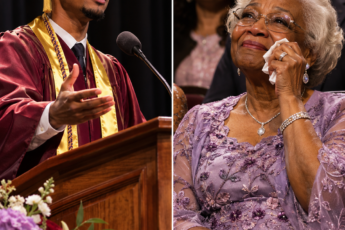
When Emily’s name was called, she stood, wiped her cheeks, and walked across the stage. The dean handed her diploma and offered a warm smile. Emily held the folder against her chest.
“Mom, Dad,” she whispered, “I wish you were here.”
For a moment, the auditorium was quiet.
Then a man stood in the back.
He was broad-shouldered, gray-bearded, and dressed in a black leather vest. A small silver lantern was stitched over his heart. He clapped once, loudly, then again.
“That’s our girl, Emily!” he called. “You earned this. Stand tall!”
A row of people in matching leather vests rose with him. They were older men and women, some with gray hair, some with tattoos, all applauding as if Emily had just won the greatest prize in the world.
The applause spread through the auditorium. Emily turned toward them, stunned. The blonde graduate stopped smiling.
The bearded man stepped into the aisle. He didn’t rush the stage or draw attention to himself. He simply waited until the applause settled, then held up a sealed manila envelope.
“We came for more than graduation,” he said. “There’s something you need to know.”
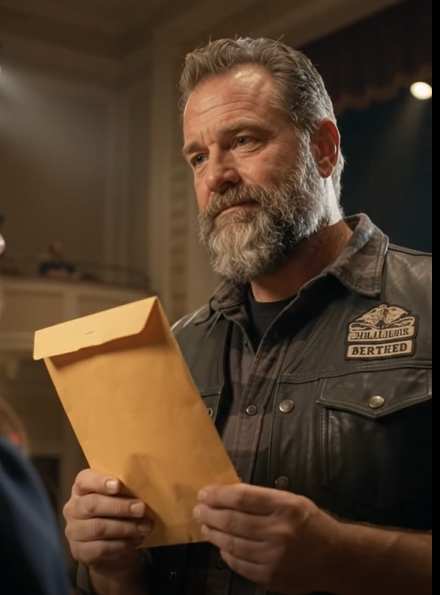
After the ceremony, Emily found him outside the auditorium beneath a row of flowering trees. The other bikers stood nearby, giving them room.
“I’m Marcus,” he said. “I knew your parents.”
Emily stared at the envelope. “How?”
“Your father, Daniel, rode with our club before you were born. Your mother, Claire, used to bring him lunch at the garage and tell us all we were eating too much junk.” Marcus smiled faintly. “She was usually right.”
Emily’s eyes filled again. “Why didn’t I know any of you?”
“Because your parents wanted you to have a quiet childhood. After the accident, your grandmother asked us to give your family space. We respected that. But your parents left instructions with me.” He tapped the envelope gently. “They asked me to give you this on your graduation day.”
Emily’s hands trembled as she opened it.
Inside was a photograph of her parents standing beside a motorcycle. Her father held toddler Emily in his arms; her mother was laughing, one hand resting on his shoulder. On the back, in her mother’s handwriting, were the words: For the day she discovers how many people love her.
There was also a letter.
Emily unfolded it carefully.
My dearest Emily,
If you’re reading this, you’ve reached a day we used to dream about. I hope you know that your mother and I are proud of you—not only for graduating, but for every hard day you kept going.
The people who bring this letter are your family, too. They promised to look out for you if we ever couldn’t. Let them. You don’t have to do everything alone.
Love, always,
Dad
Emily pressed the letter to her chest.
Marcus waited until she could speak. “There’s one more thing. Your parents started a fund for students who have lost family and are trying to finish school. They never had much money, but the club kept it going. We’ve added to it over the years.”
He handed her a second paper from the envelope. It was an award letter: Emily had been selected to receive the fund’s first graduate fellowship. It would cover her tuition for a master’s program in social work.
Emily looked up at him, astonished. “You chose me?”
“We didn’t choose you because you’re Daniel and Claire’s daughter,” Marcus said. “We chose you because you kept showing up, even when life made it hard. Your parents would’ve recognized that.”
Behind him, one of the bikers held out a bouquet of yellow roses. Emily took it, laughing through her tears.
Then Marcus reached into his jacket again and pulled out a small brass key.
“Your dad’s old workshop is still standing,” he said. “We’ve kept it in good shape. Your mother used to say it should become a place where young people could learn a trade, get help with school, or just find someone willing to listen. We thought you might want to help us make that real.”
Emily looked from the key to the faces around her. These people had been part of her parents’ lives, and somehow, even from a distance, they had kept their promise.
She closed her fingers around the key.
The blonde graduate passed nearby on her way out. She glanced toward Emily and the crowd around her, then lowered her eyes and kept walking.
Emily didn’t watch her go.
She looked at the empty seats she had imagined filling with her parents, and for the first time that day, they didn’t feel empty. Their friends stood beside her. Their words were in her hands. Their love had traveled farther than she had known.
A week later, Emily opened the workshop doors for the first time. The bikers had cleaned it, painted the walls, and set a long wooden table beneath the windows. On the wall, they had hung her parents’ photograph.
Emily placed her diploma beside it.
Then she turned the key in the lock and stepped inside—not as a girl waiting for someone to come for her, but as a woman ready to welcome others.
And on the door, she hung a simple sign:
Come in. You belong here.