My fifteen-year-old daughter kept telling me that her stomach hurt and that every day she felt weaker than the last. My husband, however, was convinced it was nothing more than stress or an attempt to get attention.
“It’ll go away on its own,” he insisted. “There’s no point wasting money on doctors and tests.”
But deep inside, I couldn’t shake the feeling that something was seriously wrong.
As the weeks passed, I watched Maya slowly change before my eyes. The energetic teenager who loved playing soccer until sunset, laughing with her friends, and taking pictures of colorful evening skies was fading away.
She came home from school and went straight to bed.
She barely touched her food.
Her face grew paler with each passing day.
Every time I tried to talk to my husband about it, he brushed my concerns aside.
“She’s overwhelmed with school. The more attention you give it, the more she’ll convince herself she’s sick.”
But my instincts told me otherwise.
One night, around two in the morning, I woke to the sound of a faint cry coming from Maya’s bedroom.
I rushed down the hallway.
She was curled into a ball on her bed, both arms wrapped tightly around her stomach.
Tears streamed down her face.
“Mom… please… help me.”
Hearing those words shattered me.
At that moment, I knew waiting any longer was no longer an option.
The next afternoon, I picked her up from school and drove straight to Riverside Medical Center without telling my husband.
The entire drive was quiet.
Maya stared silently out the window while I tried to stay calm.
At the hospital, the nurses checked her vital signs before the doctor ordered blood work and an abdominal ultrasound.
While we waited for the results, my phone buzzed.
It was my husband.
“Where are you?”
I didn’t answer.
At that moment, nothing mattered except staying beside my daughter.
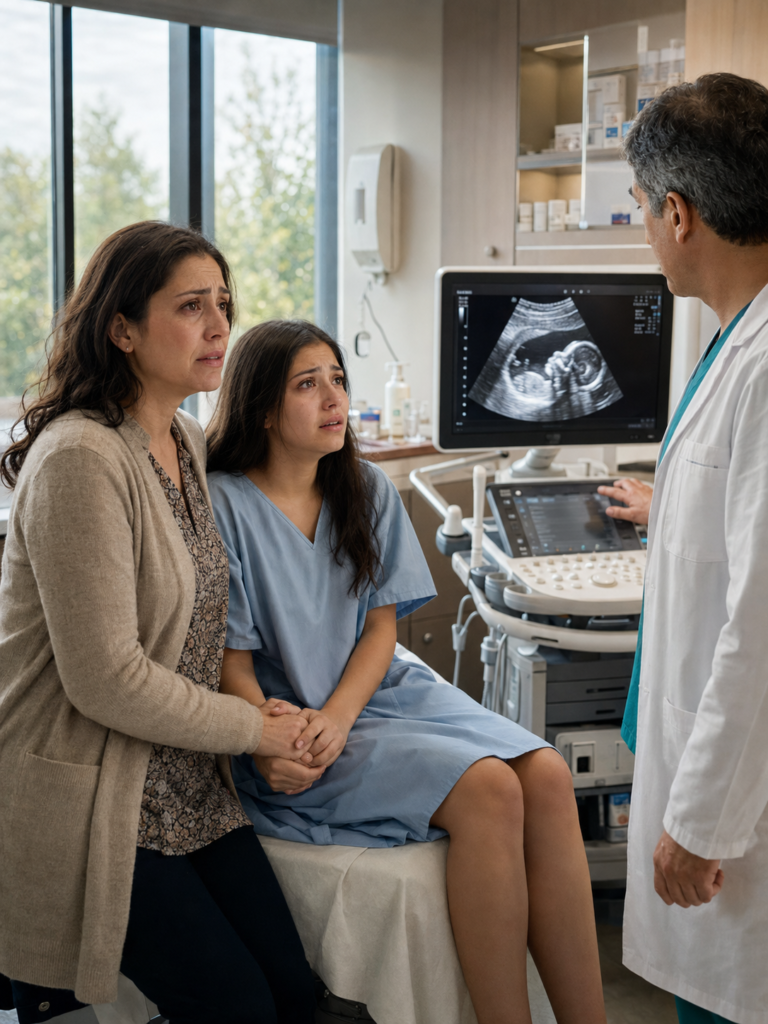
During the ultrasound, I noticed the technician becoming unusually quiet.
He studied the monitor carefully, captured several additional images, then excused himself, saying the physician would be with us shortly.
When Dr. Lawson entered the room, the expression on his face immediately told me something required further investigation.
“Mrs. Thorne,” he said gently, “I’d like to discuss Maya’s initial results.”
Maya looked at him nervously.
“Is everything okay?”
The doctor turned the monitor slightly toward us.
“The scans have revealed an abnormal finding that requires additional testing. Before we can make a diagnosis, we need more information to understand exactly what we’re seeing.”
The room became completely silent.
I squeezed Maya’s hand as tightly as I could.
A few moments later, Dr. Lawson continued.
“The imaging shows a mass in her abdomen. We can’t say exactly what it is yet, but the encouraging news is that we’ve found it early enough to move quickly.”
Only two words stayed with me.
Early enough.
Maya looked directly at him.
“Am I going to get better?” she asked softly.
He smiled reassuringly.
“We’re going to do everything possible to help you recover. We now have a treatment plan, and you’ll have an entire medical team with you every step of the way.”
The following days were filled with additional scans, blood tests, and appointments with specialists.
Gradually, the answers became clearer.
A personalized treatment plan was put in place.
The road ahead wouldn’t be easy.
But we were no longer facing it alone.
When Robert finally arrived at the hospital and saw Maya lying in her room, he stood motionless for several seconds.
Then he lowered his head.
“I’m sorry,” he whispered. “I should have listened to both of you.”
Maya didn’t answer right away.
After a long pause, she gave him a small smile.
It couldn’t erase everything that had happened.
But it opened the door to forgiveness.
Over the months that followed, the treatments began producing encouraging results.
Maya slowly regained her appetite.
Her strength returned.
Before long, the bright smile that had disappeared finally came back.
One warm spring afternoon, I watched her grab her soccer ball and run across the backyard just as she used to.
As I listened to her laughing with her friends, I realized something I will never forget.
Children often understand their own bodies better than we realize.
When they repeatedly tell us something is wrong, they deserve to be taken seriously.
Listening carefully, seeking medical advice, and acting without delay can change everything.
As Maya and I walked home together that afternoon, I understood that courage isn’t the absence of fear.
Real courage is choosing to act out of love, even when everyone else doubts you.
Every time I see my daughter’s smile today, I’m grateful I trusted my instincts instead of waiting.
Sometimes the greatest way to protect the people we love is simply to believe them when they ask for help.