The grand ballroom looked like something from another world.
Golden mirrors reflected the glow of hundreds of candles, crystal chandeliers illuminated the elegant guests, and a live orchestra filled the room with soft music.
That evening, the Beaumont family had invited dozens of distinguished guests to their magnificent estate. The family was known for its wealth, influence, and long history.
No one expected the most important person of the night to arrive wearing worn-out clothes and dusty bare feet.
The boy looked about twelve years old.
His shirt was torn, his suspenders were faded, and his trousers were far too short. He walked slowly through the crowded ballroom, looking around as though he were searching for someone.
One by one, conversations stopped.
A security guard approached him.
“Who are you looking for?”
The boy lowered his eyes.
“My family.”
The guard looked confused.
“Your family is here?”
“I was told to come here,” the boy replied. “My mother told me.”
The guard asked where his mother was.
The boy hesitated.
“She disappeared when I was very young.”
The guards decided to escort him outside.
But before they could do so, a young woman spoke from near the staircase.
“Please, let him stay.”
Everyone turned.
Seventeen-year-old Eleanor Beaumont was sitting in a wheelchair. Several years earlier, an accident had changed her life, but she had remained one of the strongest members of the family.
She was staring at the boy with an expression none of the guests could understand.
“Let him explain why he came,” she said.
The boy reached beneath his worn shirt and pulled out a small golden pendant.
An unusual symbol was engraved on it.
A flower surrounded by a crown.
Several members of the Beaumont family immediately recognized the emblem.
Then an elderly woman slowly rose from her seat.
It was Isabelle Beaumont, the family matriarch.
For decades, she had been known as a formidable woman who rarely showed emotion.
But the moment she saw the pendant, her hands began to tremble.
“Where did you get that?”
“My mother gave it to me.”
“What was her name?”
The boy looked at her.
“Clara.”
Isabelle froze.
That name had not been spoken in the family for years.
Clara Beaumont had been her daughter.
Twelve years earlier, Clara had disappeared, and the family had eventually assumed that she was gone forever.
Isabelle approached the boy.
“What is your name?”
“Gabriel Morel.”
She stared at him for several seconds.
Then she noticed markings on the back of the pendant—an old date and a pair of initials that matched symbols preserved among the family’s belongings.
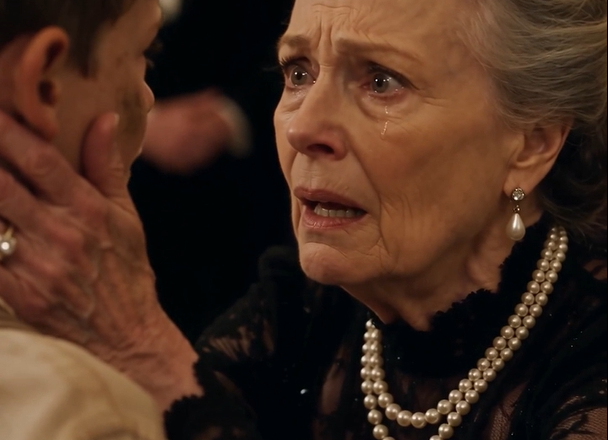
Her eyes filled with tears.
“How old were you when your mother disappeared?”
“Four.”
Isabelle covered her mouth.
She looked at Gabriel again.
His eyes reminded her of Clara.
“Do you know anything about your father?”
Gabriel shook his head.
“My mother never talked about him.”
The boy explained that he and Clara had lived far from the city in a small community. After his mother disappeared from his life, he had spent years struggling on his own.
Isabelle finally understood what the pendant meant.
She pulled Gabriel into her arms.
“You’re my grandson.”
The ballroom fell completely silent.
But Eleanor still looked troubled.
She slowly approached Gabriel.
“I think I know why you were brought here.”
Gabriel looked at her.
“Why?”
Eleanor turned toward Isabelle.
“Because Mom wanted him to find you.”
Isabelle stared at her granddaughter.
“What are you saying?”
Eleanor took a breath.
“I don’t think Clara is dead.”
The room went silent again.
Isabelle could barely believe it.
“We searched for her for years.”
“I know,” Eleanor said. “But recently, I received something.”
She took an old envelope from her dress.
Inside was a photograph.
It showed Clara holding a little boy.
Gabriel.
Written on the back was a short message explaining that, when the boy was old enough to understand his past, he should be brought to his grandmother.
Isabelle began to cry.
“Why didn’t she come home?”
“Because she was afraid.”
“Afraid of what?”
Eleanor explained what she had learned.
Years earlier, Clara had fallen in love with a man who worked at the Beaumont estate. Her family strongly opposed the relationship because of their different social backgrounds.
When Clara discovered that people close to the family intended to separate her from her child, she chose to leave rather than risk losing him.
She took Gabriel away and spent years keeping their lives private.
Before her health deteriorated, Clara gave her son the pendant and told him that one day it would help him find his family.
Gabriel wiped away his tears.
“She always told me that someday I’d know where I belonged.”
Isabelle held the pendant tightly.
“And now you do.”
But another secret was about to come to light.
An elderly household employee stepped forward from the back of the room.
He had worked for the Beaumont family for decades.
In his hands was a small wooden box.
“Madam,” he said quietly, “there is something you need to see.”
Inside the box were dozens of letters.
Every one had been written by Clara.
She had tried to contact her mother for years.
But the letters had never reached Isabelle.
Someone had deliberately kept them hidden.
Isabelle looked around the room.
Then she saw her own brother standing near the window.
He lowered his head.
He had intercepted the letters because he feared Clara’s return would affect the family’s future and inheritance.
Isabelle walked toward him.
“You knew.”
The man could barely look at her.
“I thought I was protecting the family.”
Isabelle shook her head.
“A family cannot be protected by hiding the truth.”
Then she returned to Gabriel.
“I’m sorry.”
Gabriel quietly answered:
“You didn’t make these choices.”
Before anyone could say another word, a weak voice came from the entrance.
“Gabriel…”
He turned.
A thin woman stood in the doorway wearing a simple coat.
Her hair had begun to turn gray, and years of hardship were visible on her face.
But Gabriel recognized her immediately.
“Mom?”
The woman began to cry.
“My little boy…”
Gabriel ran toward her.
Mother and son embraced in the middle of the ballroom.
The orchestra had stopped.
Nobody spoke.
After twelve years of separation, Clara and Gabriel were finally together again.
Isabelle watched them through tears.
Then Clara noticed Eleanor.
She walked toward the young woman and gently took her hands.
“You’ve grown so much.”
Eleanor smiled.
“I wish I’d known you sooner.”
Clara smiled back.
“Then we’ll simply have to make new memories.”
The reunion changed the Beaumont family forever.
A few weeks later, Gabriel moved into the estate, but he refused to live as though wealth made him more important than anyone else.
He made one request to his grandmother.
“I don’t want another child to experience what I did.”
Isabelle understood.
Part of the estate was transformed into a support center for children who had nowhere safe to go.
Gabriel became deeply involved in the project.
Years later, he became a doctor and dedicated his career to helping children in difficult circumstances.
Eleanor also found a new purpose. She created an organization focused on supporting people living with disabilities.
And Isabelle changed too.
She no longer cared about displaying her wealth.
She kept only one treasured object close to her—the old pendant that had brought Gabriel back into her life.
Years later, Gabriel asked her why his mother had chosen that particular pendant.
Isabelle smiled.
“She probably knew that someone would recognize its meaning.”
Gabriel turned it over.
For the first time, he noticed a tiny inscription on the back.
“What does it say?”
Isabelle read it quietly.
It carried a simple message: true inheritance is not measured by what we own, but by the people we refuse to abandon.
Gabriel looked at the pendant.
He finally understood.
It had never been about finding a wealthy family.
It had been about finding the people he had lost—and discovering that family could still choose love after years of mistakes.
That night, Gabriel no longer felt like a forgotten child searching for a place in the world.
For the first time, he knew exactly where he belonged.
He was home.