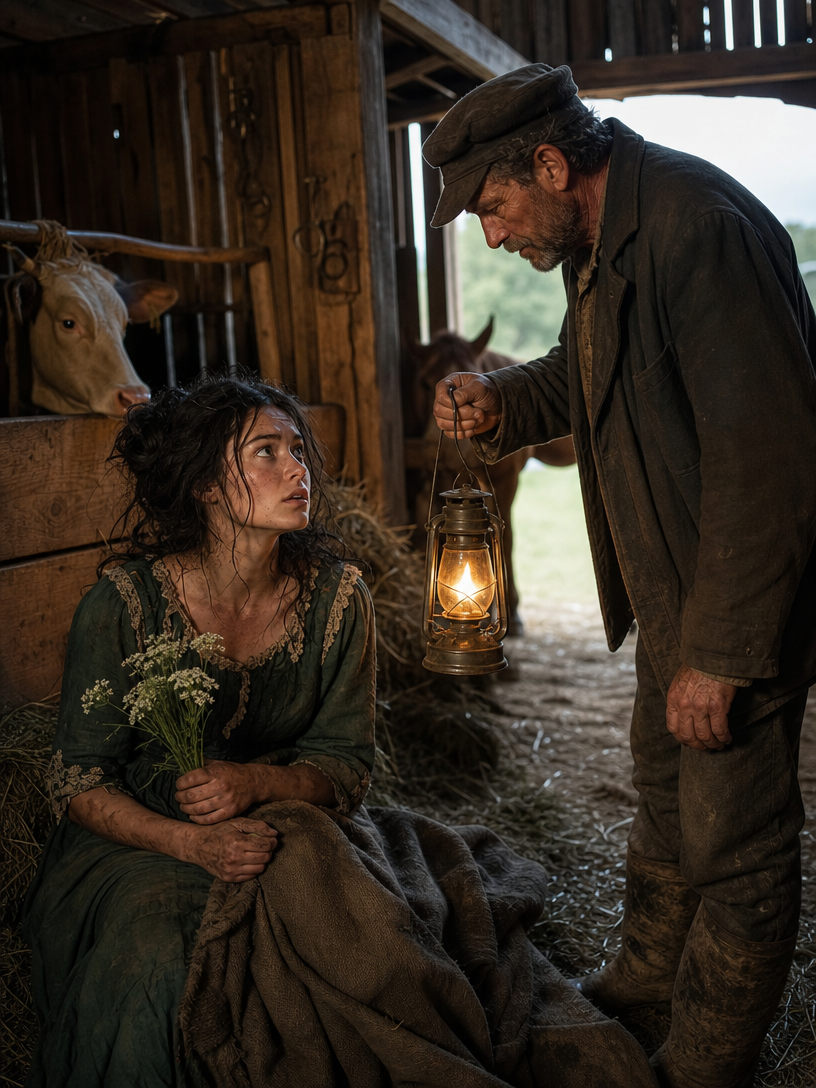
The first thing Jed Hayes noticed through the wall of swirling snow was the dress.
At least, it had once been a wedding dress.
Now the hem was stained brown with mud, the frozen fabric cracked with every movement, and torn lace hung from the sleeves like shredded ribbon. Weak, trembling fists struck the barn door—not loudly enough to be a proper knock, yet too desperate to be mistaken for the wind.
The Montana storm had erased almost everything beyond the barn. Fences, trees, and even parts of the corral had disappeared beneath sheets of white. Bitter gusts forced their way through every crack in the weathered wood, carrying the scent of hay, livestock, and something far more troubling.
Illness.
Jed instinctively reached for his revolver before lifting the lantern higher.
Life in the mountains taught hard lessons. A stranger appearing during a blizzard could be a traveler in need—or the beginning of a nightmare. For five years he had survived alone on that isolated ranch. Long enough to learn that kindness without caution often came at a terrible price.
Then the woman’s eyes fluttered open.
Hazel.
Terrified.
Human.
He lowered the weapon immediately.
Lifting her from the frozen doorstep, he carried her inside. She felt frighteningly light. Her head fell against his shoulder while icy water soaked through his coat from the ruined dress.
Behind them, the cattle shifted restlessly.
Thirty animals.
Every one of them represented years of sacrifice.
Years of labor.
Years of fighting weather, debt, and bad luck.
Now several of his strongest steers could barely remain standing. Foam gathered around their mouths while their bodies trembled under the lantern’s glow.
Winter always demanded payment.
But this wasn’t winter’s work.
Something else was happening.
Jed carried the stranger into the tack room and set several wool blankets beside her.
“Get out of those clothes,” he said, turning away. “The cold will finish you if the storm doesn’t.”
Her fingers shook uncontrollably as she struggled with the frozen laces. Jed fixed his attention on the saddles hanging nearby, refusing to look. Fear deserved respect, not exploitation.
Several minutes later she emerged wrapped tightly in wool.
Only then did he notice the dark bruises circling both wrists.
Not the kind left by a fall.
The kind left by another person.
She noticed his stare and tightened the blanket around herself.
“My name is Abigail Thornton,” she said quietly. “And I escaped from a living nightmare.”
The story unfolded in fragments.
Gideon Reed—the wealthiest ranch owner in the valley—held enormous leverage over her father through unpaid debts. Eventually he stopped asking for repayment.
Instead, he demanded Abigail.
Not as compensation.
As a bride.
She had been standing in her wedding gown when she overheard him boasting to his associates.
He wasn’t just acquiring a wife.
He was collecting property.
Independent ranchers were easy prey, Reed claimed. One difficult season, one financial setback, and their land could be purchased for pennies.
Then he mentioned another target.
A ranch high in the mountains.
A stubborn rancher living alone.
A man whose herd would soon be wiped out.
Once the cattle were gone, the land would follow.
Jed’s expression hardened.
Silence filled the room.
Even the storm seemed to pause.
Then a steer groaned painfully from the other side of the wall.
Abigail turned toward the sound.
Something changed in her eyes.
The fear remained.
But determination appeared beside it.
She pulled the blanket tighter around her shoulders.
“Take me to the feed,” she said.
“You should be resting.”
“I spent years studying veterinary medicine with my grandfather,” she replied sharply. “Show me what they’ve been eating.”
Jed hesitated.
A woman who had nearly frozen to death shouldn’t be inspecting livestock in the middle of a blizzard.
And a rancher watching his livelihood disappear couldn’t afford false hope.
Yet there was something about the way she looked at the animals.
She wasn’t searching for sympathy.
She was searching for answers.
So he led her to the hay storage.
Lantern light flickered across floating dust particles.
Abigail buried both hands deep into the feed and began examining it carefully.
One handful.
Then another.
Then another.
Suddenly she froze.
Slowly, she pulled a pale, unfamiliar plant from the hay.
The color drained from her face.
Jed leaned closer.
He understood immediately that she had found something important.
Abigail stared at the stalk beneath the lantern.
Her voice dropped to a whisper.
“This isn’t a disease,” she said.
“It’s…”