The morning Bruno began acting strangely, I thought something was seriously wrong with him.
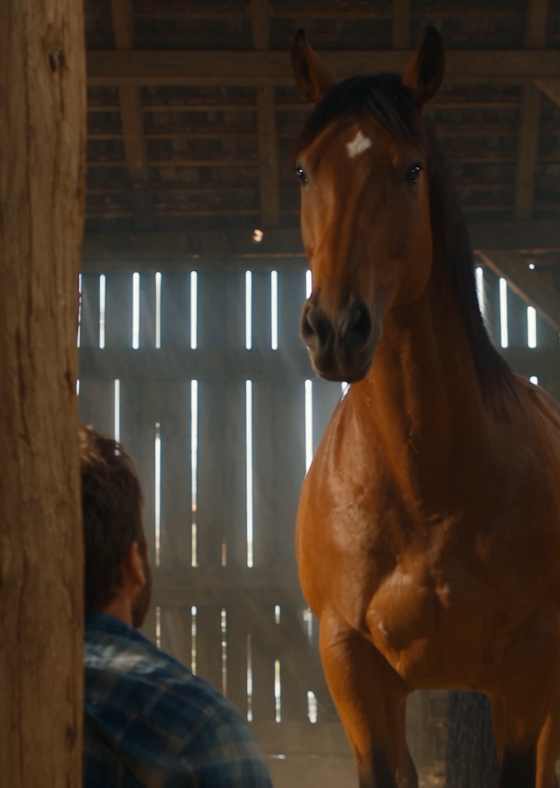
I had walked into the barn carrying a fresh bucket of water when the large brown horse suddenly became restless.
He backed away, tossed his head and let out a sharp neigh.
“Easy, Bruno.”
Normally, he was one of the calmest horses on the farm.
That morning was different.
He kept positioning himself between me and the northern side of the barn, then turning toward an old section we had barely used in years.
At first, I assumed he had heard an animal behind the wall.
Then Bruno walked toward a pile of old straw and began pawing at the floor.
“What’s over there?”
He looked back at me.
I know how ridiculous that sounds.
I’ve spent most of my life around horses, and I don’t believe they communicate in some magical language.
But Bruno clearly wanted my attention.
So I followed him.
Underneath the straw, something metallic caught the light.
I crouched.
It was a ring attached to the wooden floor.
I had lived on that property for more than fifty years.
I had never seen it before.
After clearing away the remaining straw, I discovered the outline of a small hatch.
My heart began beating faster.
The northern part of the barn had belonged mostly to my father, Henry.
After he died eighteen years earlier, I had never completely cleared it out.
Too many memories lived there.
I pulled the ring.
The wooden panel lifted with a long creak.
Beneath it was a narrow staircase disappearing into darkness.
I stared at Bruno.
He calmly stepped backward.
“Of course,” I muttered. “You find the mystery and I have to go down there.”
My name is Thomas Bennett.
The Bennett farm had been in my family for four generations.
My grandfather started with cattle.
My father gradually transformed much of the property into a horse ranch.
And eventually, it became mine.
For most of my life, I assumed it would remain that way.
Then my wife Sarah became ill.
After losing her, I struggled to keep everything together.
Expenses accumulated.
Two difficult farming seasons followed.
The farm began losing money.
Eventually, I received the kind of letters nobody wants to open.
I was running out of time.
My daughter Emily knew things were difficult, but she didn’t know how difficult.
She was twenty-seven and living several hours away with her husband.
Every Sunday she called.
“How’s the farm, Dad?”
And every Sunday I gave her the same answer.
“Still standing.”
Technically, that wasn’t a lie.
I simply didn’t tell her how close we were to losing it.
A property developer had already made an offer.
The money would have solved most of my immediate problems.
There was only one strange complication.
Years earlier, shortly before he died, my father had made me promise never to sell the northern field.
He never properly explained why.
For years I treated the promise as sentimental.
But sentiment doesn’t pay bills.
That morning, I had finally decided to consider the offer seriously.
Then Bruno led me to the hatch.
I found a flashlight and descended the stairs.
At the bottom was a room.
Not exactly a basement.
More like an old workshop.
Dust covered a wooden table, shelves, tools and several boxes.
Then my flashlight landed on a photograph hanging from the wall.
My father.
He was much younger, standing proudly beside a horse.
I removed the photograph.
There was a message written on the back.
“For Thomas. When you’re ready.”
I stared at those words.
My father had been gone for eighteen years.
Yet suddenly it felt as though he had been waiting for me.
I searched the workbench.
Inside one drawer was an envelope.
My name was written across the front.
I sat down before opening it.
The letter began with a joke.
My father wrote that if I had discovered the room without his help, one of the horses had probably done a better job of guiding me than he ever had.
I laughed despite myself.
That sounded exactly like him.
Then the letter became serious.
He reminded me that our farm had survived bad seasons, financial problems and several generations of stubborn Bennetts.
But he also wrote something I desperately needed to hear.
The farm was important.
My life was more important.
I should never destroy myself trying to preserve land simply because previous generations had owned it.
Then he mentioned the northern field.
Decades earlier, he and my grandfather had discovered something unusual beneath that part of the property.
They had decided not to publicize it until they understood its importance.
My father instructed me to find a red metal box and contact a university before making any decision about the land.
I searched the shelves.
Eventually, I found the box.
Inside were carefully wrapped objects, old photographs, hand-drawn maps and notes.
I opened one package.
At first, I thought it contained an ordinary stone.
Then I looked closer.
It appeared to be a fossilized tooth.
Another package contained what looked like part of a fossilized bone.
My father and grandfather had apparently discovered a fossil site beneath the northern field.
And they had kept records of everything.
At the bottom of the box was another envelope.
This one wasn’t addressed to me.
It said:
“For Emily.”
My daughter.
The letter had been written shortly before my father’s death.
Inside was a photograph of him sitting on the porch with five-year-old Emily on his lap.
On the back, he had written that Emily loved horses more than I ever had.
Then came one final sentence.
“Maybe she’ll be the one who helps this place find its future.”
I sat alone in that dusty room for a long time.
Then I called my daughter.
Emily arrived the next morning.
She jumped out of her truck and immediately looked toward the barn.
“Are you okay? You told me Bruno went crazy.”
“He didn’t exactly go crazy.”
She looked toward the paddock.
Bruno was calmly eating.
“He looks pretty normal to me.”
“He had something to show me.”
Emily stared at me.
“Dad, that’s not a normal sentence.”
“Come with me.”
I showed her everything.
The hidden room.
The photographs.
The letters.
The fossils.
Finally, she read my father’s message.
Then she looked at me.
“You were planning to sell the farm.”
It wasn’t a question.
I lowered my eyes.
“Yes.”
“Why didn’t you tell me?”
“You have your own life.”
Her expression changed.
“I’m your daughter. I’m part of this life too.”
I didn’t know what to say.
“You spent my entire childhood telling me that this family helps each other,” she continued. “Then Mom died and everything became difficult, and somehow you decided that rule didn’t apply to you?”
That hurt because she was right.
I had been so determined not to burden my daughter that I had never given her the opportunity to help.
Emily wiped her eyes and picked up my father’s letter again.
“What university was Grandpa talking about?”
That question changed everything.
A few weeks later, specialists came to examine the northern field.
They spent several days studying the area and reviewing the material my father had preserved.
Eventually, the lead researcher asked Emily and me to meet her beside the barn.
My stomach tightened.
“Well?” I asked.
She smiled.
“Your father understood that this property was unusual.”
The fossils were not limited to a single specimen.
The field contained a scientifically valuable deposit with material from several prehistoric species.
The researchers wanted to study the site over the long term.
Additional organizations became interested in preserving the area for research and education.
Months of meetings followed.
Paperwork.
Surveys.
Agreements.
For someone who hated paperwork, I suddenly had enough of it to last several lifetimes.
But eventually an arrangement was reached.
The northern field would remain protected while researchers continued their work.
And the partnership provided enough financial stability to stop me from losing the farm.
I didn’t become wealthy.
I didn’t need to.
I simply no longer had to sell everything my family had built.
When the developer learned that the northern field would be preserved for scientific research, his interest disappeared.
For the first time in years, I slept through an entire night.
I assumed our surprises were over.
Bruno disagreed.
Every evening he still walked toward the northern section of the barn.
One afternoon, Emily noticed him staring at an old wooden cabinet.
“Why does he keep doing that?”
“No idea.”
Bruno nudged the cabinet.
Emily laughed.
“Please don’t tell me there’s another secret room.”
“Don’t even joke about that.”
Bruno nudged it again.
We moved the cabinet.
Behind it was a narrow storage space.
Inside sat an old leather saddle covered in dust.
I recognized it immediately.
My father’s.
I hadn’t seen it since shortly after his death.
Emily brushed the dust away.
A small brass tag dropped to the floor.
She picked it up.
Bruno’s name was engraved on one side.
On the other were a date and two initials.
H.B.
Henry Bennett.
My father.
“That doesn’t make sense,” Emily said.
I agreed.
Bruno had come to my farm years after my father died.
So I searched through the old breeding records.
And finally I found the connection.
Bruno’s mother had once belonged to my father.
He had sold her shortly before his death when managing all the horses became too difficult.
Years later, without knowing anything about that history, I had purchased Bruno from another ranch.
The horse that led me to my father’s hidden room came from the final bloodline of horses my father had raised himself.
Emily stared toward the barn doorway.
Bruno stood there quietly in the evening light.
“You bought him without knowing any of this?”
“Not a clue.”
She smiled.
“Grandpa would have loved that.”
A year later, the farm looked different.
But it was still ours.
Emily and her husband moved back.
We converted an unused building into a small educational center where local children could learn about horses, farming and the prehistoric discoveries beneath the northern field.
Emily managed most of it.
I repaired fences, argued with paperwork and continued claiming that retirement was something I would consider eventually.
Bruno became everyone’s favorite.
One Saturday morning, I walked toward the paddock and stopped.
Emily was standing beside him.
Her five-year-old daughter Lucy was sitting proudly in the saddle.
“Grandpa!” Lucy shouted. “Look!”
“I’m looking!”
Bruno walked slowly around the paddock.
Patient.
Gentle.
Emily kept one hand near her daughter.
Suddenly, I remembered the old photograph from the hidden room.
My father sitting beside five-year-old Emily.
Now Emily stood beside her own daughter.
Three generations.
The same farm.
And somehow, the same family of horses.
That evening, I returned to the barn alone.
Sunlight entered through the gaps in the old wooden walls.
Bruno stood quietly in his stall.
I walked over and placed my hand against his chest.
“You scared me badly that morning,” I told him.
Bruno snorted.
I smiled.
“But I suppose you knew where I needed to look.”
As I turned away, he gently nudged my shoulder.
And suddenly I remembered something my father used to tell me when I was young.
A good horse doesn’t always take you where you planned to go.
Sometimes it takes you where you need to be.
For decades, I thought he was talking about riding.
I finally understood.
I had spent years believing that protecting my family’s legacy meant refusing to let anything change.
But that wasn’t what saved the farm.
The farm survived because I finally accepted help.
From my daughter.
From people who understood the scientific value of our land.
From a message my father had left behind.
And, strangely enough, from a horse I initially thought was simply behaving badly.
As I closed the barn doors that evening, I could hear Lucy laughing outside.
Researchers were still working in the northern field.
Emily was calling her daughter in for dinner.
Bruno lifted his head toward their voices.
For years, I had believed I was watching the final chapter of the Bennett farm.
I had been wrong.
A new chapter had already begun.
I simply needed someone to show me where to find it.
And that someone happened to have four legs.