The instant I saw Helena’s expression change, I knew I had finally found something important.
She wasn’t confused by my question.
She was frightened by it.
I pointed toward the ventilation grille near the twins’ bedrooms.
“You know why that’s here, don’t you?”
Helena’s face lost its color.
Vicente Moreira, who had been standing beside me, slowly turned toward her.
“Helena?”
She lowered her eyes.
For eighteen months, Vicente’s twin sons, Lucas and Leonardo, had been growing weaker.
Specialists had examined them.
Tests had been repeated.
Treatments had changed.
Nothing had provided a convincing explanation.
But nobody had paid much attention to the faint artificial scent that seemed strongest in the corridor outside their bedrooms.
Until now.
After a long silence, Helena finally spoke.
“The system was installed about a year and a half ago.”
“By whom?” I asked.
She hesitated.
“Dr. Henrique recommended it.”
Vicente stared at her.
“Our doctor?”
Helena nodded.
According to her, the physician had suggested installing a specialized fragrance system after the twins lost their mother.
He had said that a carefully controlled scent might make their bedrooms feel calmer and help them establish better sleeping routines.
Vicente had apparently approved general improvements to the children’s rooms without realizing that this particular equipment had been included.
Once a month, a maintenance service visited the estate and replaced small cartridges inside the system.
Vicente’s expression hardened.
“Why wasn’t I told exactly what was being put into the air my sons were breathing?”
Helena looked uncomfortable.
“I asked about it once. I was told it was simply part of the environmental system and wasn’t considered medical treatment.”
I looked again at the grille.
The faint smell suddenly seemed impossible to ignore.
I couldn’t prove it was responsible for anything.
But after watching Lucas and Leonardo struggle with exhaustion, headaches, poor appetite and difficulty concentrating, I wasn’t willing to dismiss the coincidence.
“Turn it off,” I said.
Helena looked at me.
“Clara—”
I turned to Vicente.
“I’m not saying this system caused their symptoms. I’m saying we don’t know what it contains. Until we do, why keep exposing them to it?”
Vicente needed only a moment.
“Shut it down.”
Every window in the twins’ rooms was opened.
The boys were temporarily moved to another section of the estate that used a separate air system.
That same evening, Vicente contacted an independent environmental testing company.
For the first time in months, we weren’t asking what mysterious illness the twins might have.
We were asking whether something around them could be contributing to how they felt.
Dr. Henrique arrived at the estate shortly afterward.
He was furious.
“This is completely irresponsible,” he said. “You cannot change a child’s care plan because a nanny noticed a smell.”
I remained quiet.
Vicente didn’t.
“Then explain the cartridges.”
Henrique frowned.
“What?”
“The ones replaced every month.”
“They’re part of a wellness system.”
“What exactly is inside them?”
The doctor hesitated.
It wasn’t a dramatic confession.
It wasn’t proof of wrongdoing.
But it was the first time I had seen him unable to provide Vicente with an immediate answer.
“I would have to check the manufacturer’s specifications.”
Vicente folded his arms.
“You recommended the system.”
“Yes.”
“And you don’t know exactly what it releases?”
Henrique’s expression tightened.
“The concentrations are supposed to be well within acceptable limits.”
“Supposed to be?”
Nobody spoke.
Vicente finally pointed toward the door.
“Until I have independent answers, another physician will oversee my sons.”
Samples from the ventilation system and unused cartridges were submitted for independent analysis.
Nobody knew what the laboratory would find.
Meanwhile, Lucas and Leonardo remained in another part of the house.
Then something happened that none of us wanted to interpret too quickly.
Lucas came downstairs for breakfast.
By himself.
He hadn’t done that in weeks.
The following afternoon, Leonardo asked whether he could go outside.
“Just for five minutes,” he said.
We walked slowly through the garden.
He became tired quickly, but he didn’t complain of the same overwhelming discomfort that had previously sent him back to bed.
Three days later, Lucas asked for a second helping at breakfast.
I exchanged a glance with Vicente.
“Don’t assume anything yet,” I warned him.
“I know.”
But hope had already entered the house.
For months, every week had seemed worse than the one before.
Now the boys were still weak, but they were no longer obviously declining.
Then the laboratory report arrived.
The findings did not identify some mysterious disease.
Instead, the analysis raised concerns about compounds being dispersed through the fragrance system and the effects that prolonged exposure could potentially have on susceptible individuals.
The reported symptoms could include fatigue, headaches, appetite changes and difficulty concentrating.
Many of them overlapped with what Lucas and Leonardo had experienced.
Further medical evaluation was still necessary before anyone could determine exactly how much the system had contributed to their condition.
But for Vicente, there was an even more troubling discovery.
The supplier responsible for servicing the fragrance system had a commercial relationship connected to Dr. Henrique’s private clinic.
Vicente read that section twice.
Then he looked at the new specialist.
“Are you telling me Henrique knew this system could be causing their problems?”
“That’s not something we can conclude from this report,” the specialist replied carefully.
The investigation that followed produced a more complicated picture.
There was no evidence available to the family establishing that Henrique had deliberately wanted to harm the children.
Instead, the concern was that after personally recommending the system, he had apparently failed to seriously reconsider it when the twins’ symptoms developed.
The possibility that his own recommendation might have contributed to their condition had been overlooked while the children were repeatedly sent for additional consultations and examinations.
Whether professional standards had been violated was something the appropriate medical authorities would need to determine.
But Vicente had heard enough.
“He was more willing to believe my sons had some unexplained illness than question his own recommendation.”
Nobody answered.
For the first time since I had met him, Vicente Moreira—the man who could negotiate multimillion-dollar deals without changing his expression—looked completely defeated.
He asked only one question.
“Will they get better?”
The specialist answered carefully.
“If the environmental exposure contributed significantly and it has now been removed, there’s reason to be optimistic. But they need continued medical follow-up, and recovery may take time.”
Vicente nodded.
That was enough for him.
Dr. Henrique was removed from the twins’ care.
The family’s attorneys preserved the relevant records, while the concerns surrounding the system were referred to the appropriate professionals and regulatory channels for independent review.
Then Vicente stopped caring about explanations.
He cared about Lucas and Leonardo.
The villa changed slowly.
The old ventilation equipment near the children’s rooms was replaced.
The endless cycle of appointments became less overwhelming.
And the twins began rebuilding ordinary routines.
Breakfast at the table.
Short walks.
Lessons beside the windows.
Games in the garden.
Sunlight.
At first, Lucas could manage only a few minutes outside before becoming tired.
Several weeks later, he could remain in the garden much longer.
Leonardo started making jokes again.
Then his brother began arguing with him over toys.
I had never been so happy to hear children arguing.
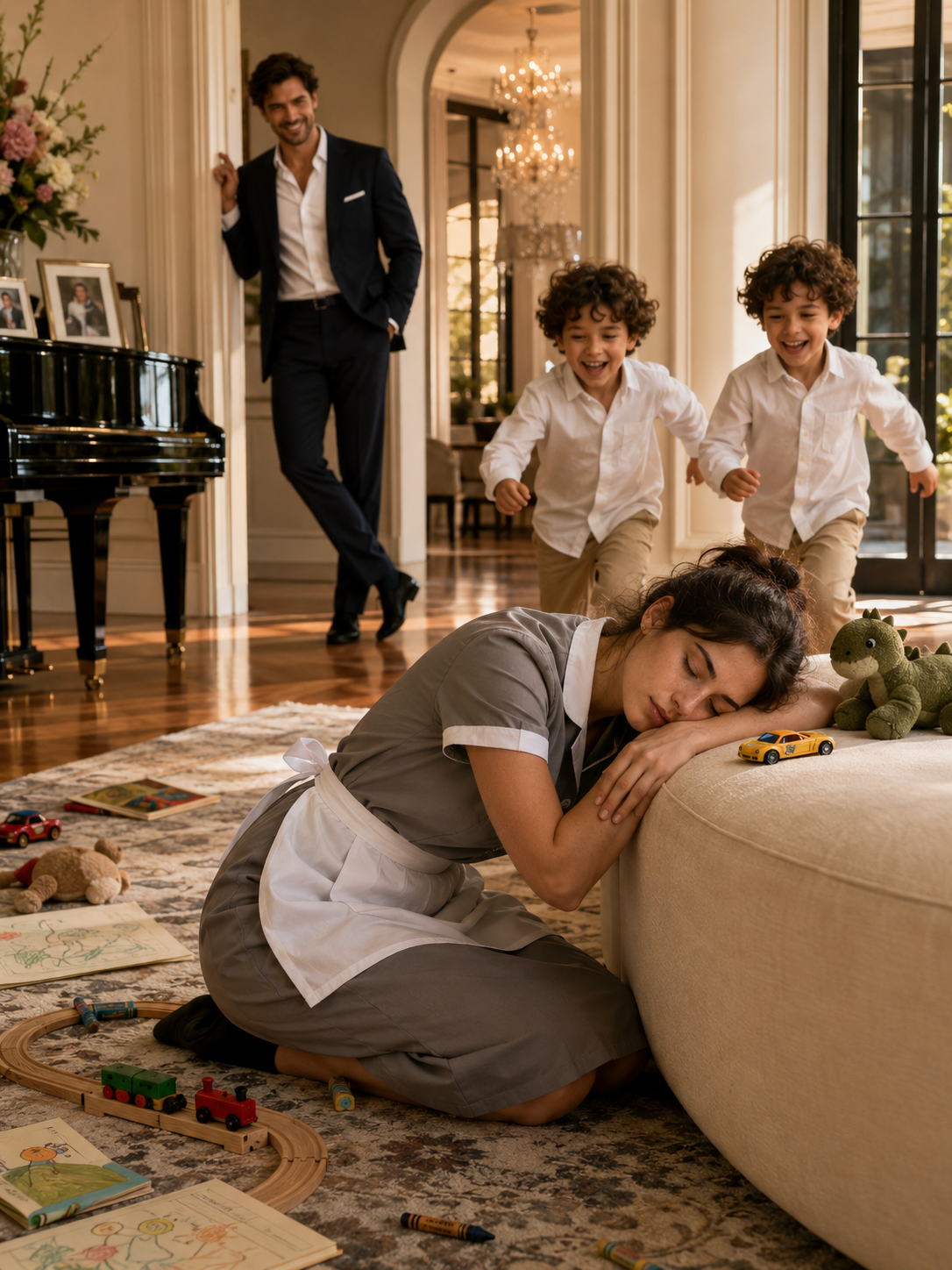
One morning, I was carrying folded clothes upstairs when I heard footsteps pounding through the hallway.
Not slow footsteps.
Running.
I rushed out.
Lucas and Leonardo flew past me toward the staircase.
“Absolutely not!” I shouted. “Slow down!”
They burst into laughter.
“Catch us, Clara!”
“Don’t make me chase you!”
That only made them run faster.
Then I noticed Vicente standing several feet behind me.
He wasn’t smiling.
He was simply watching.
His sons were running.
Months earlier, he had sometimes needed to carry them back to bed.
Now I was complaining because they had too much energy.
Vicente turned his head toward the window.
But not before I saw him wipe his eyes.
I pretended not to notice.
Six months later, Lucas and Leonardo returned to school.
Their recovery was still being monitored, and nobody treated the experience as though it had magically disappeared.
But they had their lives back.
One evening, Vicente asked me to meet him in his study.
It was the same room where he had interviewed me on my first day at the estate.
Back then, the desk had been buried beneath medical reports.
Now most of them were gone.
Vicente gestured toward the chair.
“Sit.”
“That sounds ominous.”
“For once, it isn’t.”
He placed an envelope in front of me.
I stared at it.
“If that’s a dismissal letter, your timing is terrible. Leonardo still owes me twenty dollars from our card game.”
Vicente almost smiled.
“Open it.”
I expected a bonus.
Instead, there was a contract.
I read the first page.
Then read the title again.
Director of Childcare and Family Wellbeing.
I looked up.
“You’ve invented a job.”
“I prefer to think I’ve corrected an organizational mistake.”
“Vicente, I’m a nanny.”
“You were.”
I laughed.
“This title sounds slightly excessive.”
He leaned back.
“Do you remember what you told me when I hired you?”
Unfortunately, I did.
“I’ve said many things I regret.”
“You told me that money can buy expertise, but it can’t guarantee that people will question themselves when they’re wrong.”
I smiled.
“You remembered.”
“I remember the woman who stopped in a hallway because something smelled strange when everyone else kept walking.”
I looked down at the contract.
“I didn’t save them, Vicente.”
His expression became serious.
“Maybe not by yourself. But you noticed something everyone else had learned to ignore.”
Before I could respond, the study door flew open.
Lucas and Leonardo stood there.
“Clara!”
“What?”
“We’re racing to the garden.”
“No.”
“Last one there loses!”
They disappeared.
I stood immediately.
Vicente raised an eyebrow.
“Aren’t you going to finish reading your contract?”
“Apparently my current employers have scheduled an emergency meeting.”
Then I ran into the hallway.
The boys were already halfway downstairs.
Their laughter echoed through the enormous villa.
For eighteen months, that house had been filled with whispered conversations, medical appointments and fear.
Now it was filled with something Vicente Moreira’s fortune had never been able to purchase.
Two children arguing about who could reach the garden first.
And for everyone who loved them, there was no sweeter sound in the world.
The End.