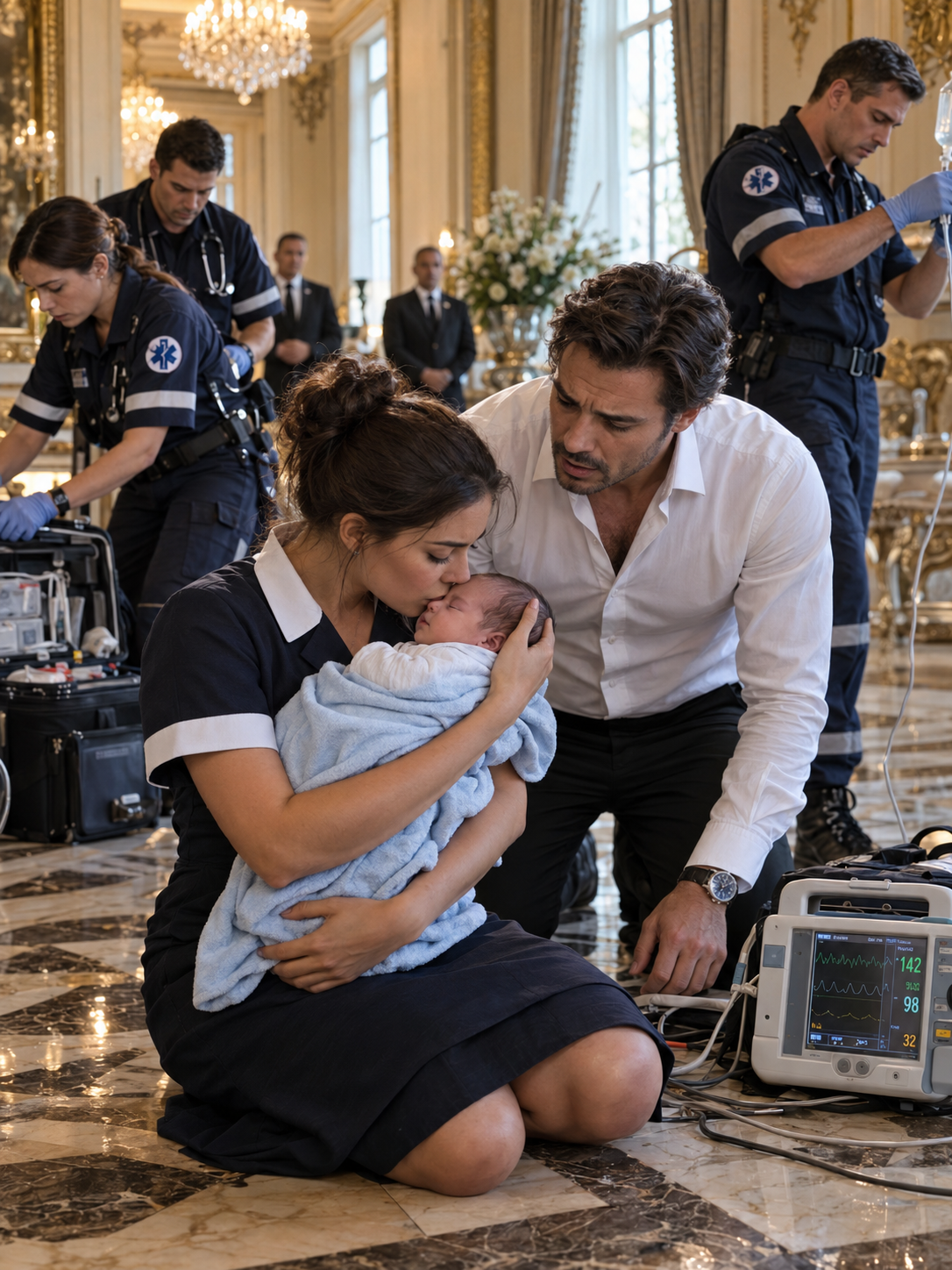
The Carter house was full of voices, yet Michael heard almost none of them.
All he could see was Noah lying still beneath several blankets while the paramedics worked around him. The monitors, hurried instructions, and frightened faces blurred together.
Emily, the young woman who worked in the house, stood close to the baby without speaking. Then she stepped forward.
“Could you uncover him for a moment?” she asked the paramedics. “I need to look at his skin.”
Her calm but firm voice drew everyone’s attention. The team carefully pulled back the blankets and opened Noah’s pajamas.
Red patches covered his chest and stomach.
Emily explained that, earlier, she had noticed a slight swelling around Noah’s eyes. At first, she had thought he was simply tired. But then he began to cough, and the signs no longer seemed unrelated.
“One possibility is a severe allergic reaction,” the lead paramedic said.
The room changed at once. The confusion disappeared, replaced by focused movement. Equipment was prepared. Noah’s breathing was checked repeatedly. The paramedics watched every signal from the monitors.
Michael stood beside the changing table, unable to follow the medical terms. He only saw skilled hands moving quickly around his son.
Then one of the screens changed.
Only slightly.
The paramedic closest to Noah checked the monitor, then examined the baby again.
“His heart is still responding,” he said.
Michael felt his entire body tense.
“Does that mean…?”
“It means we keep going.”
There was no dramatic awakening. Noah did not suddenly open his eyes or cry.
But his chest rose once.
Then again.
For Michael, that was enough.
A few minutes later, the decision was made to take Noah to the hospital immediately. Michael would later remember that time only in fragments: the stretcher rushing through the hallway, Margaret holding one of Noah’s stuffed animals without realizing she had picked it up, Frank speaking urgently on the phone.
Outside, rain fell steadily against the dark street.
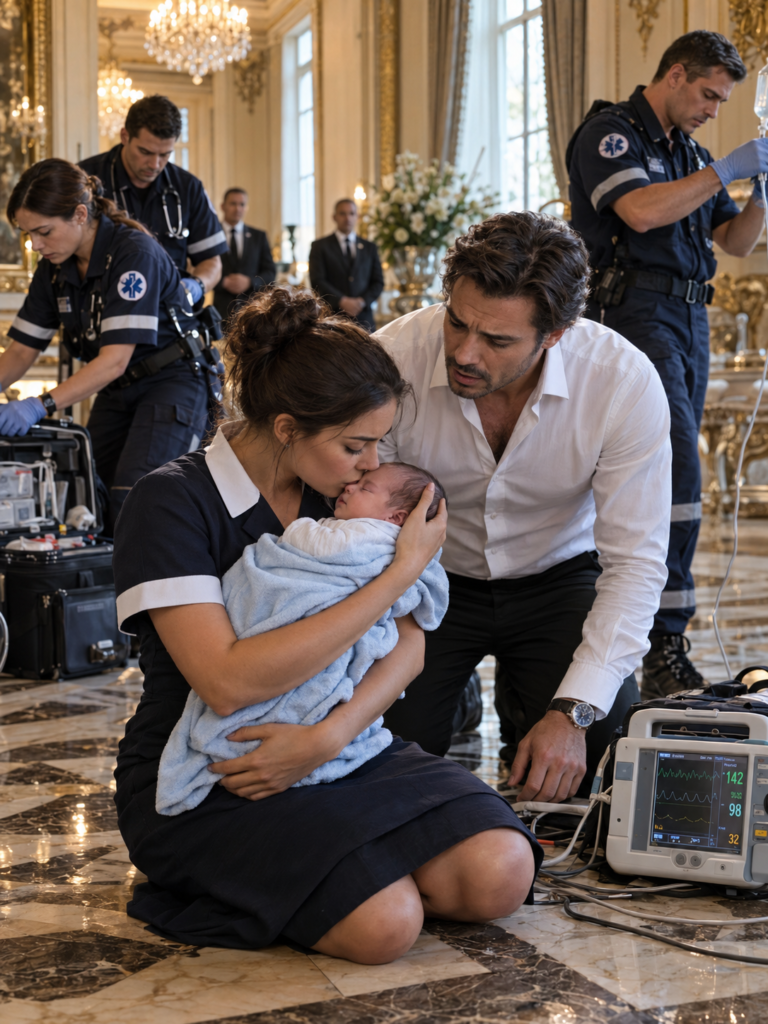
Before climbing into the ambulance, Michael looked back at the house. Emily stood beside Margaret, her hair loose from its tie and her face pale with worry.
For months, she had walked through the same rooms as he had. Yet Michael realized he barely knew anything about her.
“Frank,” he said before the ambulance doors closed. “Bring Emily to the hospital too.”
Frank looked surprised.
“Emily?”
“The doctors may need to know exactly what she noticed.”
Then the doors shut, and the ambulance pulled away.
In the middle of the night, the hospital seemed almost painfully ordinary.
Bright hallways. Vending machines. Tired people holding paper cups of coffee. Nurses walking from room to room.
Michael had expected the entire world to feel different while his son fought to recover. Instead, everything around him continued as if nothing had happened.
His phone kept lighting up with work messages. Meetings, contracts, decisions that had seemed urgent only hours earlier.
He did not open a single one.
He placed the phone face down on the table.
The only thing that mattered was the door behind which Noah was being treated.
When Dr. Lena Shah finally appeared, Michael stood so quickly that his chair slid backward.
“Noah is stable,” she said.
Michael stared at her.
He had heard the words, but it took him a moment to believe them.
“Stable?”
Dr. Shah explained that Noah was receiving help with his breathing, that his heart function had improved, and that he would remain under close observation. Everything suggested a serious allergic reaction, but they still needed to find its cause.
“We need to go through Noah’s entire day,” she said. “What he ate, any medicines, vitamins, soap, detergent, new clothes—anything unusual.”
Michael opened his mouth.
Then he realized he had no answer.
He knew numbers, investments, contracts, and business plans. He could enter any boardroom prepared to take control.
But he could not tell the doctor what his own son had eaten that afternoon.
“I don’t know,” he said quietly.
The words felt heavier than he expected.
Not long afterward, Margaret arrived with Frank and Emily. Margaret was able to describe Noah’s day much better than Michael. She remembered his meals, his bath, his bottle, and the vitamins he normally took. Nothing obvious had changed.
Dr. Shah wrote everything down before turning to Emily.
“You were the first person to notice the rash?”
Emily nodded.
“At first, it was barely visible near his collar. Later, I noticed that his eyelids looked swollen.”
“Have you seen symptoms like this before?” the doctor asked.
Emily hesitated.
“My younger brother has a severe peanut allergy,” she said. “That is why I recognized some of the signs.”
Dr. Shah studied her for a moment.
“Is that the only reason?”
Emily looked down.
“No. I studied nursing for two years. I also trained in pediatric care, but I never finished my degree.”
Michael could not hide his surprise.
Emily had lived and worked under his roof for months, and he had never known.
“Why didn’t you finish?” he asked, realizing too late how personal the question was.
Still, Emily answered.
Her mother had become seriously ill, and Emily had gone home to care for her. By the time her family situation improved, returning to school was no longer financially possible. She needed steady work, so she accepted the job with the Carters.
After asking Emily a few more questions, Dr. Shah returned to Noah’s unit.
Michael sat silently.
Until that night, he had been used to defining people by what they did for him.
Driver.
Assistant.
Cook.
Housekeeper.
Nanny.
Simple labels. Practical labels. Enough to know whom to call whenever he needed something.
But those words said almost nothing about the people behind them.
Emily was not simply the young woman who worked in his house.
She was a daughter who had cared for her mother. A student who had put her future on hold. A person who had paid close enough attention to Noah to notice the small signs that others had missed.
Margaret sank into a chair beside them.
“I should have seen it sooner,” she whispered.
Emily sat down next to her.
“You could not have noticed everything. His pajamas covered most of the rash.”
“But I’m the one who takes care of him.”
“That is exactly why you know how quickly a baby can change,” Emily replied gently. “You could not have known what was about to happen.”
Margaret did not answer, but she stopped blaming herself aloud.
Michael watched the two women.
That night, he understood not only how little he knew about Emily, but also how little he knew about Noah’s daily life.
For years, he had believed responsibility meant making sure everything worked. Hiring capable people. Organizing the house. Providing whatever was needed.
But being present was something else entirely.
It meant knowing what made Noah smile, what foods he liked, when he was tired, and what small changes could mean something was wrong.
Michael had built a life where nearly every problem could be handed to someone else.
Sitting in that hospital waiting room, he understood that some things should never be fully delegated.
When the pediatric ward door opened again, he stood up without looking at his phone.
He did not think about his company.
He did not think about the following day’s schedule.
He thought only about Noah.
And about the people who had been beside him for so long, waiting for Michael to finally see them.