For more than five decades, I had believed I knew every corner of our farm.
I knew which fence posts leaned after a hard winter, which barn door swelled whenever it rained, and which section of the pasture stayed muddy long after the rest of the ground had dried.
I knew the horses even better.
That was why I immediately noticed something was wrong with Rowan.
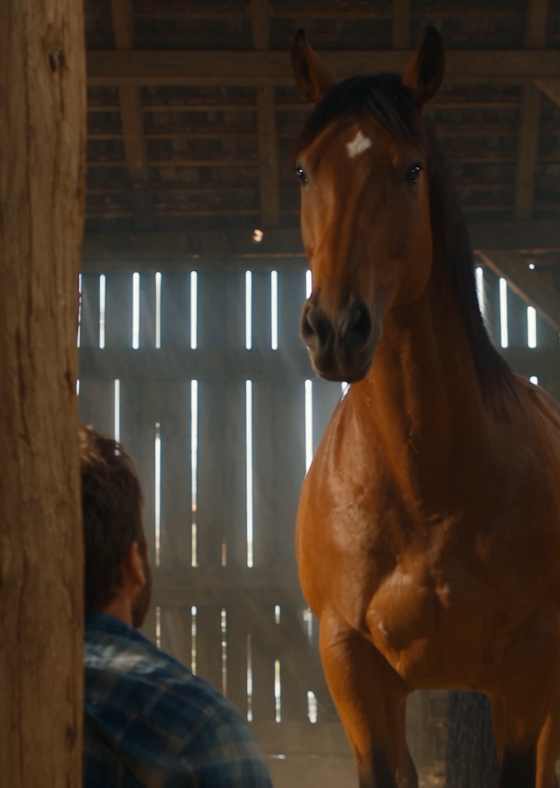
He was normally the most dependable horse on the property—a large chestnut gelding with the patience to stand quietly while children brushed him or while I struggled with a stubborn buckle. Very little seemed capable of upsetting him.
But one cool morning, I entered the barn and found him pacing.
He moved toward the northern end of the building, stopped, looked back at me, then returned. A moment later, he did it again.
“What are you trying to tell me?” I asked.
Rowan flicked his ears and walked toward an old corner filled with unused equipment and loose hay.
That section of the barn had been neglected for years.
It had once been my father’s territory. After he died, I kept telling myself I would eventually sort through everything he had left behind.
I never did.
Some places contain more memories than objects, and I wasn’t always ready to disturb them.
Rowan lowered his head and scraped at the floor.
I assumed he had heard a mouse or some other small animal beneath the boards. But instead of losing interest, he continued until part of the old hay shifted aside.
Something underneath reflected the morning light.
I moved closer.
A metal loop was set into one of the floorboards.
I stared at it.
I had been walking through that barn since childhood, yet I had no memory of seeing it before.
After pulling away the remaining hay, I noticed straight seams in the wood.
It wasn’t an ordinary floorboard.
It was a hatch.
Rowan stepped away as if his job was finished.
“You could at least pretend this was your idea to investigate,” I told him.
He simply watched me.
I wrapped both hands around the metal loop and pulled.
The wood resisted at first. Then the panel rose, revealing a narrow staircase descending beneath the barn.
For several seconds, I did nothing.
My father had built and repaired much of this place himself. If anyone had known about a hidden space beneath it, he had.
And suddenly I remembered the promise he had asked me to make shortly before his death.
Never sell the northern field without thinking very carefully.
At the time, I had assumed it was an old man’s attachment to land he had spent his life working.
Now I wasn’t so sure.
That mattered because I had recently been considering doing exactly what he had asked me not to do.
The farm was in trouble.
After my wife passed away, keeping the property running had become increasingly difficult. Then came two poor seasons, rising expenses, repairs I could no longer postpone, and bills that seemed to multiply faster than I could pay them.
A development company had offered to purchase most of the property.
Accepting would have ended my financial problems.
It also would have ended more than a century of my family’s life on that land.
My daughter, Claire, knew money was tight, but I had hidden the worst of it from her.
She lived several hours away with her husband and called me almost every weekend.
Whenever she asked how things were going, I gave her some variation of the same answer.
“We’re managing.”
It was technically true.
I simply never explained how little time remained for us to keep managing.
The night before Rowan discovered the hatch, I had nearly convinced myself to accept the developer’s offer.
Now I was standing above a staircase I hadn’t known existed.
I found a flashlight and carefully went down.
The stairs ended in a small underground room.
It wasn’t a cellar in the usual sense. It looked more like a private workshop that had been sealed away and forgotten. Shelves covered the walls. Old tools rested on a workbench. Several wooden crates had been stacked in one corner.
Dust lay over everything.
Then my flashlight crossed a framed photograph.
I stopped.
The man in the picture was my father, decades younger than I remembered him.
He was standing beside a horse, smiling in the uncomplicated way people sometimes do before life has had time to change them.
I took the photograph from the wall.
There was handwriting on the back.
It was addressed to me.
The message was brief. My father had written that if I ever discovered the room, then circumstances had finally brought me to something he hadn’t known how to explain while he was alive.
I searched the workbench.
Inside one of its drawers was a sealed envelope bearing my name.
I sat down.
Even after all those years, I recognized his handwriting immediately.
The first part of the letter made me laugh.
My father had always believed horses understood far more about people than people understood about horses. He joked that if one of them had somehow helped me find the room, I should probably thank the animal before taking any credit myself.
Then the tone changed.
He wrote about the farm.
He reminded me that our family had survived droughts, poor harvests, debt and enough bad decisions to fill several notebooks. But he warned me not to confuse preserving the farm with sacrificing everything for it.
Land mattered, he wrote.
Family mattered more.
Those words were difficult to read.
For years I had treated asking for help as a kind of failure. I thought protecting Claire meant keeping my problems away from her.
My father seemed to have anticipated that stubbornness.
Then he explained the northern field.
Many years earlier, while repairing drainage on that part of the property, he and my grandfather had uncovered unusual objects beneath the soil.
They suspected the discovery could be scientifically important, but neither of them had the knowledge to determine exactly what they had found.
Instead of making grand claims, they carefully documented the location, preserved several samples and left the ground largely undisturbed.
My father had kept everything in a red metal case.
His letter asked me to have qualified researchers examine the material before I ever agreed to major changes involving that field.
I found the case on the lowest shelf.
Inside were notebooks, old photographs, hand-drawn diagrams and several carefully wrapped objects.
One resembled a mineralized tooth.
Another appeared to be a fragment of ancient bone.
I knew enough to understand that I didn’t know enough.
Whatever those objects were, they needed to be examined by professionals.
At the bottom of the case was another envelope.
This one had Claire’s name on it.
My father had written it when she was still a child.
Inside was an old photograph of the two of them sitting together on our porch. Claire couldn’t have been more than five.
His note said that she had always possessed a curiosity about the farm that adults sometimes lost with age.
He hoped that one day she might help us understand what the place could become rather than merely what it had been.
I stayed in that room for a long time.
Then I climbed the stairs, walked outside and called my daughter.
She arrived the following morning.
Before she had even closed her car door, she demanded to know why I had told her that Rowan had behaved strangely and then refused to explain anything else over the phone.
“He’s perfectly fine,” I said.
She glanced toward the paddock, where Rowan was calmly eating.
“That horse looks considerably less worried than you do.”
“He found something.”
Claire raised an eyebrow.
“Dad, you’re making this sound like the beginning of a mystery novel.”
“Just come inside.”
I showed her the hatch.
Then the underground room.
Then the photographs, notebooks and preserved objects.
She listened quietly until she found the letter addressed to her.
After reading it, she sat down.
Neither of us spoke for a while.
Finally she looked at me.
“You were going to sell, weren’t you?”
There wasn’t much point pretending.
“Yes.”
Her face tightened.
“How close were you to telling me?”
I didn’t answer.
That was answer enough.
“Why?”
“Because you have your own responsibilities. I didn’t want you rearranging your life because I couldn’t keep the farm going.”
She stared at me for several seconds.
“You spent my childhood teaching me that families don’t leave one another to handle everything alone.”
“I know.”
“Apparently you forgot to include yourself in that rule.”
That landed harder than I expected.
She was right.
In trying to protect her, I had denied her the opportunity to decide for herself whether she wanted to help.
Claire wiped her eyes and looked again at the materials my father had stored.
Then she asked the question that changed the direction of everything.
“Who can tell us what these actually are?”
We contacted a university department and explained what we had found.
I deliberately kept my expectations low.
For all I knew, the objects might have been interesting but ordinary.
A small research team eventually visited the farm. They examined the preserved material, studied my father’s notes and surveyed portions of the northern field.
Their first visit led to another.
Then another.
Several weeks later, the lead researcher asked Claire and me to meet her at the edge of the field.
She explained that my father and grandfather had indeed documented something worth protecting.
The material appeared to come from an area containing scientifically useful fossil remains, and preliminary work suggested the site deserved careful long-term study.
Nobody promised buried treasure.
There was no miraculous fortune waiting beneath the grass.
What we had was something quieter and, in its own way, more meaningful: a piece of natural history that had survived beneath our family land for an extraordinary length of time.
The following months involved meetings, surveys, legal paperwork and conversations with organizations interested in research, preservation and education.
Eventually, an arrangement was developed that allowed the relevant portion of the northern field to remain protected while specialists continued studying it.
The agreement also gave the farm enough financial breathing room for me to avoid selling the entire property.
I did not become rich.
That was never the outcome.
What changed was simpler: for the first time in years, I wasn’t waking before dawn wondering how many months we had left.
The developer’s proposal was no longer something I needed.
I thought that was the end of Rowan’s contribution to the family history.
I was wrong.
He continued showing unusual interest in the old northern section of the barn.
One afternoon, Claire caught him repeatedly nosing an ancient wooden cabinet against the wall.
She laughed.
“If there’s another staircase behind that thing, I’m leaving.”
“There had better not be.”
We moved the cabinet anyway.
There was no staircase.
Behind it was a shallow storage recess containing an old saddle.
The moment I saw it, I recognized it.
It had belonged to my father.
I hadn’t seen it in years.
Claire lifted it carefully, and a small metal tag slipped loose.
There was a horse’s name on it and, on the reverse, my father’s initials.
That made no sense at first.
Rowan hadn’t even been born when my father died.
Curiosity got the better of us.
We went through the old breeding records that had survived in the barn office.
Eventually, we found the explanation.
Years before his death, my father had owned a mare that he was particularly fond of. When his health declined and managing the horses became difficult, he sold her to another ranch.
That mare later became part of a breeding line that continued for years.
Rowan was one of her descendants.
I had purchased him without knowing any of that.
The horse that had drawn my attention to my father’s hidden workshop happened to descend from one of the last lines my father had personally raised.
Claire looked from the records toward Rowan.
“You seriously didn’t know?”
“Not even a little.”
She smiled.
“Grandpa would have enjoyed this far too much.”
So would my wife.
That thought no longer hurt quite as sharply as it once had.
A year later, the farm was still standing, but it was no longer trapped in the past.
Claire and her husband moved closer and became more involved in its future. An unused building was renovated into a modest educational space where visiting families and school groups could learn about horses, agriculture and the scientific work taking place on part of the property.
The researchers continued their work.
I continued repairing fences and complaining about paperwork.
Rowan became a favorite among visitors.
One Saturday morning, I walked toward the paddock and heard a child’s laughter.
Claire was standing beside Rowan.
Her young daughter, Sophie, sat proudly in the saddle while he walked at the slow, patient pace he seemed to reserve for children.
“Grandpa! Look at me!”
“I see you!”
Claire kept close beside her daughter.
For a moment, the scene felt strangely familiar.
Then I remembered the photograph from beneath the barn.
My father with Claire when she was little.
Now Claire was standing beside her own daughter.
Different day.
Different generation.
Same patch of earth.
That evening I went back into the barn after everyone else had gone inside.
The setting sun came through the gaps between the weathered boards, laying narrow strips of light across the floor.
Rowan stood quietly nearby.
I rubbed his neck.
“You caused quite a bit of trouble that morning,” I told him.
He gave a soft snort.
I laughed.
“But I suppose it worked out.”
As I started toward the door, he nudged my shoulder.
And I remembered something my father used to say when I was young.
He believed the best horses didn’t simply carry a rider along the road the rider had chosen. Sometimes they forced you to notice a different path.
As a boy, I thought he was talking about horsemanship.
Standing there decades later, I understood the idea differently.
I had spent years believing that honoring my family’s past meant preventing anything from changing.
But refusing change had nearly cost me everything.
The farm survived because I finally allowed its future to look different from its past.
I listened to my daughter.
I trusted people who understood something about our land that I did not.
I followed instructions left by a father who had known me well enough to predict how stubborn I might become.
And, through a coincidence I will probably never fully explain, I paid attention to a horse that refused to ignore one forgotten corner of an old barn.
Outside, Sophie was laughing.
Claire was calling her in for dinner.
Farther away, researchers were finishing another day’s work near the protected field.
Rowan raised his head toward the voices.
Not long before, I had believed I was responsible for watching the final years of our family farm.
I had been mistaken.
The place didn’t need me to preserve it exactly as it had always been.
It needed us to discover what it could become next.
And somehow, that discovery began with four hooves scraping at an old wooden floor.