Clara’s message came in the middle of a rainy afternoon.
I was stuck in traffic, thinking about getting home, having dinner, and spending the rest of the evening with my wife and our newborn son.
Then my phone buzzed.
It was Clara.
Her message contained only one line:
“David, can you come back? I need help…”
Nothing else.
I called her immediately.
No answer.
I tried again.
Still nothing.
A feeling of dread settled over me.
Clara had only been adjusting to motherhood for a few weeks. Leo’s birth had been exhausting, and she still needed plenty of rest. That was why my mother, Eleanor, had offered to stay with us temporarily.
In theory, she was there to help.
In reality, I had started to worry about what was happening in our home.
My mother had always been controlling. All my life, I had found excuses for it. She said she was demanding because she cared. That her harsh comments were simply honesty. That she needed to control every situation because she was used to solving problems.
Clara rarely complained.
But lately, she had seemed different.
Quieter.
More anxious.
And that message brought every small sign I had ignored rushing back into my mind at once.
I turned around and headed home immediately.
When I finally arrived, the first thing that struck me was the silence.
With a newborn in the house, complete silence was strange.
“Clara?”
No one answered.
The smell of an elaborate dinner was coming from the kitchen.
Then I heard faint crying.
It was coming from Leo’s room.
I rushed inside.
My son was crying, distressed, and clearly needed attention.
I picked him up.
“I’m here, little one.”
Then I went to look for Clara.
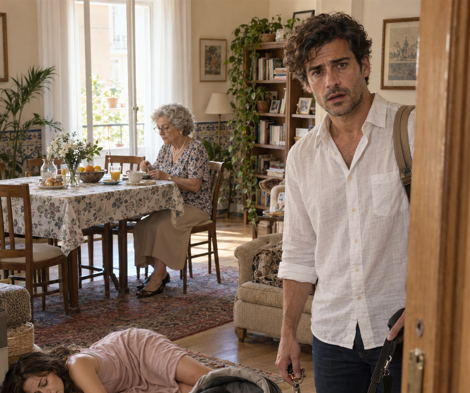
I found her in the living room.
She was lying on the couch, extremely weak and barely conscious.
“Clara!”
I dropped to my knees beside her.
She responded faintly when I said her name.
A few feet away, my mother was sitting at the table.
She looked strangely calm.
“What happened?” I asked.
Eleanor sighed.
“She’s overreacting. I asked her to do a few things, and she decided to lie down.”
I stared at her, unable to understand.
“She’s sick.”
“She’s tired. All mothers are tired.”
I turned back to Clara.
She needed medical care, not a family argument.
I looked for her phone to call for help.
It wasn’t beside her.
“Where is her phone?”
My mother pointed toward the kitchen.
“I put it aside. She was too focused on it.”
I found the phone where Clara couldn’t reach it.
That was the moment I knew something serious had happened.
I called for medical help immediately.
While we waited, I focused only on Clara and Leo.
My mother kept insisting that I was turning an ordinary situation into a drama.
For the first time in my life, I stopped listening to her.
At the hospital, the doctors examined Clara.
She was dehydrated, had a fever, and was suffering from postpartum complications that required immediate treatment.
I sat in the waiting room with Leo, trying to understand how we had ended up there.
Then two officers arrived with a family services worker.
Someone had given them a completely different version of what had happened.
My mother had called and claimed that Clara was having a severe emotional crisis and that I had reacted aggressively before leaving with our son.
I couldn’t believe it.
But arguing would not solve anything.
So I calmly explained that Clara was receiving medical care and asked them to verify her condition directly with the hospital staff.
I also made it clear that I had serious concerns about what had happened in our home.
The authorities took notes.
I didn’t accuse anyone of crimes that had not yet been established.
I didn’t need to.
The facts could be investigated.
My priority was Clara.
Hours later, the doctors told me she was responding to treatment.
Only then did I look at my phone.
There were dozens of calls and messages.
My family had already heard Eleanor’s version of the story.
According to them, my mother had tried to help us, and Clara had reacted irrationally.
Some of them even insisted that I should apologize.
I didn’t respond.
Because as I read those messages, I remembered something.
A few weeks earlier, I had installed visible security cameras in some of the common areas of our apartment.
I had done it after several strange incidents.
Clara had found marks on her arms that she couldn’t explain.
Some of Leo’s things would appear in different places.
The baby monitor had been unplugged more than once.
At the time, even I had doubted what was happening.
That was perhaps the part that hurt the most.
I had wanted to believe there was an innocent explanation for everything.
Now I needed to know the truth.
I accessed the recordings.
What I saw removed every doubt.
I didn’t need to watch hours of footage to understand the pattern.
In several clips, Eleanor could be seen pressuring Clara to continue doing household chores when she clearly needed rest.
The footage also showed her taking Clara’s phone away when she tried to contact me.
Later, the recordings showed Clara becoming weaker until she finally had to lie down.
Instead of seeking help, my mother continued acting as though it were simply a lack of willingness.
I stared at the screen.
I felt ashamed.
Not of Clara.
Of myself.
For weeks, she had tried to show me that something was wrong.
And I had taken far too long to understand.
I saved a copy of the recordings and decided that any legal matters would be handled by the appropriate professionals.
I didn’t want to turn this into a family war.
I wanted to protect my wife and my son.
But Eleanor had other plans.
The next morning, several relatives insisted on meeting with me.
I agreed.
We met in a private room at the hospital.
My sister, two uncles, several cousins, and finally Eleanor arrived.
My mother looked exhausted.
She sat surrounded by family members who had clearly come prepared to defend her.
One of my uncles spoke first.
“David, we need to resolve this before the situation destroys the family.”
“I agree.”
My answer seemed to reassure him.
“Then you should start by admitting that you reacted badly yesterday.”
I looked at Eleanor.
“Is that what you told them?”
My mother lowered her eyes.
“I was only trying to help. Clara was very upset.”
My sister stepped in.
“Maybe she needs psychological support. We shouldn’t ignore that.”
“Any care Clara needs will be decided with medical professionals,” I replied. “Not by us sitting around a table.”
My uncle sighed.
“No one is attacking her.”
“Good.”
I opened my laptop.
“Then let’s look at what really happened.”
Eleanor looked up.
Her expression changed.
I connected my laptop to the room’s screen.
“A few weeks ago, we installed visible cameras in the common areas of our home.”
No one spoke.
I played several relevant clips.
I didn’t show anything private or unnecessary.
Only enough to establish the sequence of events.
The room fell silent.
They watched Clara trying to continue with chores while she was clearly exhausted.
They heard her ask to rest.
They saw her phone being moved out of reach.
And finally, they watched as her condition worsened and she did not receive the help she needed.
My family’s reaction slowly changed.
My sister stopped looking at the screen and turned toward our mother.
One of my uncles took off his glasses.
Eleanor tried to explain what we were seeing.
“You don’t know the full context.”
I paused the video.
“Then explain it.”
She didn’t answer.
“Explain why a woman who had just given birth was asking to rest, and no one considered that she might need help.”
Silence.
“Explain why she didn’t have access to her phone.”
Nothing.
My mother finally looked at me.
“I’m your mother.”
Those four words had worked on me for most of my life.
Not that day.
“Yes,” I said. “And Clara is my wife. Leo is my son. Being my mother does not mean you get to decide how they should be treated.”
Eleanor began to cry.
I didn’t know whether those tears were sincere.
It didn’t matter.
“David, you can’t keep me away from my grandson over a misunderstanding.”
“This is not a discussion about punishment.”
I closed my laptop.
“It is a decision about safety and trust.”
Then I looked at the rest of my family.
“I’m not asking you to choose between us. You can have whatever relationship you want with Eleanor. But no one is going to pressure Clara into minimizing what happened, and no one is going to show up at our home to convince her that she overreacted.”
My sister lowered her eyes.
“I didn’t know it had happened like that.”
“That is exactly why you should have waited before judging her.”
That was all I needed to say.
I packed up my laptop and went back to Clara.
Her recovery took time.
There was no miraculous transformation the next day.
First, she had to regain her strength.
Then we had to rebuild something even harder: our sense of safety.
When she was well enough to talk for longer, I sat beside her bed.
“I failed you,” I told her.
Clara slowly shook her head.
“You came back.”
“But I should have listened to you sooner.”
Her eyes filled with tears.
“I started thinking that maybe I was overreacting.”
I took her hand.
“I never want you to feel like you have to prove to me that something is hurting you.”
That conversation mattered more than any confrontation I had with my mother.
Because understanding what had happened was not enough.
I had to change the way we protected our home.
When Clara was discharged, we decided not to return immediately to our old routine.
We needed peace.
Over the following months, we set clear boundaries with my family.
Some relatives apologized for rushing to believe only one version of the story.
Others tried to remain “neutral.”
I learned that neutrality does not always help when someone has been treated unfairly.
I didn’t ask anyone to hate my mother.
I simply made it clear that our relationship with her would not return to what it had been unless she acknowledged what happened and respected our boundaries.
Eleanor refused.
For a long time, she continued saying that everything had been exaggerated.
That, too, was an answer.
And we learned to live without expecting another one.
Six months later, on a quiet afternoon, I was sitting in the living room while Leo played on a blanket.
Clara was beside him.
Suddenly, our son managed to roll over on his own.
Clara burst out laughing.
Leo seemed surprised by his own achievement, then began kicking his legs proudly.
I laughed too.
It was a completely ordinary moment.
And that was exactly why it felt extraordinary.
For months, I had associated our family life with hospitals, arguments, and fear.
Now all I could hear was my wife’s laughter and the happy sounds of our son.
Clara looked up at me.
“He’s growing up too fast.”
I sat beside her.
“Yes, he is.”
She took my hand.
We had not forgotten what happened.
We probably never would.
But we had stopped allowing it to define every day of our lives.
I had learned something too—something I wish I had understood much sooner.
For years, I confused keeping the peace with being a good son.
I thought loving my mother meant defending her, softening her words, and avoiding conflict at any cost.
I was wrong.
Sometimes loving your own family means setting boundaries.
And becoming a husband and a father meant understanding that my responsibility was not to keep everyone around me happy.
It was to listen.
To protect.
To believe the person I love when they tell me that something is wrong.
That afternoon, I watched Clara lift Leo into her arms as he laughed.
I didn’t feel as though I had “won” a battle against my mother.
Something far more valuable was right in front of me.
My wife was healing.
My son was safe.
And our home was beginning to feel like a place where none of us had to live in fear.
That was enough.