By the time we reached the clinic, my infant son’s fever was dangerously high.
I had spent most of the night holding him against my chest, watching every change in his breathing and trying to convince myself I wasn’t missing something important.
For days, I had been told I worried too much.
My husband, Daniel, said becoming a new mother had made me overly cautious.
His mother, Margaret, said babies picked up on their mothers’ anxiety and that I needed to “relax.”
So when the physician examined my son and initially suggested that exhausted parents sometimes interpret normal symptoms as emergencies, I felt the same familiar humiliation settle over me.
Daniel gave a small shrug.
“My wife worries about everything,” he said.
Margaret smiled as though his comment proved her point.
I didn’t argue.
I simply held my son closer.
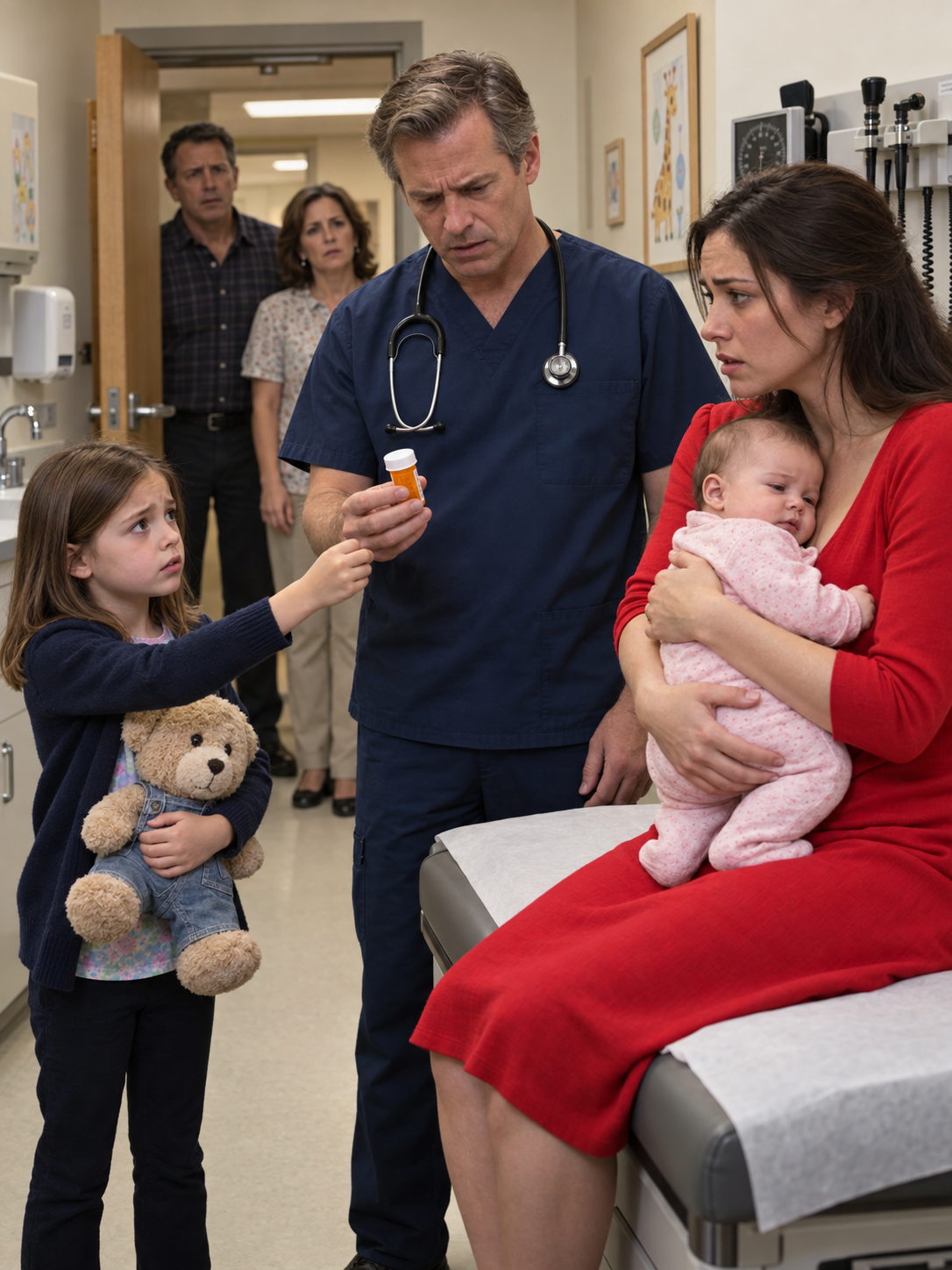
Then my seven-year-old daughter, Lily, who had been sitting quietly in the corner with her teddy bear, stood up.
“Doctor?”
Everyone turned toward her.
She lifted the stuffed animal.
“There’s something you should see.”
Tucked beneath the bear’s little denim clothing was a prescription bottle.
The doctor’s expression changed immediately.
“Where did you get that?”
Lily looked toward me, then toward her grandmother.
“I found it after Grandma threw it away.”
The room went silent.
Margaret sat forward.
“She’s a child. She probably misunderstood.”
Lily shook her head.
“No, I didn’t.”
The physician crouched slightly so he could speak to her calmly.
“Tell me what you remember.”
Lily hugged the teddy bear against herself.
She explained that several nights earlier, she had come downstairs after hearing her baby brother crying.
She had seen Margaret handling his medication.
According to Lily, the medicine that had been prescribed for the baby was poured away, and something from a different bottle was used instead.
My stomach tightened.
I looked at Margaret.
“What is she talking about?”
Margaret immediately became defensive.
“I was trying to help him settle down. You had barely slept in days.”
The doctor raised a hand gently.
“Let’s not make assumptions yet. We need to determine exactly what the baby received.”
He examined the prescription bottle Lily had brought.
It appeared almost untouched.
That alone didn’t prove what had happened, but it was enough to make the situation more serious.
A nurse was called in, and the bottle was set aside so the medical team could review it properly.
My son shifted weakly against me.
I stopped caring whether anyone thought I was dramatic.
“Please check everything you need to check,” I said. “I want to know exactly what happened.”
Daniel sighed.
“This is getting blown out of proportion.”
I looked at him.
“Your son is sick.”
“My mother raised children. She knows what she’s doing.”
“That isn’t what I asked.”
He fell silent.
The physician turned back to Lily.
“Do you remember anything about the other bottle?”
She nodded.
“It was Grandma’s. She keeps it in her room.”
Margaret interrupted.
“I gave him only a tiny amount because he wouldn’t settle. That’s all.”
My chest tightened.
“You gave my baby something that wasn’t prescribed for him?”
Margaret’s expression hardened.
“You were making him anxious. He needed rest.”
For months, almost every concern I raised had been dismissed.
If I checked the baby too often, I was obsessive.
If I asked someone to wash their hands before holding him, I was controlling.
If I called the pediatrician, I was overreacting.
Eventually, I had started questioning myself.
That stopped in that room.
I looked at the physician.
“Please document what my daughter told you. And I’d like to answer questions about my son myself.”
Daniel looked offended.
“I’m his father.”
I turned toward him.
“Then tell me something.”
He stared back.
“Did you know your mother was giving him something different?”
He didn’t answer.
Instead, he looked toward Margaret.
That was the first moment I felt real fear.
Not because I knew what had happened.
Because I realized Daniel might know more than he was saying.
The physician remained calm.
He explained that the priority was treating the baby and identifying any medications or substances he might have received. He made no accusation and drew no conclusion before the facts were established.
Then he asked Lily another question.
“When did you first notice this?”
She looked down at the teddy bear.
“The first night Grandma slept at our house.”
Daniel shook his head.
“Lily, maybe you were half asleep.”
She looked directly at him.
“I wasn’t.”
He went quiet.
Lily continued.
“The baby was crying, so I came downstairs.”
She swallowed.
“Grandma had something in her hand.”
I asked carefully, “Did you see this happen again?”
Lily began counting on the teddy bear’s paw.
“Three times.”
Margaret immediately objected.
“That’s ridiculous.”
But Lily kept speaking.
“She waited until Mom was asleep.”
The room seemed to shrink around me.
Then Lily looked at her father.
Her expression wasn’t angry.
It was confused.
“Dad was there too.”
Daniel’s face changed.
“What do you mean?” I asked.
Lily hugged the bear tighter.
“He was holding the baby.”
No one spoke.
The doctor did not speculate.
He simply asked the nurse to continue documenting the information while the medical team focused on my son’s immediate care.
I looked at Daniel.
For days, he had told me I was imagining problems.
Now I understood why he had been so determined to convince me nothing was wrong.
Or at least, I understood that there were questions he had never wanted me to ask.
“What did you know?” I said quietly.
Daniel opened his mouth.
Nothing came out.
Margaret stepped between us verbally.
“We were helping you.”
I looked at her.
“Helping me would have meant telling me.”
She tried again.
“You were exhausted.”
“So you made decisions about my baby without me?”
Daniel finally spoke.
“We thought you’d panic.”
That sentence hurt more than I expected.
Not because it was cruel.
Because he said it as though excluding me had been reasonable.
The physician interrupted before the argument could grow.
“This conversation can continue later. Right now, the baby needs our full attention.”
He was right.
I followed the nurse into the treatment area with my son in my arms.
Lily came with me.
Daniel and Margaret remained behind for the moment.
As we walked down the hallway, Lily reached for my hand.
“Mom?”
“Yes?”
“Was I bad for telling?”
I stopped.
“No.”
She looked uncertain.
“You did the right thing by telling an adult when something worried you.”
Her fingers tightened around mine.
Behind us, I could hear Daniel speaking to his mother in a low voice.
I didn’t turn around.
I still didn’t know exactly what had happened.
I didn’t know whether the other medicine had caused my son’s symptoms or whether something else was making him ill.
And I wasn’t going to accuse anyone before the doctors had answers.
But one thing had already changed.
I was no longer going to let anyone convince me that asking questions about my child made me unreasonable.
A few minutes later, the physician returned.
He had new information.
And from the expression on his face, I knew the next conversation was going to change our family permanently.