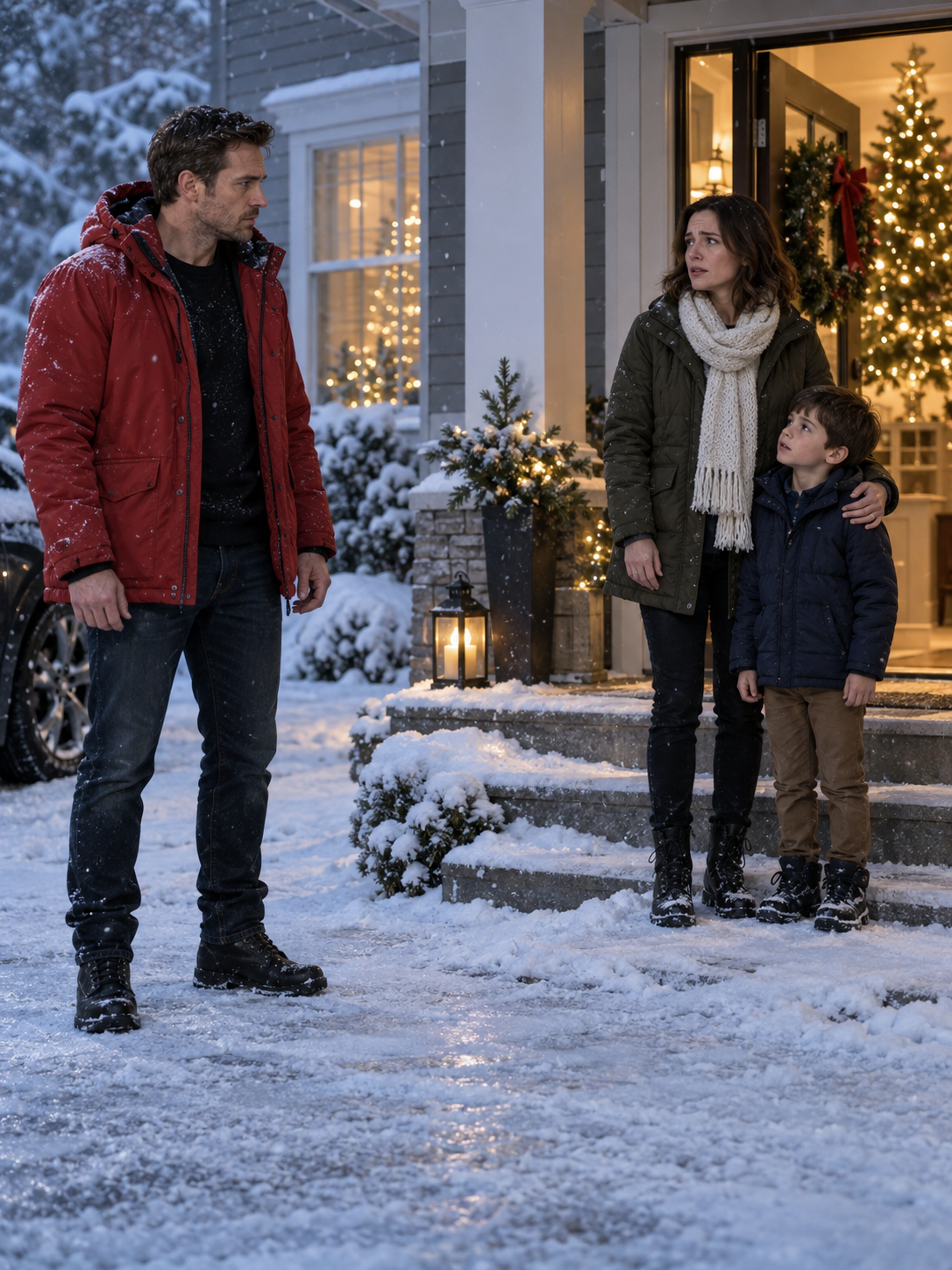
Seven years after my marriage ended, I found myself standing outside my former wife’s home on Christmas Eve.
I hadn’t come expecting forgiveness.
I wasn’t even sure Claire would let me inside.
I had come because I finally understood that the story I’d believed about the end of our marriage wasn’t the whole truth—and because I owed her an apology whether she accepted it or not.
Snow covered the front steps and clung to my coat as I rang the bell.
For several seconds, nothing happened.
Then the door opened.
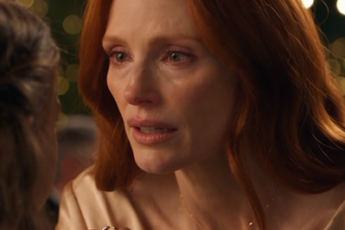
Claire stood there.
Seven years had changed both of us, but I recognized her immediately. Her hair was shorter, and there was a guarded calm in her expression that hadn’t been there when we were married.
“Daniel?”
“Hi, Claire.”
She stared at me.
“What are you doing here?”
“I need to talk to you.”
Before she could respond, a child’s voice came from somewhere inside.
“Mom!”
A little boy hurried into the hallway carrying a homemade Christmas ornament that appeared to be falling apart in his hands.
“The star came off again.”
Then he noticed me.
He stopped.
And so did I.
There was nothing extraordinary about seeing a child in Claire’s house. Seven years was a long time. She had every right to rebuild her life.
But something about this boy caught me completely unprepared.
His expression.
The shape of his face.
And especially his blue-gray eyes.
I had seen those eyes in photographs from my own childhood.
The boy studied me with equal curiosity.
“Who are you?”
I swallowed.
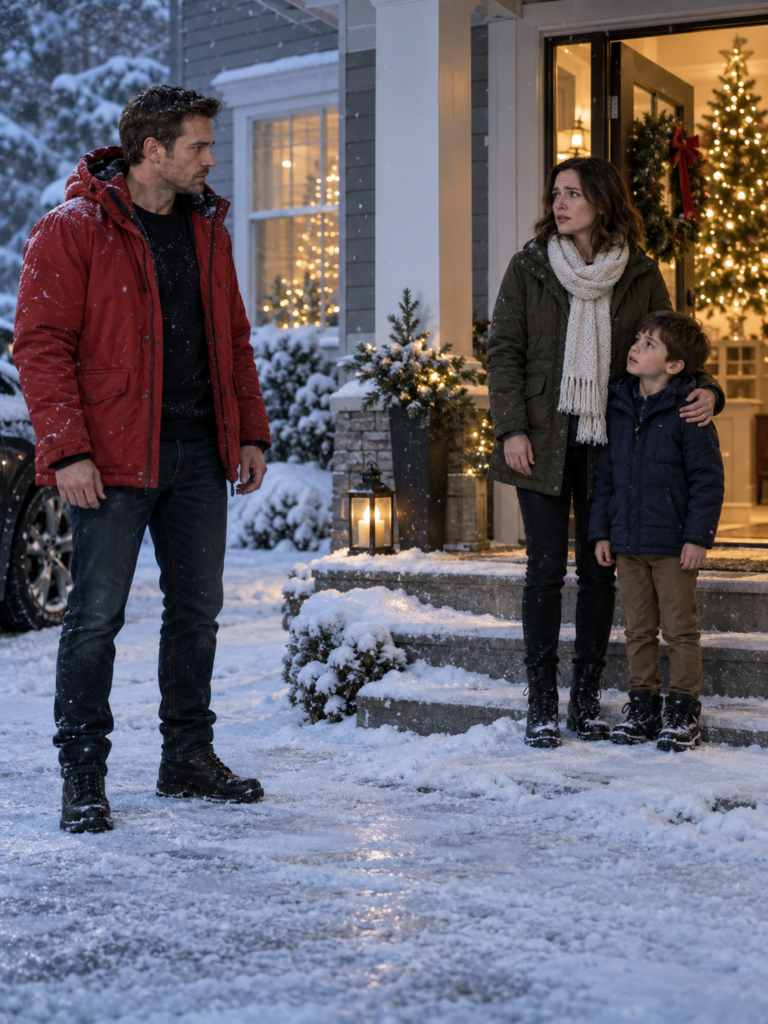
“I’m Daniel. I’m an old friend of your mom’s.”
Claire looked at me sharply.
Technically, it wasn’t a lie.
It simply left out almost everything that mattered.
The boy noticed an old military insignia on my coat.
“Were you in the Army?”
“For a long time.”
He smiled.
I felt an unexpected ache in my chest.
Claire gently touched his shoulder.
“Go see if the cookies are ready, sweetheart.”
“But—”
“Please.”
He disappeared toward the kitchen, though I caught him looking back once.
The moment he was gone, I turned toward Claire.
“How old is he?”
She closed her eyes briefly.
“Daniel…”
“Please.”
She looked at me again.
“He’s seven.”
Every thought in my head seemed to stop at once.
Seven.
Our divorce had happened seven years earlier, shortly before a lengthy assignment took me away.
I glanced toward the room behind her.
There were children’s drawings on the wall. A small model rocket sat on a shelf. Christmas lights surrounded family photographs.
In one picture, the boy was laughing.
Something about that smile reminded me painfully of my father.
I forced myself not to jump to a conclusion.
“Is there something about him I should know?”
Claire’s expression hardened.
“This is exactly why I didn’t want this conversation happening at my front door.”
“Then let me come inside.”
“No.”
That answer hurt, but I understood it.
I had disappeared from her life seven years earlier believing things about her that I now had reason to question.
I didn’t get to arrive unexpectedly and demand access to the life she’d built afterward.
So I lowered my voice.
“Did you ever try to contact me after I left?”
Claire looked away.
“Yes.”
One word.
That was all it took.
“How?”
“I sent letters.”
“I never received them.”
“I know.”
The certainty in her voice unsettled me.
“How could you know that?”
Before she answered, the little boy returned carrying a plate with several badly shaped Christmas cookies.
“Mom said I could have one,” he announced.
Claire almost smiled.
He held the plate toward me.
“You can have one too.”
I took the smallest cookie.
“Thank you.”
“I’m Noah.”
“Nice to meet you, Noah.”
He ran back inside.
Hearing his name somehow made everything more real.
Claire finally opened the door wider.
“You can come in for a few minutes.”
The house was warm and smelled faintly of cinnamon.
I remained near the entrance while she went upstairs.
When she returned, she was carrying a small wooden keepsake box.
She placed it on the table between us.
“I kept these because someday I knew we’d have to talk.”
Inside were ordinary pieces of a child’s early life—hospital keepsakes, photographs, birthday cards, and several folded papers.
Then Claire removed an envelope.
My name was written across the front.
I recognized her handwriting immediately.
“When did you send this?”
“Shortly after you left.”
I examined the envelope.
It had eventually been returned.
“I never saw it.”
“I believe you now.”
“Now?”
Claire sat opposite me.
“For years, I thought you’d simply decided not to respond.”
My stomach tightened.
“Why would you think that?”
“Because I received an answer.”
She reached into the box again and placed another piece of correspondence beside the first.
I read it slowly.
It claimed that I knew about the pregnancy, had chosen my military career, and did not want further involvement.
I looked up.
“I didn’t write this.”
“I know.”
“Who did?”
Claire hesitated.
“I can’t prove exactly how every message was handled. That’s one of the reasons I never wanted to make accusations without evidence.”
I looked again at the correspondence.
There were details in it that suggested someone close to me had known where I was and how difficult I would be to reach during that period.
One possibility immediately entered my mind.
My mother.
But possibility wasn’t proof.
“Did you contact her?” I asked.
Claire nodded.
“When I couldn’t reach you directly, I tried going through your family.”
“What did she tell you?”
“That you knew.”
I felt sick.
“She said you didn’t want to come back,” Claire continued. “She told me you wanted a clean break and that contacting you would only make everything worse.”
“That wasn’t true.”
“I understand that now.”
I looked toward the kitchen.
Noah was quietly singing to himself while decorating another cookie.
My voice dropped.
“Claire, is Noah my son?”
She didn’t give me the dramatic answer I expected.
Instead, she said something far more sensible.
“The timing raises that possibility. But I’m not going to tell a seven-year-old that someone is his father based on resemblance and dates.”
She was right.
Of course she was.
Whatever emotions were tearing through me, Noah deserved certainty rather than assumptions.
“What do we do?”
“We take this slowly.”
I nodded.
“If you’re willing, we can establish the facts properly. And until then, nothing changes for Noah.”
“Agreed.”
Claire studied my face.
“You really didn’t know?”
“No.”
For the first time that evening, the anger disappeared from her expression.
What replaced it was sadness.
“I spent years thinking you had abandoned him.”
“And I spent years believing you wanted me gone.”
Neither of us spoke for a while.
Two people had lost seven years because we’d trusted messages and assumptions more than we’d trusted each other enough to verify them.
But there was something else I needed to say.
It was why I’d come in the first place.
“Claire, even before tonight, I owed you an apology.”
She looked at me.
“I judged you when our marriage was falling apart. I believed things I should have questioned. I was angry, and leaving was easier than admitting I might have been wrong.”
She didn’t rush to forgive me.
I respected her for that.
Finally, she said, “An apology doesn’t restore seven years.”
“I know.”
“And if Noah turns out to be your son, you don’t get to walk into his life tomorrow and expect him to understand any of this.”
“I know that too.”
“What he needs comes first.”
“Always.”
A few minutes later, Noah wandered into the room again.
He held up his repaired ornament.
“Mom fixed it.”
I smiled.
“Looks good.”
He examined me thoughtfully.
“Are you staying for Christmas?”
I looked at Claire.
She looked back at me.
“No,” I told him gently. “I just came to talk to your mom.”
He seemed disappointed for approximately two seconds before becoming interested in his cookie again.
As I prepared to leave, Claire handed me copies of the correspondence.
“Take these.”
I tucked them carefully into my coat.
At the door, I stopped.
“Claire?”
“Yes?”
“Thank you for telling me.”
She looked toward Noah.
“Don’t thank me yet. We still don’t know everything.”
She was right.
The boy’s age wasn’t proof.
His eyes weren’t proof.
The unanswered letters weren’t proof of who had interfered or why.
But they were enough to show me that the version of my past I’d carried for seven years had enormous gaps in it.
I stepped back into the snow.
Through the window, I could see Claire helping Noah hang his crooked ornament on the Christmas tree.
I had arrived hoping to correct one mistake from my past.
Instead, I had discovered the possibility that the past itself had been very different from what either of us believed.
And before I could think about becoming part of Noah’s future, there were two things I needed to do.
Find out the truth about his parentage.
And determine, without accusations or assumptions, how a message meant for me had been answered by someone else seven years earlier.