Nobody at the Hawthorne estate noticed the boy when he first slipped through the open doors.
That changed within seconds.
It was the family’s annual winter gala, the kind of evening designed to remind everyone exactly how powerful the Hawthornes were. Musicians played beneath a vaulted ceiling, waiters moved between guests carrying silver trays, and nearly every person in the ballroom wore clothes that cost more than most families earned in a month.
Then a thin boy appeared at the edge of the room.
He couldn’t have been older than twelve.
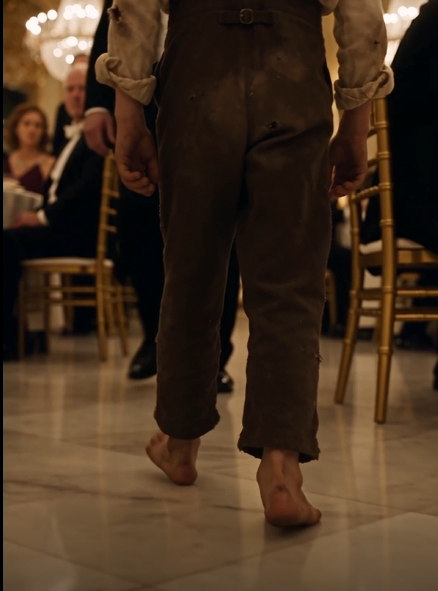
His jacket was several sizes too large. His shoes were worn almost flat, and a small canvas bag hung from one shoulder.
He didn’t look frightened.
He looked determined.
A member of the security staff noticed him and approached.
“Can I help you?”
The boy scanned the room before answering.
“I’m looking for someone.”
“Who?”
He hesitated.
“My grandmother.”
The guard’s expression softened slightly.
“What’s her name?”
“I don’t know what she calls herself now.”
That answer drew attention from several nearby guests.
The guard crouched slightly.
“How did you get here?”
“My mother told me to come.”
“Is she outside?”
The boy’s face changed.
“No.”
Before the guard could ask another question, a young woman near the center of the ballroom spoke.
“Wait.”
Everyone turned.
Nineteen-year-old Lily Hawthorne sat beside her father in a wheelchair. She had been injured in a serious accident several years earlier, but neither the accident nor the long recovery had diminished her curiosity.
She was staring at the boy.
More precisely, she was staring at his neck.
“What’s underneath your shirt?” she asked.
The boy instinctively touched his chest.
The guard glanced at Lily.
She explained.
“I saw something when he walked in.”
The boy slowly reached beneath his shirt and pulled out a chain.
A small brass pendant hung from it.
It wasn’t especially valuable.
Time had scratched its surface, and one edge was slightly bent.
But engraved into the metal was an unmistakable symbol:
a small bird resting above three stars.
The effect on the Hawthorne family was immediate.
Conversation disappeared.
An elderly woman seated near the fireplace slowly stood.
Margaret Hawthorne had spent more than forty years managing the family’s businesses and charitable foundation. People who knew her described her as composed even during the worst crises.
But when she saw the pendant, she had to steady herself against the chair.
“Come closer,” she said.
The boy obeyed.
Margaret reached toward the pendant but stopped before touching it.
“Where did you get this?”
“My mother.”
“What is her name?”
The boy swallowed.
“Elena.”
Margaret closed her eyes.
Several relatives exchanged confused looks.
Lily didn’t.
She was watching her grandmother.
“Grandma?”
Margaret opened her eyes again.
“My daughter was named Elena.”
The ballroom seemed to shrink around them.
Margaret had once had two children.
Her son, Lily’s father, had remained with the family.
Her daughter had disappeared more than a decade earlier.
For years, private investigators and family friends had searched for her. Eventually the trail ended, and the family accepted the possibility that Elena would never return.
Margaret looked at the boy again.
“What’s your name?”
“Noah.”
“How old are you?”
“Twelve.”
Margaret’s voice became quieter.
“Did your mother ever tell you her last name?”
“She said it didn’t matter anymore.”
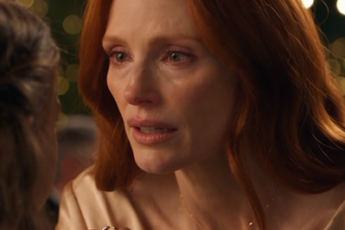
Margaret’s eyes filled with tears.
“Did she tell you anything about this pendant?”
Noah nodded.
“She said if I ever had nowhere else to go, I should bring it here.”
He turned it over.
On the back were two tiny initials and a date.
Margaret recognized them immediately.
She had ordered two pendants made decades earlier, one for each of her children. They were never sold publicly and had little monetary value.
Their importance was entirely personal.
Margaret lowered herself into a chair.
“Where is Elena?”
Noah stared at the floor.
“I don’t know.”
His mother had raised him in a small town several hours away. They lived quietly, moved several times, and rarely spoke about relatives.
Then, months earlier, Elena’s health had begun to decline.
She eventually arranged for Noah to stay temporarily with a trusted family friend while she sought treatment elsewhere.
Before leaving, she gave him the pendant and an envelope.
“She told me that if she couldn’t come back soon, I should find the house with the stone birds beside the gate.”
Everyone in the room knew those statues.
They had stood at the entrance to the Hawthorne property for generations.
Margaret’s voice broke.
“She remembered.”
Noah looked confused.
“Remembered what?”
“This was her home.”
The boy stared around the ballroom as though seeing it for the first time.
Then Margaret said the words that changed everything.
“And if Elena is your mother, I’m your grandmother.”
Noah didn’t move.
Neither did Margaret.
It was Lily who finally crossed the space between them.
She stopped beside Noah.
“There is something else.”
Margaret looked at her.
“What?”
Lily reached into the small bag attached to the side of her chair and removed a cream-colored envelope.
“I received this three weeks ago.”
Her father’s expression changed.
“You never mentioned a letter.”
“I didn’t know whether it was real.”
The envelope contained a photograph.
It showed a younger Elena sitting beneath a tree with a little boy in her arms.
Noah.
Behind the photograph was a handwritten message.
Lily had received it without a return address.
The message asked her to make sure Noah reached Margaret if he ever appeared at the estate.
Margaret stared at the handwriting.
There was no mistaking it.
She had seen her daughter write thousands of notes as a child.
“Elena sent this?”
“I think so.”
“Then she’s alive.”
For the first time since entering the ballroom, hope appeared on Noah’s face.
“You think she’s coming back?”
Lily reached for his hand.
“I think she wanted us to find each other first.”
Margaret sat silently for several moments.
Then she asked the question nobody else had dared ask.
“Why did she leave us?”
The answer came from somewhere behind them.
“I may know.”
An older man named Thomas Reed stepped forward.
He had worked on the Hawthorne estate for nearly thirty years, first as a groundskeeper and later as the property manager.
He was carrying a wooden document box.
Margaret recognized it.
It had once belonged to her late husband.
Thomas placed it on a table.
“I should have given you this years ago.”
Inside were letters.
Dozens of them.
Some envelopes had yellowed with age.
Every one was addressed to Margaret.
Every one had been written by Elena.
Margaret picked up the oldest with trembling hands.
“She wrote to me?”
“Many times.”
“Then why didn’t I receive them?”
Thomas looked across the ballroom.
His gaze settled on Margaret’s older cousin, Charles.
The man immediately looked away.
Margaret understood before anyone spoke.
“Charles?”
He remained silent.
“Tell me you didn’t do this.”
Charles finally stepped forward.
His explanation came slowly.
Years earlier, Elena had fallen in love with Daniel Reed, Thomas’s nephew, who had worked on the estate while studying.
Several members of the extended Hawthorne family strongly disapproved.
Not because Daniel had mistreated Elena.
Because he wasn’t wealthy.
They believed Elena’s relationship would create embarrassment and complicate future family arrangements.
Margaret had known people objected.
She hadn’t known how far some of them were willing to interfere.
Elena eventually became convinced that remaining near the family would mean living under constant pressure and losing control over how her child was raised.
So she left.
But she hadn’t completely abandoned her mother.
She wrote.
Again and again.
Charles had quietly prevented many of those letters from reaching Margaret.
“I thought she’d eventually come to her senses,” he said.
Margaret stared at him.
“You stole years from us.”
“I was protecting what your parents built.”
“No.”
Her voice remained calm, which somehow made the words heavier.
“You were protecting an idea of this family while destroying the actual people inside it.”
Nobody defended him.
Margaret turned back to Noah.
“I thought your mother had chosen never to speak to me again.”
Noah looked at the box of letters.
“Maybe she thought the same thing about you.”
Margaret’s face crumpled.
For the first time that evening, she cried openly.
Noah stepped forward awkwardly.
Then he wrapped his arms around her.
Margaret held him tightly.
“I am so sorry,” she whispered.
“You didn’t know.”
“I should have known.”
“You know now.”
Lily smiled through tears.
But the evening still had one surprise left.
The main doors opened.
At first, nobody paid attention.
Then Noah lifted his head.
A woman stood in the entrance.
She was thinner than the woman in Lily’s photograph. There were gray strands in her dark hair, and exhaustion showed in her face.
But Noah recognized her instantly.
“Mom?”
The woman covered her mouth.
“Noah.”
He ran.
She dropped her bag just before he reached her and wrapped both arms around him.
For several moments, nothing else in the ballroom mattered.
Elena had been receiving treatment in another city. Her condition had improved enough for her to travel, and after years of fear and uncertainty, she had finally decided that running from the past could no longer protect her son.
She had sent Lily the photograph first.
Noah’s arrival had simply happened sooner than she expected.
Margaret remained several feet away.
Mother and daughter looked at each other.
More than a decade of silence stood between them.
Margaret didn’t rush forward.
Neither did Elena.
Finally Margaret whispered:
“I never received your letters.”
Elena looked toward the wooden box.
Then toward Charles.
Understanding crossed her face.
“All those years…”
“I thought you didn’t want me.”
Elena shook her head.
“I thought you had rejected me.”
Margaret took one uncertain step closer.
“I can’t give those years back.”
“No.”
“I can’t undo what happened.”
“No.”
“But if you’ll allow me, I would like whatever years we still have.”
Elena’s eyes filled with tears.
Then she crossed the remaining distance and embraced her mother.
The orchestra remained silent.
Nobody asked it to start again.
The gala was effectively over.
Something far more important had taken its place.
In the months that followed, the Hawthornes changed in ways nobody expected.
Noah didn’t suddenly become a spoiled heir.
He disliked being treated differently because of his connection to the family.
Instead, he asked Margaret for something surprisingly simple.
“Can we help kids who don’t have somewhere safe to stay?”
That question eventually became a family project.
A building on the edge of the Hawthorne property was renovated into a community center offering temporary support, tutoring, meals, and connections to local services for families going through difficult periods.
Lily helped design the accessibility features.
Elena became involved after her recovery.
Margaret funded the project but insisted that professionals and community organizations guide its work.
And Noah?
He went back to school.
For the first time in years, he didn’t have to wonder where he would be living the following month.
He grew older.
The worn jacket disappeared.
The nervous boy who had entered the ballroom became a confident young man.
But he kept the pendant.
Years later, while sitting with Margaret on the same terrace where Elena had played as a child, Noah turned the old piece of metal over in his hand.
“I’ve always wondered something.”
“What?”
“Why did Mom trust this little thing to bring me here?”
Margaret smiled.
“Because she knew somebody in this house would recognize it.”
Noah examined the faded bird and stars.
Then he noticed something he had never seen clearly before.
A tiny inscription ran along the lower edge.
The letters had almost disappeared with age.
“What does it say?”
Margaret took the pendant and held it toward the afternoon light.
Then she smiled.
“It says that what we inherit matters less than whom we choose not to leave behind.”
Noah was quiet for a moment.
All those years, he’d assumed his mother had given him the pendant so he could find a wealthy family.
He finally understood that wealth had never been the point.
The pendant was a path back to people who had lost one another through pride, fear, silence, and someone else’s interference.
It had led him to a grandmother who thought her daughter had abandoned her.
To a mother who believed returning home was impossible.
To a cousin who had been waiting for the truth without realizing it.
And eventually, to a family willing to admit that its name and money meant very little if it couldn’t learn from what had happened.
Noah closed his fingers around the pendant.
The night he’d first entered the Hawthorne ballroom, he’d believed he was searching for relatives.
What he found was something harder to define.
A place where the truth was finally allowed to surface.
A chance for people who had lost years to stop losing more.
And, for the first time he could remember, a place he could call home.