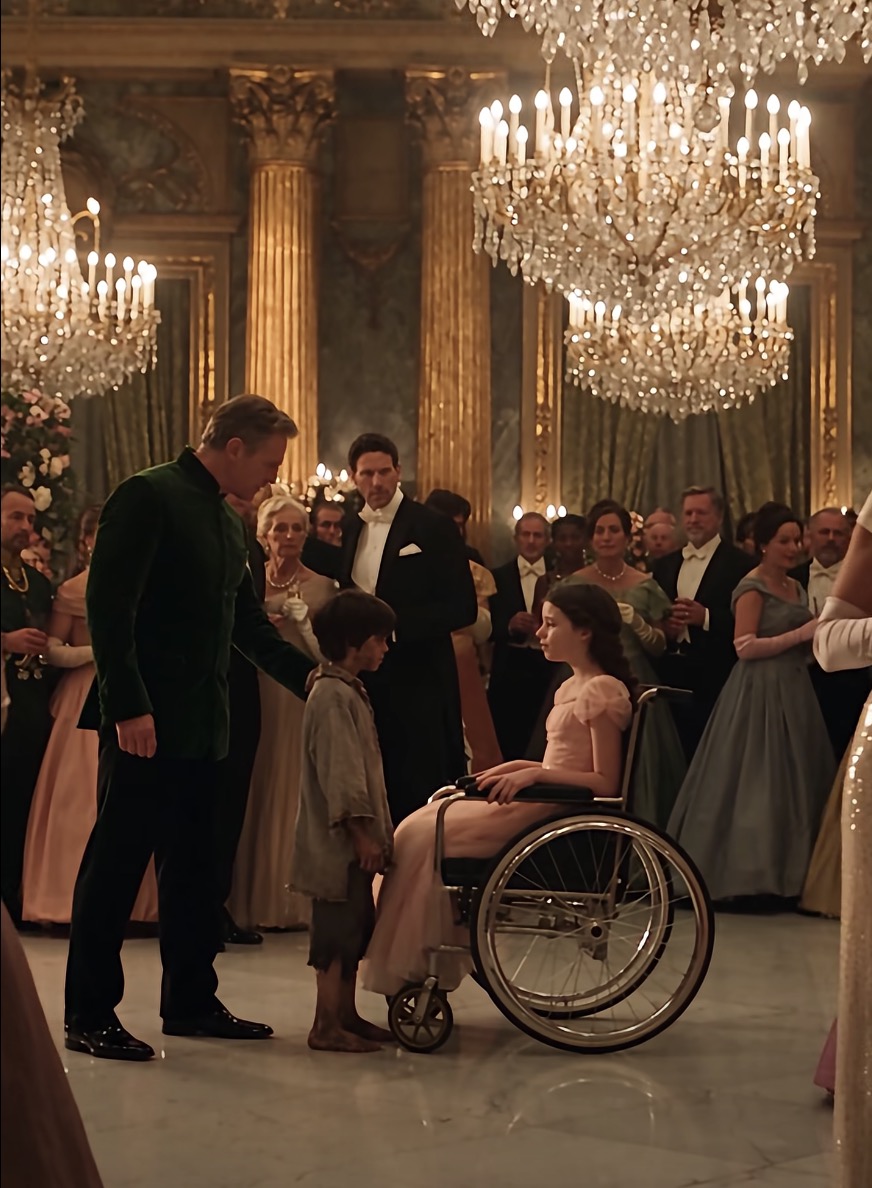
The girl remained upright as her father stepped forward.
But he was not looking at her.
His eyes were fixed on the pendant around the boy’s neck.
Color drained from his face.
The boy sensed the change and took a step back. The girl reached for his hand and held it tightly.
“Please do not,” she said.
Her father stopped.
Tears ran down her face, but fear was no longer the only emotion there. Something buried deep inside her had surfaced.
Long before the wheelchair, the doctors’ offices, and the careful voices of adults trying to protect her from difficult things, she had known another child.
A little boy who hid beside her under tables whenever adults argued.
A boy who tapped a pattern against his wrist whenever she was scared.
Tap. Tap-tap. Tap.
It meant: I am here.
She remembered it even when people told her she was confused. Even when old photographs disappeared. Even when the broken half-heart pendant became the only object that suggested someone else had once worn its matching half.
Her father looked at the boy.
“Where did you get that pendant?”
The boy did not reply.
He looked only at the girl.
Slowly, she returned to her wheelchair. Her legs shook from the effort of standing, but there had been no miracle. She had simply pushed herself beyond fear for a few seconds because, for the first time in years, something felt familiar and safe.
Her father knelt beside her.
“You remember him?” he asked.
She nodded.
Then she looked at him with quiet pain.
“You told me he was never real.”
The words filled the ballroom.
Her father lowered his eyes.
The boy’s fingers closed around the pendant. When the two metal halves touched, the small sound seemed louder than anything else in the room.
The girl touched his sleeve.
“Where did you go?”
His face tightened, but he remained silent.
Instead, he reached into the pocket of his loose trousers and pulled out an old photograph. Its corners were worn, and a crease ran through the center.
He placed it carefully in her hands.
The picture showed two children sitting on the floor of a small room.
One was a younger version of her.
The other was him.
Between them lay a complete heart-shaped pendant, still whole.
Her father saw the photograph and went still.
The girl turned it over.
Four words were written on the back in faded handwriting:
Keep them together. Always.
Her father covered his mouth.
At last, the boy looked directly at him. There was no anger in his expression—only a sadness no child should have had to carry for so long.
“Who wrote this?” the girl asked.
Her father could not answer.
The boy looked toward the edge of the ballroom.
An older woman stood there in a plain dress, her eyes fixed on the photograph. The man in the green suit followed the boy’s gaze, and the moment he recognized her, his legs seemed to weaken.
The girl looked from one face to another.
“What is happening?” she asked.
No one replied.
The barefoot boy placed the photograph gently in her lap. Then he tapped the familiar rhythm against his wrist.
Tap. Tap-tap. Tap.
The girl smiled through her tears.
Whatever the adults had hidden, whatever explanation came next, she finally knew the truth about one thing.
The boy had been real.
She had never imagined him.