“Oops.”
That was all Vanessa said after my birthday cake fell onto the stone patio.
She looked at the ruined yellow layers and cream-colored flowers, then glanced at me with a small smile.
My son Daniel stared at her.
“Vanessa, what happened?”
“I bumped into the table.”
But I had been watching.
There had been plenty of room to walk around it.
And somehow, I knew the cake hadn’t fallen because of a simple mistake.
What Vanessa didn’t understand was that the cake meant far more to me than its price.
My name is Margaret Hale.
I had been married to my husband, Thomas, for thirty-eight years.
We weren’t extraordinarily wealthy, but we had built a comfortable life together. Thomas started a landscaping company from almost nothing, and over the years we managed to buy a home and several acres outside the city.
Then one ordinary Tuesday, Thomas passed away unexpectedly.
My life changed overnight.
For months, I barely touched the garden we had created together.
I stopped hosting Sunday dinners.
I stopped baking.
Even birthdays felt like reminders of everything that had changed.
Our only son, Daniel, worried about me.
He called almost every evening and visited whenever he could.
Then Vanessa entered his life.
She was confident, fashionable, and seemed to make Daniel happy.
After a difficult divorce several years earlier, my son had finally started smiling again.
For that reason, I wanted Vanessa and me to get along.
But little comments began bothering me.
She would compliment my house and immediately suggest that it needed updating.
She once looked at an old photograph of Thomas and me and made a joking remark about my dress.
Another afternoon, while studying an antique cabinet, she asked whether Daniel would eventually inherit everything.
When I looked surprised, she laughed.
“Margaret, I’m joking.”
Perhaps she was.
So I let it go.
Three months later, Daniel proposed.
He sounded happier than I had heard him in years.
I kept my concerns to myself.
Then my sixty-fifth birthday arrived.
I didn’t want a party, but Daniel insisted.
“Dad would have wanted us to celebrate.”
That convinced me.
We planned a simple backyard gathering with family, neighbors, music and food.
And then Daniel arrived carrying a large bakery box.
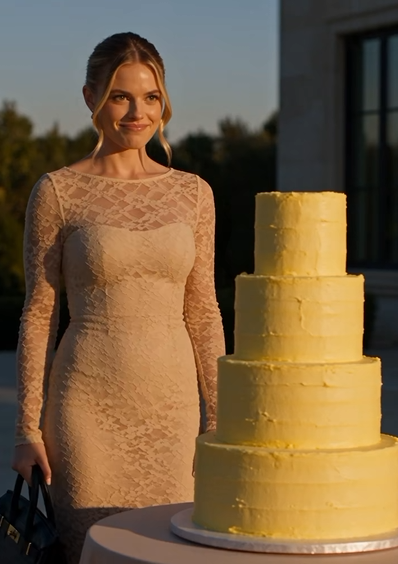
Inside was a beautiful three-tiered yellow cake.
I couldn’t speak for several seconds.
Thomas had bought me a yellow birthday cake every year since I was twenty-seven.
The first one he had attempted to bake himself. It looked terrible, but I ate two slices anyway.
After that, yellow cake became our tradition.
Daniel remembered.
“Dad would have ordered one,” he said.
I hugged him.
That cake wasn’t valuable because it came from an expensive bakery.
It was valuable because it brought back a happy memory.
And Vanessa knew the story.
The party began that afternoon.
For the first time in a long while, I looked around my backyard and felt genuinely happy.
Then Vanessa arrived.
She greeted Daniel, wished me a happy birthday and noticed the cake.
“Oh.”
Daniel smiled.
“It was Dad’s tradition.”
Vanessa simply replied, “Right.”
About twenty minutes later, I saw her crossing the patio.
The cake stood on a table near the lawn.
Vanessa passed close beside it.
Her handbag moved against the stand.
A second later, the entire cake toppled onto the patio.
Conversation stopped.
Daniel hurried over.
“What happened?”
Vanessa looked at the cake.
“Oops.”
I asked quietly, “Why?”
She frowned.
“Why what?”
“Why did you do that?”
Vanessa insisted it had been an accident.
I didn’t argue.
But Daniel had noticed something too.
“There was plenty of room around the table,” he said.
Vanessa became defensive.
“It’s only cake. We can buy another one.”
That was the problem.
To her, its value could be measured in dollars.
To me, it represented nearly four decades of birthdays with Thomas.
The conversation grew uncomfortable.
Eventually Vanessa admitted that she was frustrated by how much of Daniel’s life still revolved around our family traditions and memories.
Daniel listened in stunned silence.
I didn’t want a public confrontation.
So I told everyone we should stop arguing.
But something had already changed.
For the first time, Daniel wasn’t automatically explaining Vanessa’s behavior.
He was simply listening to what she was saying.
And sometimes listening is enough.
He finally asked:
“Did you knock the cake over intentionally?”
Vanessa hesitated.
Then she admitted that she had.
Daniel closed his eyes.
“Why?”
Her answer revealed that the real problem had never been a cake.
She resented how often Daniel visited me, our Sunday dinners, and the place his father’s memory still had in our family.
She believed that after they married, those things should change.
Daniel stared at her.
Then he quietly said:
“I don’t think we should get married.”
Vanessa looked shocked.
“You’re ending our engagement over a cake?”
Daniel shook his head.
“No. The cake just made me pay attention to everything else.”
Their engagement ended that afternoon.
After Vanessa left, nobody knew how to continue the party.
Then my neighbor Susan clapped her hands.
“Who knows how to bake?”
Within minutes, half my guests were crowded into my kitchen.
Someone found flour.
Someone else found eggs and sugar.
Children competed over who would stir the batter.
The result was possibly the ugliest yellow cake I had ever seen.
It leaned slightly.
The frosting began melting because nobody had waited for it to cool.
And the birthday message was misspelled.
I laughed until tears filled my eyes.
Daniel stood beside me.
“I’m sorry, Mom.”
I squeezed his hand.
“Sometimes people understand things only when they’re ready to see them.”
Then we ate our imperfect cake.
It was wonderful.
Six months later, Daniel appeared at my house carrying another small yellow cake.
“It isn’t my birthday,” I said.
“I know.”
Across the top were four words:
FOR NO REASON AT ALL.
I smiled.
“Your father used to do things like this.”
“I remember.”
We ate cake at ten in the morning.
A year after my birthday party, Vanessa’s former friend Claire unexpectedly visited me.
She brought several printed messages that Vanessa had sent months earlier.
The messages suggested that Vanessa had been thinking about Daniel’s future relationship with my property and believed that, after marriage, she could persuade him to distance himself from some of his family responsibilities.
Claire apologized for not speaking sooner.
I didn’t judge her.
Sometimes people remain silent because they don’t know when loyalty has become the wrong choice.
Daniel read the messages.
Then he looked around the kitchen where he had spent so much of his childhood.
“She wasn’t really angry about the cake, was she?”
“No.”
He nodded slowly.
And finally, the last unanswered questions from that birthday disappeared.
Two years later, Daniel met Rachel, a school librarian.
The first time Rachel visited, she noticed a photograph of Thomas.
“Was that your husband?”
“Yes.”
“You look very happy together.”
“We were.”
She smiled.
“Daniel talks about him often.”
Something about that simple response stayed with me.
Rachel never treated our memories as competition.
She understood that loving someone in the present didn’t require erasing the people who had mattered in the past.
A year later, Daniel proposed.
They chose to marry in my backyard.
On the morning of the wedding, Rachel appeared in my kitchen wearing her wedding dress.
“I need to show you something.”
She opened the refrigerator.
Inside was a three-tiered yellow cake.
It looked almost exactly like the one from my sixty-fifth birthday.
I stared at it.
Rachel suddenly looked nervous.
“Daniel told me the story. I thought maybe we could give that memory a different ending.”
I hugged her.
That afternoon, Daniel and Rachel exchanged vows beneath the old oak tree.
Later, the yellow cake was carried outside.
Everyone who had attended my birthday recognized the connection immediately.
Rachel handed me the first slice.
“The bride should have the first piece,” I protested.
“Not today.”
I looked down at the cake and thought about Thomas.
For years, I had believed certain objects carried our memories.
The cakes.
The house.
The photographs.
But I finally understood that memories don’t disappear when something breaks.
They live in the people who remember.
And people can create new memories without replacing the old ones.
I tasted the cake.
Rachel watched nervously.
“Well?”
I pretended to think seriously.
“Thomas’s first cake was better.”
Daniel burst out laughing.
Rachel stared at me before realizing I was joking.
Soon everyone was laughing with us.
Standing there in the evening sunlight, surrounded by the people I loved, I finally understood something.
A good life isn’t a life in which nothing ever goes wrong.
Plans change.
Relationships sometimes end.
Things we value can be damaged.
A good life is what happens afterward.
It’s finding the people who will walk into the kitchen with you, gather whatever ingredients remain, and help you begin again.
And sometimes, when you do…
the second cake becomes an even better memory than the first.