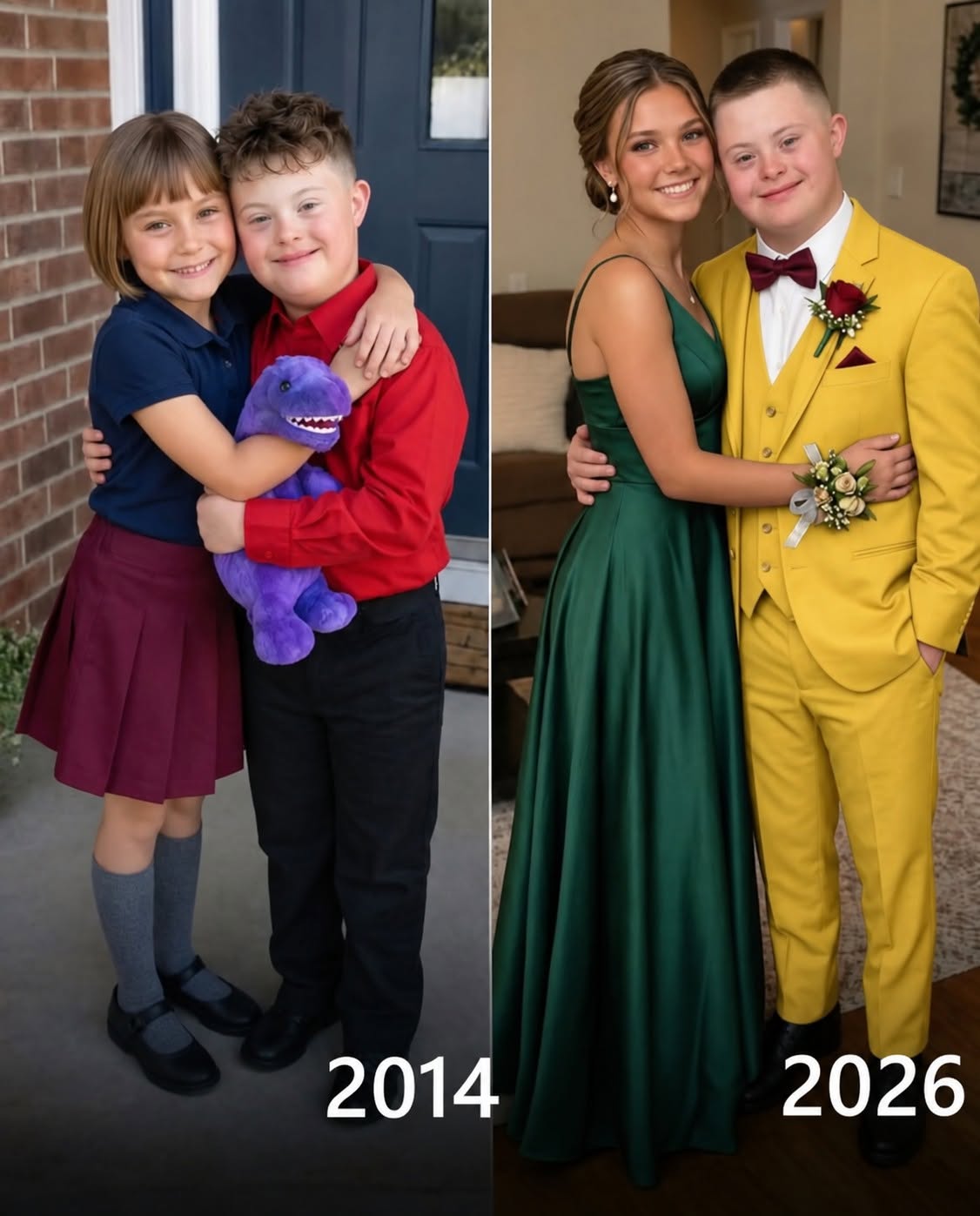
When I was six years old, I made Noah a promise neither of us fully understood.
Twelve years later, he arrived at my house dressed for senior prom, holding a corsage and wearing the proudest smile I’d ever seen.
I thought we were finally going to keep that childhood promise.
Then Mom pulled me upstairs, locked my bedroom door, and said:
“You can go with Noah. But before you do, you need to know why I’m afraid of tonight.”
That was when I learned there had been another promise involving Noah.
One made during the worst year of my family’s life.
And unlike mine, it had been kept secret.
Noah and I met in first grade.
Our friendship was founded on two principles we considered extremely important at six years old:
Raisins ruined perfectly good food.
And dinosaurs were objectively fascinating.
Noah has Down syndrome.
But as a child, that wasn’t how I defined him.
He was simply Noah.
He remembered baseball statistics nobody had asked for.
He could spend twenty minutes explaining why my favorite dinosaur wasn’t as impressive as I thought.
And he had absolutely no respect for my artistic ambitions.
Once, I proudly showed him a picture I’d drawn.
He studied it seriously.
Then he said:
“Why does it look like a potato?”
“It’s a horse!”
“That makes it worse.”
I didn’t speak to him for approximately eleven minutes.
Then we were best friends again.
The prom promise happened after our teacher announced she was getting married.
Suddenly everyone in class was discussing weddings.
Noah announced that his wedding would have chocolate cake and no slow music.
Another boy laughed.
“Who’s going to marry you?”
Noah stopped smiling.
I didn’t understand everything behind that question.
I understood enough.
“Someone will.”
Noah looked at me.
“You?”
At six, romance was somewhere below dinosaurs and chocolate milk on my list of priorities.
“Maybe when we’re old.”
Then I remembered something my older cousin had recently explained.
“But first we have to go to prom.”
“What’s prom?”
“A fancy dance.”
He considered this.
“With cake?”
“I don’t know.”
“Then weddings are better.”
I laughed.
Noah held out his pinkie anyway.
“Prom?”
I hooked mine around his.
“Prom.”
I forgot about that conversation.
Noah didn’t.
Our friendship survived the next twelve years.
We didn’t remain attached at the hip.
We developed different interests and different groups of friends.
But somehow, whenever something important happened, Noah was there.
When my parents divorced, he never asked me to explain why I was angry.
He just came over.
When I failed my driving test, he created a handmade certificate declaring me “Most Dangerous Future Driver.”
When my first serious boyfriend broke up with me, Noah appeared with ice cream.
“I never liked him,” he announced.
“You invited him to your birthday.”
“I was being polite.”
“You gave him the biggest piece of cake.”
Noah shrugged.
“I made a mistake.”
That was Noah.
He couldn’t magically fix my life.
He simply had a gift for making difficult days feel less lonely.
So when senior prom approached, he reminded me of our promise.
“You owe me a dance.”
I stared at him.
“What?”
“First grade.”
Then I remembered.
“You seriously remember that?”
“You promised.”
I laughed.
“All right.”
He immediately pulled out his phone.
“What are you doing?”
“Ordering my bow tie.”
“You already picked one?”
“Three months ago.”
Apparently, my participation had been considered inevitable.
When I told Mom I was going with Noah, she became strangely quiet.
I assumed she was emotional because we’d been friends for so long.
I was wrong.
Prom night arrived.
Noah appeared at our front door in a dark suit with a bow tie and a corsage he’d apparently spent far too long choosing.
Mom opened the door.
Her face changed.
Not because of Noah.
Because of something she saw behind him.
A car was parked at the curb.
Noah’s mother was driving.
She waved through the windshield.
Mom went pale.
Then she turned to me.
“Christina, upstairs. Please.”
“What?”
“Now.”
I followed her.
Inside my bedroom, she closed the door.
Then locked it.
“Mom, you’re freaking me out.”
She sat on my bed.
“You can still go.”
“Obviously.”
“But there’s one condition.”
I stared at her.
“What condition?”
“You have to listen to everything I’m about to tell you before you decide.”
“Decide what?”
Her eyes filled with tears.
“Whether you’re ready to know what Noah did for our family.”
That made no sense.
“Noah was a kid.”
“I know.”
She took a breath.
“Do you remember much about the year your father left?”
Fragments.
Arguments behind doors.
Mom crying in the laundry room because she thought I couldn’t hear her.
Moving temporarily into my aunt’s apartment.
Being angry without really understanding what I was angry about.
“I remember some of it.”
“What do you remember about me?”
I hesitated.
“You were sad.”
Mom nodded.
“I was more than sad.”
She didn’t give me a diagnosis or turn the conversation into a medical confession.
She simply explained that after the divorce, she had gone through a period when everyday responsibilities became overwhelming.
She struggled to sleep.
She sometimes forgot meals.
There were mornings when getting out of bed felt nearly impossible.
She had hidden most of it from me.
Or thought she had.
“Why are you telling me this tonight?”
“Because one afternoon, you weren’t supposed to be home.”
I frowned.
Then she told me.
I had been seven.
School had ended early because of a maintenance problem.
Noah and I were supposed to wait with his mother until Mom could pick me up.
Instead, Mom didn’t answer her phone.
Noah’s mother became concerned and drove us home.
I apparently ran inside first.
Mom was upstairs.
She wasn’t responding norma