All my life, I had hoped my father would one day be proud of me. I never imagined I would have to defend the home my grandfather left me in court—or discover that our family dispute concealed a much older story.
My name is Evelyn Carter. I spent much of my life serving in the U.S. Navy. I came home with medals, painful memories, and a knee injury that reminded me every day of the missions I had survived.
Yet in my parents’ eyes, I was still the daughter who had never followed the path they had chosen for her.
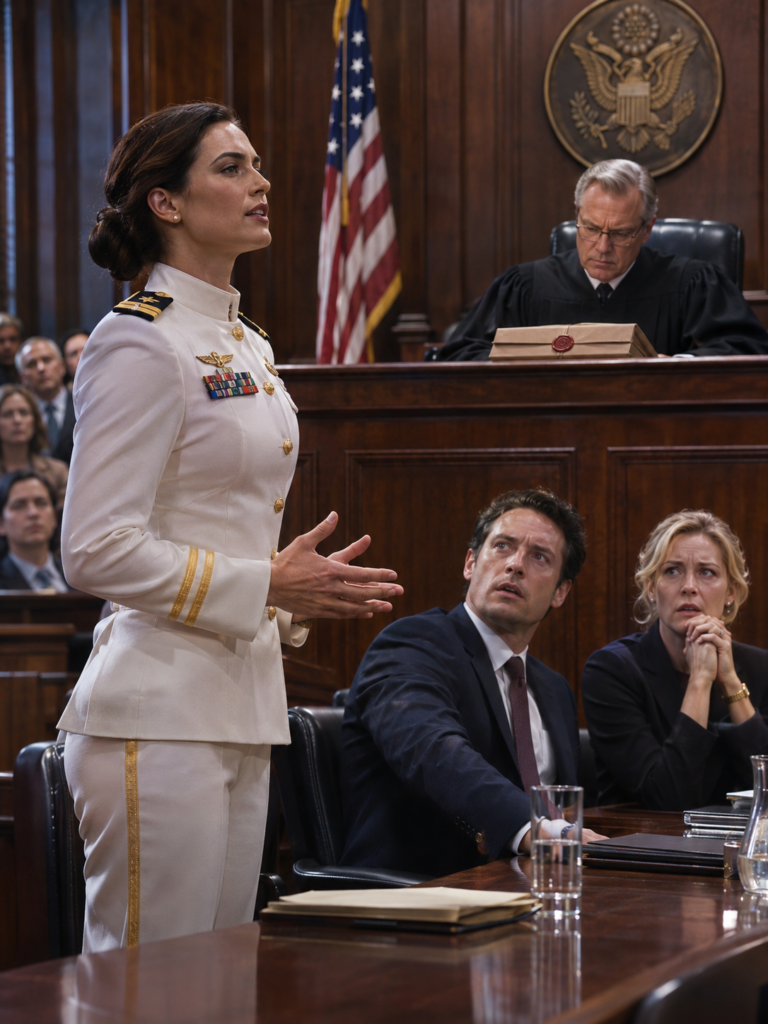
That morning in court, my father, Robert, claimed I had abandoned the family farm and that my parents had been left to maintain it on their own.
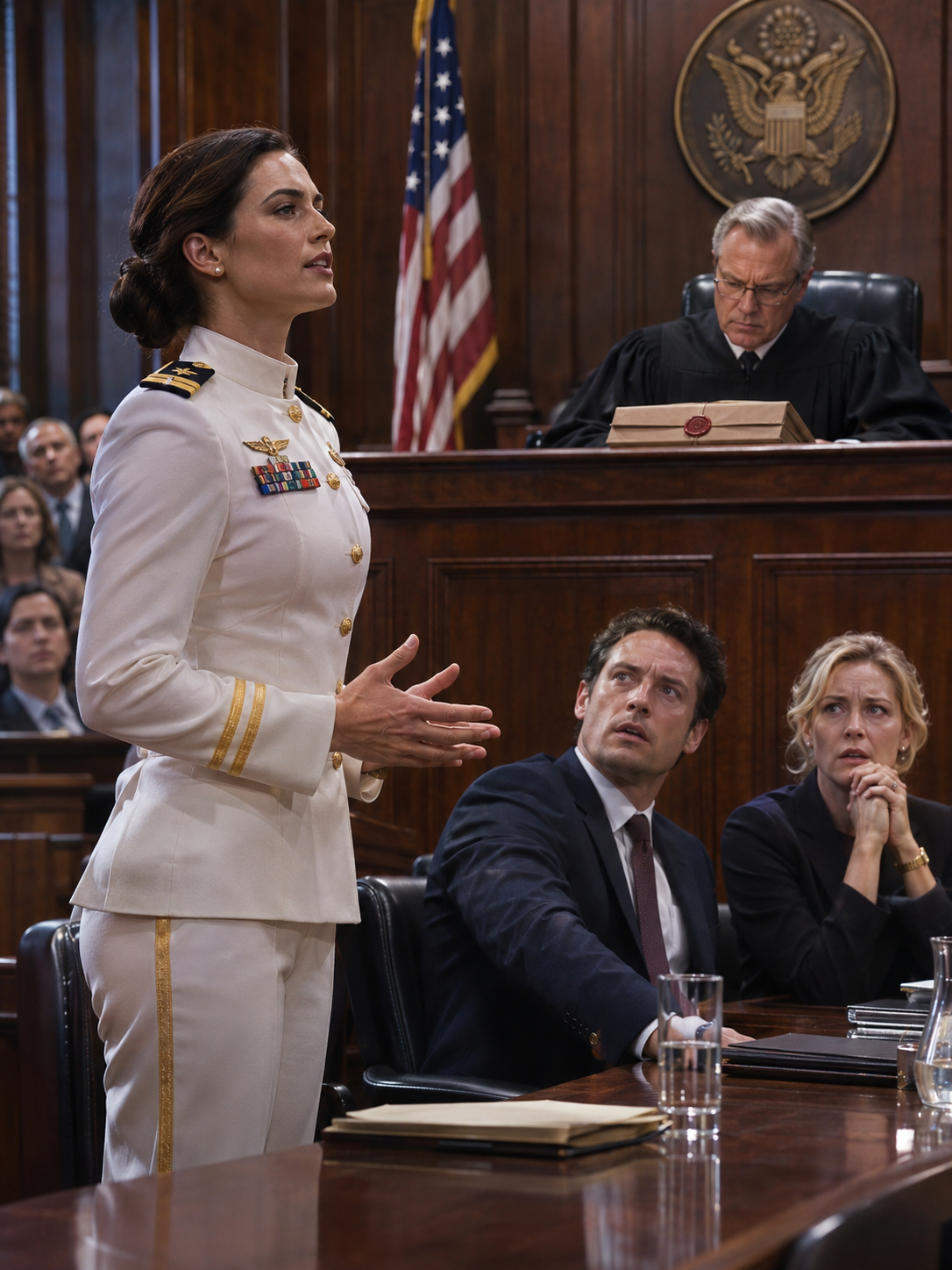
The judge, Simmons, was about to review the documents when he noticed my uniform.
“Commander Carter, did you take part in a mission in Afghanistan during which a lieutenant named Daniel Simmons was rescued?”
I was quiet for a few seconds.
“Yes, Your Honor.”
His expression changed.
“Daniel is my son. He told me what you did for him.”
A murmur swept through the courtroom.
I was transported back to that mission—the calls for help, the difficult evacuation, and the men who had risked their lives for their fellow servicemembers.
Most of all, I thought of Aaron Lewis, my best friend, who had never returned from another operation.
My father seemed unable to understand why the judge treated me with such respect.
But the hearing wasn’t about my military service.
It was about our farm.
My attorney, Sarah Mitchell, presented thirteen years of records: property taxes, insurance payments, repairs, and maintenance expenses.
They all showed that I had continued paying for the property, even while I was stationed overseas.
Then Sarah revealed something far more troubling.
My parents had started the process of selling the farm without my permission. One of the documents even bore a signature presented as mine—one I firmly denied writing.
My father tried to justify his decisions by pointing to the family’s financial difficulties.
I simply asked him why he had never told me about them.
His answer hurt more than all his accusations.
“You chose your career over us.”
My throat tightened.
“I never asked you to approve of every decision I made, Dad. I only wanted you to respect the person I became.”
Then my attorney placed one last file before the court.
It contained my grandfather Thomas’s written wishes. He had left the farm to me personally and set aside a neighboring plot for a project supporting veterans and their families.
The judge ruled that the evidence did not give my parents grounds to claim ownership of the property.
The farm was still mine.
I should have felt relieved.
But as we left the courthouse, Sarah told me that another document existed in the family trust’s archives. A few moments later, a recent photograph of the farm arrived on my phone.
Someone had been inside while I was away.
Beneath the image was a mysterious message:
“Ask the judge why his son was really involved in that mission.”
I realized the story was far from over.
Sarah alerted the authorities, and we returned to the property with officers. My old dog, Knox, was safe, but someone had tied a small envelope to his collar.
Inside were a key and a note referring to a promise my grandfather had made.
The key fit an old compartment in his workshop. With help from the officers, we examined it.
We found a photograph, several documents, and a small recording device.
The photograph showed my grandfather, my father, Judge Simmons, and Aaron Lewis.
I stared at their faces. The picture had been taken before I had even met Aaron.
Why had he never told me he knew my family?
The recording began to provide some answers.
My grandfather had once worked in a field connected to defense equipment. He had discovered troubling irregularities in certain contracts and refused to stay silent.
My father had been professionally connected to people involved in those matters.
Aaron, meanwhile, had taken part in efforts to investigate the irregularities.
A letter from my grandfather confirmed that he had entrusted some information to Aaron, hoping to protect the people who might be affected.
I understood then that my friend had known part of my story long before I did.
Judge Simmons eventually agreed to meet with us. He explained that his son, Daniel, and Aaron had tried to deliver important documents to investigators. There had also been inconsistencies in the information about the route taken by the convoy involved in the accident that had changed our lives.
None of those discoveries, by themselves, established who was responsible for everything.
But they were enough to justify a thorough investigation.
That night, Daniel arrived with Lily, Aaron’s daughter. She had grown so much since I had last seen her.
She was carrying a box of records her family had kept. Among them were communications that appeared to connect an influential contractor, Charles Voss, to several disputed decisions. Some messages also came from an account associated with my father’s former business activities.
I felt unsteady.
Could my own father have played a part, even indirectly, in the circumstances that had cost Aaron his life?
Daniel reminded me that the evidence would need to be authenticated and reviewed by investigators.
Then another discovery shook me.
A message attributed to my father showed that he had tried to stop an operation when he learned I might be in danger.
That didn’t erase his earlier decisions.
But it revealed a more complicated story than the one I had imagined.
A few hours later, Robert arrived at the farm.
He didn’t come to argue. He brought a box of old documents and admitted that he had hidden information for years, afraid of the consequences and under pressure from people he had become involved with.
My mother also admitted that she had taken part in some of the silence.
I listened without interrupting. Then I told them that admitting their mistakes was necessary, but our relationship could not immediately return to the way it had been.
For the first time, they accepted my answer.
We handed the documents over to the proper authorities. Slowly, the investigation began to piece together what had happened.
Charles Voss faced charges related to contract irregularities and attempts to cover them up. My father, too, had to answer for his own role.
The truth could not undo the losses or the years of pain.
But it brought an end to a long period in which too many questions had gone unanswered.
Amid all those revelations, Lily brought me something I never would have expected: a photograph of a little girl named Grace.
She was the daughter of Nadia, an interpreter I had helped during a mission overseas. Nadia had died later, and Aaron’s family had helped raise Grace.
Before she died, Nadia had expressed the hope that I might one day find her daughter.
When Grace arrived at the farm, she stood in the doorway for a long time.
“Are you Evelyn?”
I knelt so I was at her eye level.
“Yes, sweetheart.”
She hesitated.
“They told me you helped my mom.”
I nodded, unable to hold back my tears.
Grace stepped closer and gently wrapped her arms around me.
That moment opened a new chapter in my life.
As time passed, we got to know each other. Grace explored the farm, grew fond of Knox, and spent long afternoons in the garden with Lily. We began the necessary process with the people responsible for her care, always taking her wishes and well-being into account.
A year later, the land my grandfather had set aside became the site of a rehabilitation and support center for veterans and their families.
We named it the Aaron Lewis Center.
At the opening ceremony, I looked at Lily, Daniel, Sarah, and Grace gathered beneath the great oak tree.
I thought of my grandfather, of Aaron, and of everyone who had taught me that courage wasn’t only about facing hardship.
It was also about learning to live after it.
That day, I was given a small pendant my grandfather had left for the center’s opening. It was shaped like a compass. On the back, a short inscription reminded me that he had always believed I could find my own way.
A few weeks earlier, I had also received a letter from my father.
He admitted his mistakes and finally wrote the words I had waited to hear since childhood: he was proud of me.
I wasn’t ready to forgive him completely.
But I no longer needed his approval to move forward.
On the evening of the center’s opening, Grace sat beside me on the porch.
“Do you think your grandfather would have loved me?”
I looked at the old oak, then at the house glowing in the evening light.
“I’m sure he would have been so happy to meet you.”
She rested her head against my shoulder.
Inside, Lily was making dinner while Knox waited patiently in case a crumb fell from the table.
For the first time in a long while, the silence of the farm no longer felt sad.
The home I had nearly lost had become the place where I was rebuilding my future.
I hadn’t regained everything life had taken from me.
But I had discovered something essential: the people we’ve lost can keep guiding us through what they leave behind.
And the best way to honor their memory isn’t to remain trapped in the past.
It’s to give the happiness still waiting for us a chance.
I took Grace’s hand, and we went inside together.
THE END