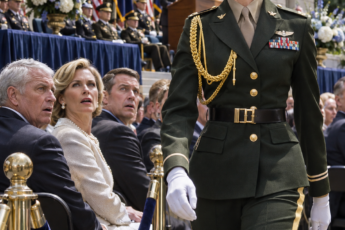
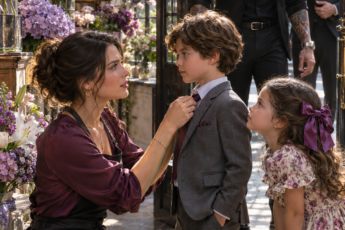
That evening, the grand ballroom of the Vale mansion glittered as if the guests had gathered among the stars. Towering gilded columns framed enormous crystal chandeliers, and the polished marble floor reflected the colors of the evening gowns. The guests spoke in quiet voices as they waited for the host, Adrian Vale, to address them.
Adrian was known for his wealth, his stern manner, and the tattoos along his neck. His fiancée, Claire, stood beside him in an elegant champagne-colored gown. They were about to announce what they planned to do with the mansion’s old ballroom. Most guests assumed it would become yet another lavish reception hall.
Only Adrian knew he had already decided to sell it.
The music suddenly stopped. Everyone looked up.
High above the floor, balanced on a narrow strip of golden fabric, stood a young woman. She wore a black uniform with a white collar and a white apron tied around her waist. She was barefoot, her arms stretched wide as if she were holding the entire ballroom in place.
The maid, Emily, kept her eyes on the people below. She wasn’t trembling. Her face showed neither fear nor doubt.
Adrian could hardly believe what he was seeing.
“What the hell is she doing up there?” he whispered.
Claire covered her mouth with one hand.
Emily smiled.
“Don’t worry. I know exactly what I’m doing.”
The golden support shifted slightly beneath her feet. A sharp tearing sound echoed through the ballroom. Several guests sprang to their feet. Claire cried out:
“Watch out!”
The support gave way.
Emily fell. The guests held their breath. Her apron fluttered as she turned in midair, pointing her feet toward the floor at just the right moment. She bent her knees, touched the marble with one hand, and came to a safe stop.
For a moment, the ballroom fell silent.
Then the guests began to murmur. Some applauded; others still couldn’t believe what they had seen. Adrian stared at her, frozen.
Emily straightened her apron, lifted her chin, and calmly said:
“I told you.”
But the story didn’t end there.
Emily took a small, worn photograph from her pocket. She walked to the stage and placed it in front of Adrian. The picture showed a young woman standing in the center of the ballroom beneath the same high ceiling. Her dress was simple, but her face was filled with joy, as if nothing in the world could hold her back.

Adrian’s expression changed.
“Where did you get this?” he asked.
“That’s my grandmother, Rosa,” Emily replied. “She worked in this house for thirty years. And when the guests had gone, she used to dance in this very ballroom.”
Adrian looked at the photograph again. His mother, Margaret, had told him since childhood that one of the maids in the mansion, Rosa, had taught her to dance. He remembered his mother repeating the story, saying Rosa had taught her not only the steps, but how to stand in the center of a stage without fear.
“Did my mother know you?” he asked.
“She never met me. But my grandmother told me about her. She said your mother was the only person who noticed that a maid’s granddaughter could have a dream, too.”
Emily turned to face the guests.
“I wore this uniform because everyone here needed to see what my grandmother saw. A person’s worth isn’t measured by what they wear or the job they do. My grandmother taught me to dance in this ballroom, but she never dared to enter it when the guests were here. She wanted me to stand here one day and never hide who I am.”
Claire looked at Adrian, moved. She was the first to applaud. The guests soon joined her, and applause filled the ballroom.
Adrian was still looking at the photograph. His mother had died three years earlier, and he had decided to sell the mansion believing the room was nothing more than an old, unused space. But that night, he understood that the ballroom held a story far greater than his family’s wealth.
He stepped onto the stage.
“This ballroom will not be sold,” he announced. “It will become a free dance center for children who don’t have a place to pursue their dreams.”
Emily looked at him in surprise.
“I want you to run it,” Adrian continued. “And the first class will begin right here.”
Claire approached Emily and took her hand.
“And I’ll help find the children who have never had the chance to dance.”
At that moment, the ballroom doors swung open. A group of children from a local foster home stood at the entrance. They had come as surprise guests for the evening, but no one had told them what was about to happen.
Emily knelt in front of them.
“Who wants to dance first?”
A little girl stepped forward. Her shoes were worn, but her eyes sparkled. Emily offered her hand, and the girl took it.
The music began again, soft and warm this time. Emily and the girl moved across the center of the ballroom. Soon, the other children joined them. Some laughed; others took shy little steps. But every face held the same joy.
Adrian stood beside the photograph. For the first time in years, he saw his mother not as a face in an old picture, but as a woman whose kindness had reached all the way to a day when she was no longer there.
The golden ribbon that had once seemed like a dangerous support remained suspended from the ceiling—not as a trick, but as a reminder that sometimes life lifts you up so you can see who needs your help next.
After that night, Emily was no longer just a maid to anyone. She became the first teacher in the ballroom where her grandmother had once secretly dreamed of dancing.
And whenever children asked why a golden ribbon hung above the center of the dance floor, Emily smiled and said:
“Because even the smallest piece of ribbon can help you rise, if you believe in your own steps.”