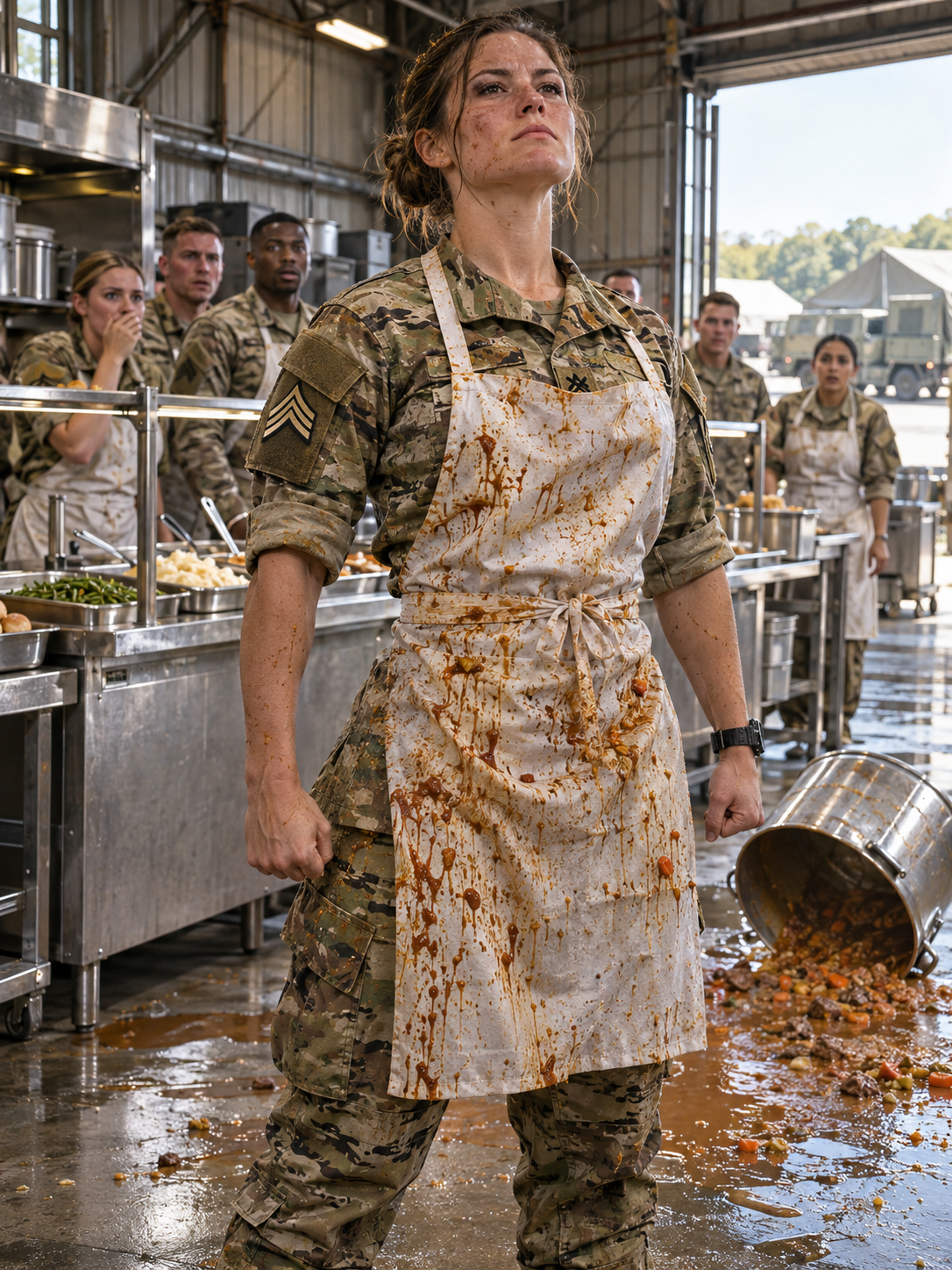
“Go ahead. Call your daddy. Let’s see if he can save you.”
General Crowe laughed as he said those words in front of forty soldiers.
Moments earlier, he had picked up a pot filled with dirty water and coffee grounds and deliberately emptied it over my head.
My uniform was soaked.
Cold water ran down the back of my neck.
Nobody said a word.
My name is Kiara Johnson. I’m twenty-four years old, and I’m a sergeant in the United States Army, specializing in military food services.
That day, I was working in the dining facility at Fort Irwin, California.
Lunch service was running forty-five minutes behind schedule, and General Crowe was furious.
He had already insulted me in front of everyone.
Then he decided that humiliating me wasn’t enough.
“You’re nothing but a cook,” he sneered. “You should know that generals eat first.”
When he challenged me to call my father, I quietly reached for my phone.
Crowe was still smiling.
But that smile wouldn’t last much longer.
Because my father was a four-star general.
“Dad?”
I heard his familiar voice on the other end.
“Kiara? What’s wrong?”
I struggled to keep my breathing steady.
“There’s a general here who would like to meet you.”
My father didn’t even ask for his name.
“Are you hurt?”
“No.”
“Do you need me to come?”
I looked at Crowe.
He was still grinning, apparently expecting everyone else to laugh along with him.
Behind him stood a captain holding the phone he had used to record the incident.
“Yes, Dad,” I answered. “And please bring someone with you.”
I ended the call.
Then I slowly removed my drenched apron.
Private Morales, who had been surviving on cold field rations for several days, placed her tray on the counter and handed me a stack of paper towels.
“Thank you,” I whispered.
She looked at my soaked uniform.
“Are you all right, Sergeant?”
I nodded.
“Your lunch is getting cold, Morales.”
“It can wait.”
I wiped my face.
Behind her, dozens of soldiers stood in uncomfortable silence.
Nobody seemed to know what to do.
My assistant, Corporal Evans, emerged from the kitchen carrying a clean apron.
He noticed the puddle on the floor, then looked at me.
I pointed toward the covered food containers.
“Replace the serving utensils and resume service. Start with Morales.”
Evans nodded.
The first sound to break the silence was a metal serving spoon tapping against a container.
Gradually, the dining hall returned to life.
Chairs scraped against the floor.
Soldiers resumed eating.
But every time a door opened, everyone turned to look.
Five minutes later, my father entered through the side entrance.
Beside him was Colonel Ruiz, my brigade commander.
Four stars rested on each of my father’s shoulders.
General Crowe immediately straightened.
“General Johnson! I didn’t realize you were still at Fort Irwin.”
“My meeting ended ten minutes ago, Dennis.”
Crowe forced an uneasy smile.
“I also had no idea this sergeant was your daughter.”
My father didn’t respond immediately.
He examined the coffee grounds scattered across the floor.
Then he looked at my wet uniform.
For a moment, I thought he was going to walk straight toward me.
Instead, he turned to Crowe.
“Well, now you know. Tell the colonel exactly what you did before you found out.”
Crowe swallowed.
“Lunch was delayed. The sergeant became agitated. There was a misunderstanding, and the pot accidentally spilled.”
I remained perfectly still.
He had just turned a deliberate act of humiliation into an unfortunate accident.
Then a chair scraped behind me.
Private Morales stood up.
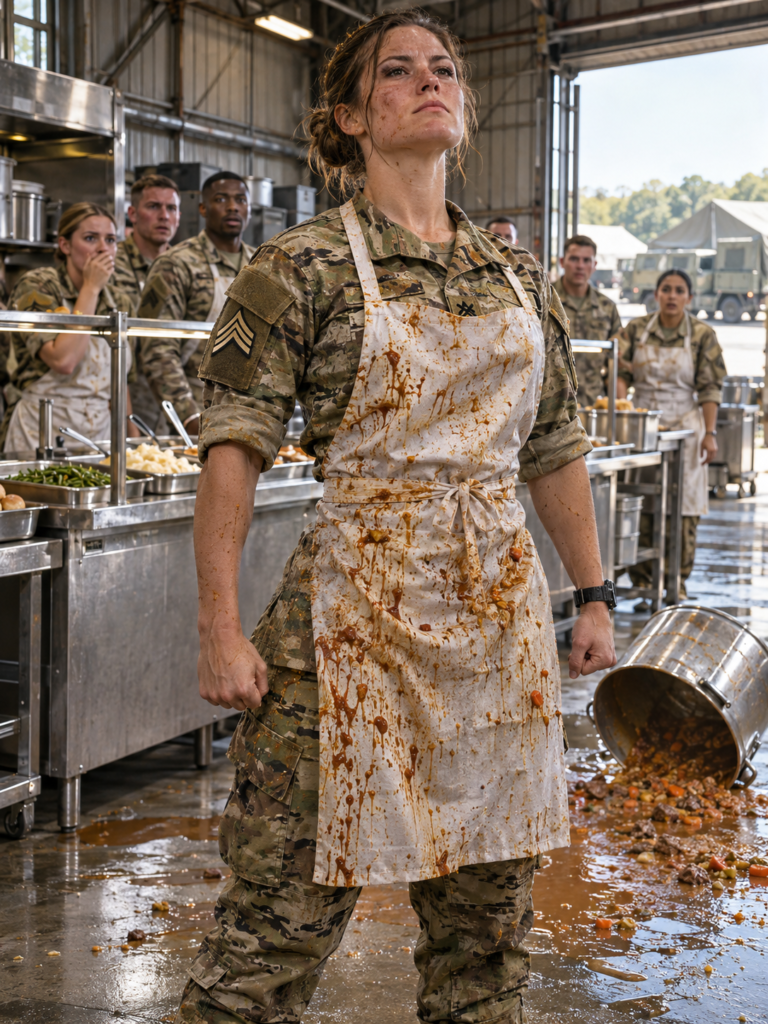
She was still holding her fork.
“That’s not what happened, sir.”
Crowe turned sharply toward her.
Morales placed her fork on the table.
For a second, I thought she might lose her nerve and sit down.
But she didn’t.
“The general picked up the pot with both hands.”
The entire dining hall fell silent.
“He waited until Sergeant Johnson looked at him. Then he poured everything over her.”
Colonel Ruiz took out a notebook.
“Name and rank?”
“Private Morales, ma’am.”
Ruiz recorded her information before addressing the room.
“Did anyone else witness this?”
The captain who had recorded the incident stepped forward.
“I have a video, Colonel.”
Crowe stared at him.
“Captain…”
But the officer didn’t back down.
He looked at his phone with visible shame.
“You can hear me laughing in the recording, too,” he admitted.
Then he presented the evidence to Colonel Ruiz.
She instructed him to preserve the original recording.
Finally, she turned toward me.
“Sergeant Johnson, are you able to explain what happened?”
I straightened my shoulders.
“Yes, ma’am.”
I told her everything.
Including the real reason lunch had been delayed.
Shortly before service was scheduled to begin, a regulator in the propane system had started losing pressure.
I had immediately ordered the burners shut down.
No meal was worth risking the safety of my kitchen staff or the soldiers we served.
I had sent Evans to retrieve replacement equipment.
Every decision had been documented in the kitchen’s maintenance and incident records.
“The first meal was served at twelve thirty-five,” I explained. “General Crowe arrived at twelve forty.”
Colonel Ruiz examined the records.
The timestamps matched my account.
Crowe said nothing.
He had arrived only five minutes after service resumed.
Had he simply joined the line, he probably would have finished eating by then.
Colonel Ruiz closed her notebook.
“General Crowe, please come with me.”
Before leaving, she addressed my father.
“General Johnson, I’ll need a written statement regarding the timing and content of your daughter’s call.”
“You’ll have it before the end of the day.”
Then he added something I would never forget.
“I would also like confirmation of who will oversee the investigation. I’ll remove myself from the process.”
He wasn’t going to use his rank to determine the outcome.
He wanted the truth to stand on its own.
When the door closed behind them, the dining hall became quiet again.
Only the refrigerators could be heard humming in the background.
My father waited until I looked at him.
“Can I give you a hug?”
I nodded.
He wrapped his arms around me.
For those few seconds, he wasn’t a four-star general.
He was simply my dad.
When he stepped back, a coffee stain remained on the sleeve of his immaculate uniform.
“Dad,” I whispered, “when you answered the phone, I almost started crying.”
“I could hear it.”
“But I barely said anything.”
He smiled gently.
“Exactly.”
For the first time since the incident, I felt the tension begin to leave my body.
The smell of roasted chicken drifted from the kitchen.
Evans lifted the lid from one of the serving containers.
My father glanced toward the counter.
“Am I too late for lunch?”
I pointed toward the stack of trays.
He picked one up.
Then he walked to the back of the line, standing behind a young soldier whose trousers were covered in dust.
Four stars on his shoulders. Not a single demand to be served first.
Two months later, I received the official findings.
The investigation had confirmed my account.
Private Morales’s testimony, the captain’s recording, and the dining facility’s records provided clear evidence of what had happened.
General Crowe had been relieved of his duties.
His original explanation was included in the investigation file.
The pot had accidentally spilled.
Whenever I remembered those words, I could still hear the sound of metal crashing against the floor.
For several weeks afterward, I flinched whenever someone dropped a lid in the kitchen.
Evans noticed.
From that moment on, whenever he walked behind me carrying a heavy pot, he announced himself.
“Behind you, Sergeant.”
It was such a small gesture.
But it meant more than he probably realized.
Even after I stopped flinching, he continued doing it.
He never treated me as though I were fragile.
He simply paid attention.
And sometimes, especially after a difficult day, that quiet consideration was exactly what I needed.
In December, Morales returned to my dining facility.
This time, she wore corporal’s stripes.
Three young soldiers recently assigned to her team accompanied her.
One of them stepped aside, holding his tray awkwardly against his leg.
“Go ahead, Corporal. You can eat first.”
Morales gently straightened the edge of his tray.
“You go ahead. There’s enough for everyone.”
She allowed all three soldiers to receive their meals before her.
I watched them move through the serving line.
Finally, Morales approached my station.
Only one piece of roasted chicken remained.
I had deliberately saved the one with the crispiest skin.
I remembered it was her favorite.
I placed it on her tray.
“Morales, I never properly thanked you for what you did that day.”
She looked at me thoughtfully.
“Sergeant, that morning, I thought everyone was going to stand up.”
She lowered her eyes.
“I was already standing when I realized I was the only one.”
I looked at her for a moment.
Then I said:
“But you stayed standing anyway.”
Morales smiled.
“It didn’t feel right to stay silent.”
I remembered how she had put down her lunch to offer me paper towels.
How she had contradicted a powerful general in front of an entire room.
How much courage it must have taken to speak when nobody else would.
She hadn’t done it to earn a promotion.
She hadn’t known whether anyone would support her.
She hadn’t known what consequences might follow.
She had simply chosen to tell the truth.
Morales picked up her tray and headed toward the tables.
Her three young soldiers had already begun eating.
Between them was an empty chair.
They had saved her a seat.
One of them pulled it out for her.
She sat down and smiled.
As I watched them, I thought about everything that had happened.
About Crowe, who believed his rank gave him permission to degrade others.
About my father, who had insisted on an impartial investigation rather than using his authority for personal revenge.
About Evans, who had learned to recognize the things I couldn’t bring myself to say.
And especially about Morales, the one soldier who stood when everyone else remained seated.
That experience taught me something I would carry for the rest of my life.
Respect isn’t measured by the number of stars on someone’s shoulders.
And courage doesn’t always require a powerful speech.
Sometimes, courage is simply standing up.
Telling the truth.
Defending someone who has been mistreated.
And remaining standing, even when you’re the only person willing to do so.
I returned to the serving counter.
A young soldier extended his tray.
“Good afternoon, Sergeant.”
I smiled.
“Good afternoon. Roasted chicken?”
“Yes, please.”
I served him his meal.
Then came another soldier.
And another.
The line kept moving.
The food was warm.
Everyone received their meal.
Because that dining facility wasn’t a place where generals deserved to eat first simply because of the stars on their uniforms.
It was a place where every human being deserved to be treated with dignity.
A uniform may give someone authority, but only their actions can earn genuine respect.
THE END.