When Kate came home on Christmas Eve, she expected the house to be empty.
Her eleven-year-old daughter, Emma, was supposed to spend the afternoon with her grandparents. Kate had imagined Emma returning later that night, excitedly talking about dinner, presents, and the stories her great-grandmother Ruth would tell during their annual video call.
But the moment Kate walked into the kitchen, she knew something was wrong.
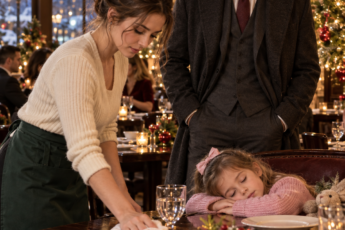
Emma was sitting quietly at the table in her red holiday dress, her hands folded tightly in front of her. Her coat hung over the back of a chair. Near the front door stood several beautifully wrapped gifts, all unopened.
Kate recognized them immediately.
Emma had spent weeks choosing those presents for her grandparents. One small package was different from the others—a handmade Christmas ornament she had prepared especially for Ruth.
“Emma?” Kate asked softly. “Why are you home already?”
The girl slowly looked up.
“I’m sorry, Mom.”
Those three words made Kate’s stomach tighten. She put down her bag and sat beside her.
“Why are you apologizing?”
Emma hesitated.
“I think I ruined Christmas.”
Kate took a slow breath. She did not overwhelm her with questions. She knew Emma needed time.
Little by little, the truth came out.
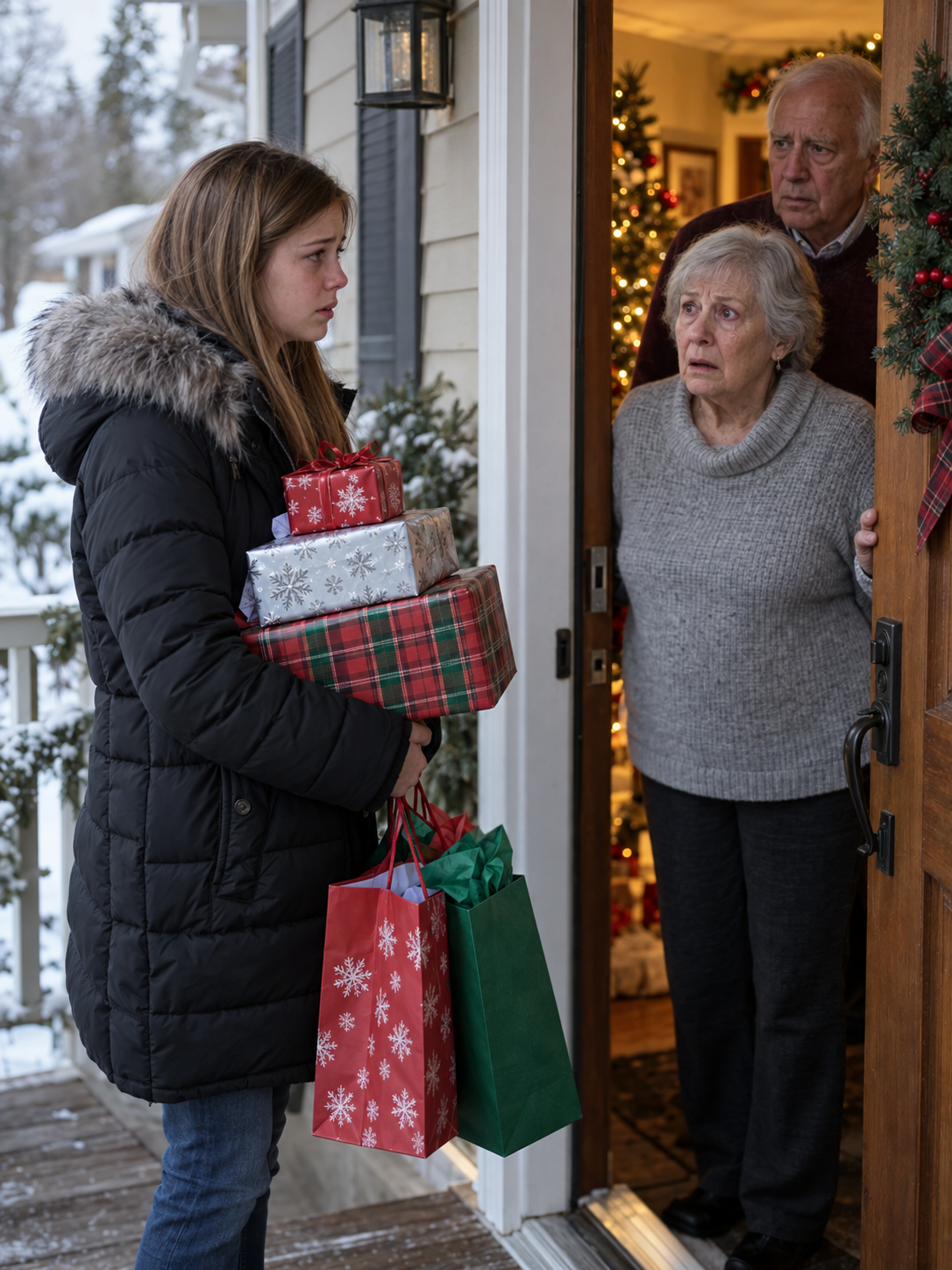
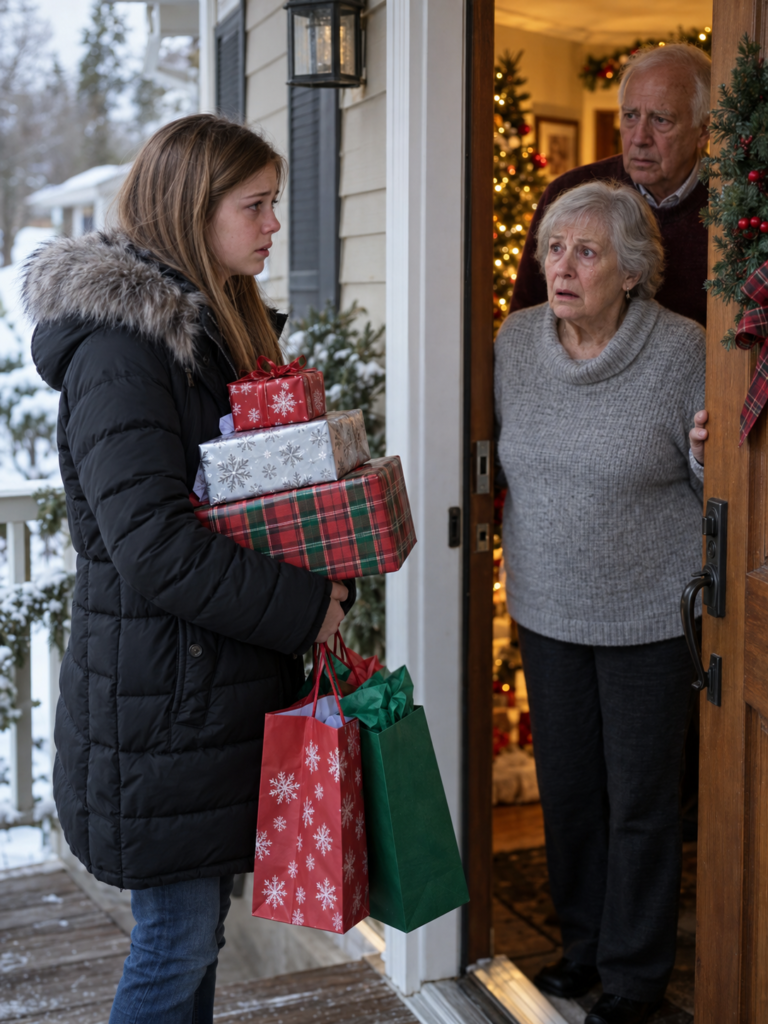
Emma had arrived at her grandparents’ house carrying the gifts and the ornament for Ruth. The house was full of guests. She had expected the door to open wide, for someone to hug her and invite her inside.
Instead, her grandmother told her dinner had been planned for an exact number of people.
There was no place for her.
“She said the house was already too crowded,” Emma whispered. “She said they didn’t save a seat for me.”
Kate remained still.
She had known that house her entire life. It was large enough for dozens of people. Finding room for one child would have taken nothing more than adding a chair.
And that house had a history.
Years ago, Ruth had passed it on to the family for one simple reason: she wanted it to remain a home where every generation could gather.
Now Emma had been turned away from that very home.
“Why didn’t you call me?” Kate asked gently.
Emma pointed at her dead phone lying on the table.
“It ran out of battery.”
“Did you ask to use their phone?”
Emma lowered her eyes.
“Yes. Grandma said it wasn’t necessary. She said calling you would only make everything into a big problem.”
Kate felt anger rise inside her, but she refused to let it spill onto Emma.
“How did you get home?”
Emma went quiet.
Her silence was answer enough, but Kate needed to hear it.
“Grandpa said I could walk,” Emma finally said. “He said it was only about twenty minutes.”
For a moment, Kate could not speak.
Her daughter had walked home alone on Christmas Eve, carrying gifts nobody wanted to accept. The worst part was not the walk itself.
It was what Emma had believed during those twenty minutes.
She had passed decorated homes and glowing windows, wondering what she had done wrong. Wondering why no one wanted her gifts. Wondering why nobody could simply make room for her.
Kate was about to answer when she noticed a strange smell.
She turned toward the stove. A small pot sat on top, with something burned at the bottom.
“What is that?”
Emma’s cheeks turned red.
“I tried to cook something.”
“By yourself?”
“I was hungry. I watched a video to learn how. I still wanted to have a Christmas meal.”
That sentence broke something inside Kate.
She had expected her daughter to be disappointed. She had never imagined Emma returning to an empty house, trying to make herself dinner and recreate a holiday celebration after being excluded from one.
Kate understood then that confronting her family immediately would not fix anything.
Not that night.
Emma did not need another family argument. She needed to feel safe.
Kate took a blanket from the living room and wrapped it around Emma’s shoulders. Then she made two large cups of hot chocolate, adding far too many marshmallows on purpose.
For the first time since she had come home, Emma gave a small smile.
Then it disappeared.
“Are you mad at me?”
“No.”
“Not even because I ruined everything?”
Kate put down her cup and held Emma’s hands.
“Listen to me. You went to see your family with love. You prepared gifts. You wanted to spend Christmas with them. None of that is wrong. Adults’ choices do not become your fault just because they hurt you.”
Emma stared at her.
“Then why didn’t they want me there?”
Kate wished she had an easy answer.
“I don’t know yet,” she said. “But I do know this: you did not ruin Christmas.”
Later, as they sat together on the couch, Kate’s phone lit up.
It was Ruth calling on video.
Emma’s great-grandmother lived far away now and could not attend every holiday gathering, but she always called on Christmas Eve.
Kate answered.
Ruth appeared on the screen with her warm, familiar smile.
“Merry Christmas, my darlings!”
Then she saw Emma.
Her smile faded.
“What happened?”
“Nothing,” Emma answered quickly.
Ruth knew her too well to believe that.
“Emma, look at me,” she said softly. “Did someone hurt your feelings today?”
Emma looked at her mother. Kate did not speak for her. She simply waited.
So Emma told Ruth everything.
She described arriving at her grandparents’ house, seeing the guests, being told there was no room, and carrying all her gifts back home.
Then she picked up the small package.
“This one was for you.”
Inside was the ornament Emma had made herself. Ruth’s name was painted on it in gold letters.
“I wanted them to show it to you during the video call,” Emma said. “But they wouldn’t take it.”
Ruth was silent for several seconds.
Then she asked, very calmly, “Who brought you home?”
Emma pulled the blanket closer around herself.
“No one.”
Ruth’s face changed.
“How did you get there?”
“I walked.”
When Ruth spoke again, her voice was quiet, but firm.
“Emma, remember this. You arrived with love, and you did nothing that should make you feel guilty. What happened today belongs to the adults who made those choices. It does not belong to you.”
Emma nodded slowly.
Then Ruth asked to speak privately with Kate.
“Do you remember why that house stayed in the family?” Ruth asked.
“Of course.”
“I wanted it to bring people together,” Ruth said. “Not to become a place where someone decides who deserves to enter.”
Kate could hear the hurt behind her words.
“I’ll talk to Mom tomorrow.”
“This needs more than a conversation,” Ruth replied. “When I arranged for the house to pass into the family, certain conditions were included in the documents. At the time, nobody paid attention to them.”
Kate sat up straighter.
“But they’ve owned the house for years.”
“I know that,” Ruth said. “I’m not saying I can simply take it back. I’m saying I want the documents reviewed. I want to know exactly what options still exist.”
Kate did not ask for more details.
That night, Emma mattered more than paperwork, property, or old family disputes.
She ended the call. They chose a Christmas movie and ate a simple dinner together. Halfway through the film, Emma fell asleep against her mother.
Kate pulled the blanket higher over her shoulders and hoped that, when Emma woke up, she would remember the hot chocolate and the safety of home—not the door that had closed in front of her.
Then Kate’s phone rang again.
This time, it was her mother.
“What did you tell Ruth?” her mother demanded without saying hello.
“Why?”
“Don’t pretend you don’t know. She just called us about the house.”
Kate looked toward the couch, where Emma was still sleeping.
“I didn’t ask Ruth for anything. Emma told her what happened.”
“You let her tell that story?”
Kate’s jaw tightened.
“She told the truth.”
“You don’t understand,” her mother said sharply. “Ruth is taking this too seriously. Now she wants to dig through old documents.”
“Maybe you should have thought about that before sending an eleven-year-old home alone on Christmas Eve.”
“It wasn’t like that.”
“Then explain it to me.”
But her mother did not explain the dinner or the missing chair.
Instead, she talked about Ruth.
She said Ruth had always had personal reasons for keeping an interest in the house. She said the family had been fighting over things connected to that property long before Emma was born.
Kate stopped arguing.
Until that moment, she had believed this was only about a cruel decision made during Christmas dinner.
Now she understood that the house was at the center of something much older.
“What kind of conflict?” Kate asked.
Her mother fell quiet.
Then she said, “Ask Ruth why she had those papers written the way she did.”
The call ended soon after.
Kate stood in the kitchen with the phone in her hand.
Near the door, Emma’s unopened gifts were still stacked neatly together. A few hours earlier, they had only seemed sad.
Now they felt like the first clue in a family story Kate had never been told.
She returned to the couch and gently covered Emma again.
One thing was certain.
Emma would never again carry the weight of choices made by adults.
And as for the house, the old documents, and whatever Ruth had spent years trying to protect, Kate made herself a promise.
She would learn the truth before another old family secret became a burden for her daughter.
The next morning, Ruth called again.
This time, she was not alone.
Beside her sat a thick folder filled with copies of documents Kate had never seen before.
Ruth placed one hand on the folder and looked directly into the camera.
“Before we speak to your parents,” she said, “there is something you need to know about that house.”
Kate felt it instantly.
Christmas had not been the end of the story.
It had only been the beginning.