When Laura turned onto her street that afternoon, the first thing she noticed was something pink beside the curb.
She slowed down.
It was Emma’s coat.
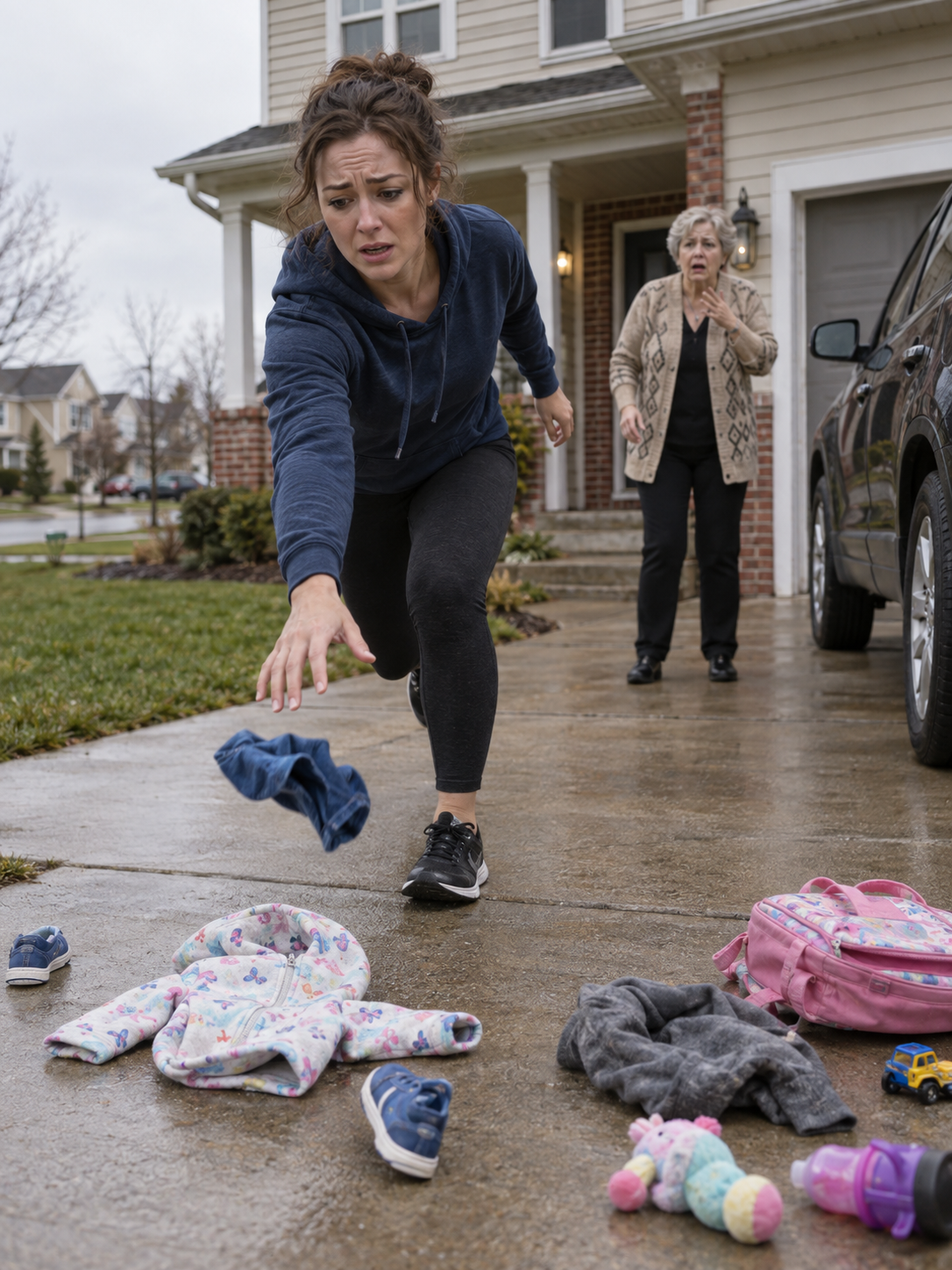
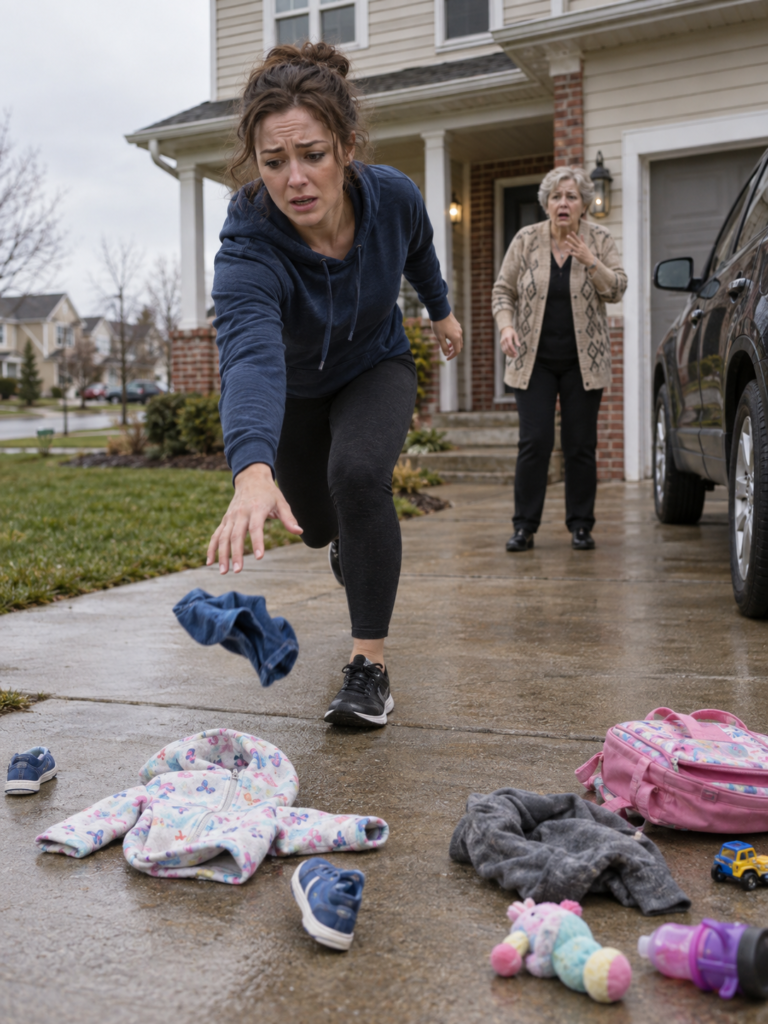
A few feet farther down, she saw two pairs of tiny sneakers, children’s clothes, a school backpack, and several open boxes scattered near the road.
Then Noah spotted his old stuffed rabbit among the things.
“Mom… why are our things outside?”
Laura didn’t answer at once.
On the front porch stood Patricia and Robert—her in-laws.
Patricia had her arms crossed. She didn’t look surprised to see them.
She looked as if she had been waiting.
Laura parked the car and stepped out.
“Patricia, what is going on?”
Her mother-in-law answered in an unsettlingly calm voice.
“Some things needed to be made clear before Daniel comes back.”
Emma got out of the car too. When she saw her clothes near the sidewalk, her face changed.
“Grandma… why did you put my things outside?”
Patricia looked at Laura before answering.
“Because your mother needs to understand that marrying Daniel doesn’t give her the right to make every decision in this family.”
Emma lowered her eyes.
Noah immediately ran to retrieve his stuffed rabbit.
A cold anger rose inside Laura, but beneath it was something stronger.
Clarity.
For twelve years, she had done everything she could to avoid conflict with Daniel’s family. And now she understood that none of her efforts had truly created peace.
They had only delayed the day when she would finally have to say no.
It had started shortly after the wedding.
Patricia constantly talked about the Mitchell family traditions. She explained how holidays should be celebrated, how married couples should make decisions, and why some matters should always stay “within the family.”
At first, Laura thought it was old-fashioned but harmless.
She smiled.
She changed the subject.
She avoided arguments.
But when the twins were born, Patricia’s attitude slowly began to change.
She loved Emma and Noah in her own way, but she often made comments that left Laura uncomfortable. According to Patricia, the children took after Laura’s side of the family too much.
They had “their own habits.”
They didn’t always understand “how the Mitchells did things.”
Laura spoke to Daniel more than once.
His answer was nearly always the same.
“My mother is just like that. Don’t let it get to you.”
For a long time, Laura tried not to.
But a comment you ignore can become a pattern.
And a pattern you tolerate can start to look like permission.
The house itself was another matter Patricia had misunderstood.
It had belonged to Laura’s grandmother.
After Laura’s parents divorced, she spent several years living with her grandmother. They had remained incredibly close until the end of her life. When her grandmother passed away, she left the house to Laura.
Daniel knew that perfectly well.
For their marriage, it had never been an issue. They lived there together. They raised their children there. Naturally, they called it “our home.”
But the ownership documents had always remained in Laura’s name.
Apparently, Patricia had never understood that detail.
A few months before the incident, Daniel accepted a temporary work assignment abroad. He would be away for six months.
Laura encouraged him to take it, even though neither of them liked being apart for that long.
At first, everything went smoothly.
Then Patricia and Robert started coming by much more often.
The first visits seemed thoughtful. They brought groceries. Robert checked if anything needed fixing. Patricia offered to watch the children.
But gradually, their behavior changed.
Robert inspected rooms without being asked.
Patricia reorganized the kitchen.
She criticized household expenses.
She gave instructions to the children as if Laura’s decisions were only temporary.
One day, Laura found Robert standing in the guest room with a measuring tape in his hand.
“What are you doing?”
“Just checking the dimensions.”
“Why?”
He put the tape away.
“I was thinking about a few possibilities for later.”
“What possibilities?”
“Nothing has been decided.”
That answer stayed with Laura.
A few days later, Patricia said the house needed “a stronger family presence” while Daniel was away.
This time, Laura didn’t smile.
“There is already a family in this house,” she said. “My children and I.”
Patricia stared at her.
“You know what I mean.”
“No,” Laura answered. “I don’t think I do.”
The tension grew worse one afternoon when Laura found Patricia in the home office, looking through several folders.
“Are you searching for something?”
“Papers related to Daniel.”
“You could have asked me.”
“I don’t need to bother you about every little thing.”
Laura calmly closed the drawer.
“If you want to look through our private documents, then yes, you do.”
Patricia looked deeply offended.
“You’re asking me to leave my own son’s office?”
“I’m asking you to respect our privacy.”
That night, Laura called Daniel and clearly asked him to speak with his parents.
He did.
For a few days, they stopped coming around.
Laura thought the problem was over.
She was wrong.
Three days later, Laura went out after school with Emma and Noah to pick up a few things. They were gone for about an hour and a half.
When they returned, their usual garage access didn’t work.
Laura tried again.
Still nothing.
At first, she assumed there had been some kind of malfunction.
Then she saw the children’s belongings near the road.
And Patricia standing on the porch.
Laura walked toward the door.
“I want to go inside my home.”
Patricia stayed in front of it.
“I think it would be better to wait for Daniel to return before making certain decisions.”
“What decisions?”
Robert appeared behind her.
“We’re simply trying to prevent the family situation from getting worse.”
Laura looked around.
“By putting my children’s things outside?”
No one answered.
Emma began to cry softly.
That was enough.
Laura turned toward her daughter.
“Hey. Look at me.”
Emma raised her eyes.
“You didn’t do anything wrong. Do you understand?”
The little girl nodded.
Laura took out her phone.
She didn’t want to turn the situation into a confrontation in front of the children, so she contacted local services for help resolving the access issue peacefully.
Patricia made a call as well.
A few minutes later, two officers arrived.
They asked everyone to stay calm and explain separately what had happened.
Laura explained that she lived in the house with her husband and two children, and that when she returned home, her usual access had no longer worked.
Patricia said she believed she was acting in her son’s best interests while he was away.
The officers did not turn the scene into a family argument.
They asked simple questions, reviewed the information each person could provide, and focused on calming the situation.
Laura was able to show documents confirming that the address was her residence.
The ownership information was also checked.
Laura’s name was on the documents.
Patricia looked confused.
“I thought the house belonged to Daniel.”
“It belonged to my grandmother,” Laura said quietly.
Robert looked at Patricia.
For several seconds, no one spoke.
One of the officers calmly explained that family and property matters should be addressed separately—with the appropriate professionals if necessary—and not on a front porch in front of two upset children.
Laura completely agreed.
“I just want to go inside with my children.”
Patricia tried to continue the discussion.
Robert seemed ready to explain his reasoning too.
But Laura no longer had the strength.
“Not today,” she said. “The children have been through enough for one day.”
Eventually, her in-laws left.
The officers remained for a little while, until Laura could safely restore normal access to the house.
Before leaving, one of them noticed Noah’s stuffed rabbit beside the curb. He picked it up and handed it to the boy.
“I think he’d rather go home with you.”
Noah hugged the toy tightly.
Laura felt tears sting her eyes.
Not because she had won anything.
There was no victory in that scene.
Only two children who needed to get back to their rooms.
Inside the house, several things had been moved.
Cabinets were open.
The office did not look the way Laura had left it.
Then she noticed that an archive box was missing.
It contained family papers, documents connected to the house, and personal records from her grandmother.
Laura simply reported that it was gone.
After a few conversations, the box was found inside her in-laws’ vehicle and returned to her.
At first glance, nothing seemed to be missing.
But inside was a photocopy of a document related to the house.
One word had been written across it:
“Transfer?”
Laura stared at that note for a long time.
She could have imagined the worst immediately.
She chose not to.
She didn’t know who had written it or what exactly they intended.
She only knew that after what had happened, she wanted her personal documents better protected.
The next day, she consulted a lawyer.
Laura explained the facts without making accusations.
The moved box.
The photocopy.
The blocked access to the house.
The repeated visits from her in-laws.
“Has Daniel ever asked you to change anything related to the property?” the lawyer asked.
“No. Never.”
“Then don’t draw conclusions without more evidence. But it would be reasonable to review who has access to your home and your documents.”
Laura followed that advice.
The access was changed.
Her important papers were stored somewhere safer.
Permissions that were no longer necessary were removed.
Then Laura called Daniel.
He answered almost immediately.
“Laura? My mother called me.”
“What did she tell you?”
“She said there had been a huge conflict at the house.”
Laura took a breath.
“Did she tell you about Emma and Noah’s things?”
There was silence.
“What things?”
Laura closed her eyes.
Then she told him everything.
Not only about the house.
Not only about the papers.
She told him about Emma’s face when she saw her clothes outside.
About Noah retrieving his rabbit.
About Patricia’s words.
When Laura finished, Daniel remained silent.
“I’m coming home,” he finally said.
Three days later, he was back.
Patricia wanted to come to the house immediately to explain herself.
Laura refused.
She was not ready to let her into the house.
So they met somewhere else.
Daniel asked one question from the beginning.
“Why did you put the children’s things outside?”
Patricia sighed.
“It wasn’t against them. I was angry at Laura.”
“But they were the ones who saw their belongings outside.”
Patricia did not answer.
Daniel continued.
“And why did you think the house belonged to me?”
“You always said, ‘my house,’ ‘my home’…”
“Because I live there with my wife and my children.”
Patricia looked at Laura.
“So everything belongs to you?”
Laura shook her head.
“This isn’t about owning everything. It’s about respecting other people’s boundaries.”
Daniel then asked why the documents had been moved.
Robert spoke about wanting to understand the situation.
Patricia gave a different explanation.
Laura did not try to determine their intentions that evening.
She had already understood what mattered.
She could no longer trust them in the same way.
For several months, contact was limited.
Emma and Noah were given support to help them feel safe again.
Sometimes Emma became afraid whenever she heard someone mention moving.
Noah hid his favorite toys in his closet.
That hurt Laura more than every argument she had ever had with Patricia.
Adults could debate for hours about homes, boundaries, and traditions.
Children remembered something much simpler:
One day, someone put their things outside.
Daniel apologized to Laura.
She accepted his apology, but explained that their life had to change.
“I don’t want surprise visits anymore.”
“Okay.”
“No one else needs access to the house.”
“Okay.”
“Our private documents stay private.”
“Of course.”
Laura looked at him.
“And no one ever makes the children pay for an adult conflict again.”
Daniel nodded.
“Never again.”
They also began working on their relationship.
Daniel realized how often he had used the words “my mother is just like that” to avoid difficult conversations.
Laura realized how often she had accepted uncomfortable situations just to preserve the appearance of harmony.
Together, they changed that.
Almost a year later, Patricia sent a letter.
Laura expected excuses.
Instead, Patricia admitted that she had allowed her anger toward Laura to affect Emma and Noah.
She wrote that she should never have involved children in a disagreement between adults.
That acknowledgment mattered to Laura.
But it did not mean that everything had to instantly return to the way it had been.
Contact resumed slowly.
On Laura and Daniel’s terms.
With time.
With boundaries.
And without pretending that nothing had happened.
Years passed.
One evening, Emma asked her mother:
“Why did Grandma put our clothes outside?”
Laura thought for a moment.
“Because she was angry, and she made a bad choice.”
“Was it our fault?”
“Absolutely not.”
“Was it yours?”
Laura shook her head.
“Every person is responsible for their own choices.”
Emma seemed satisfied with that answer.
For Laura, though, those words represented years of learning.
For a long time, she believed keeping the peace meant avoiding conflict.
She understood now that real peace needs boundaries.
Today, the house is still the home where Emma and Noah grew up.
But Laura almost never thinks about legal papers when she talks about home.
She thinks about Emma’s backpack resting quietly in the entryway.
About Noah’s old rabbit on his bed.
About the doors behind which her children know they are safe.
And above all, she thinks about what she learned that afternoon.
Being family does not give anyone every right.
Loving someone does not mean accepting everything.
And setting a boundary is not destroying peace.
Sometimes, it is exactly what finally makes peace possible.