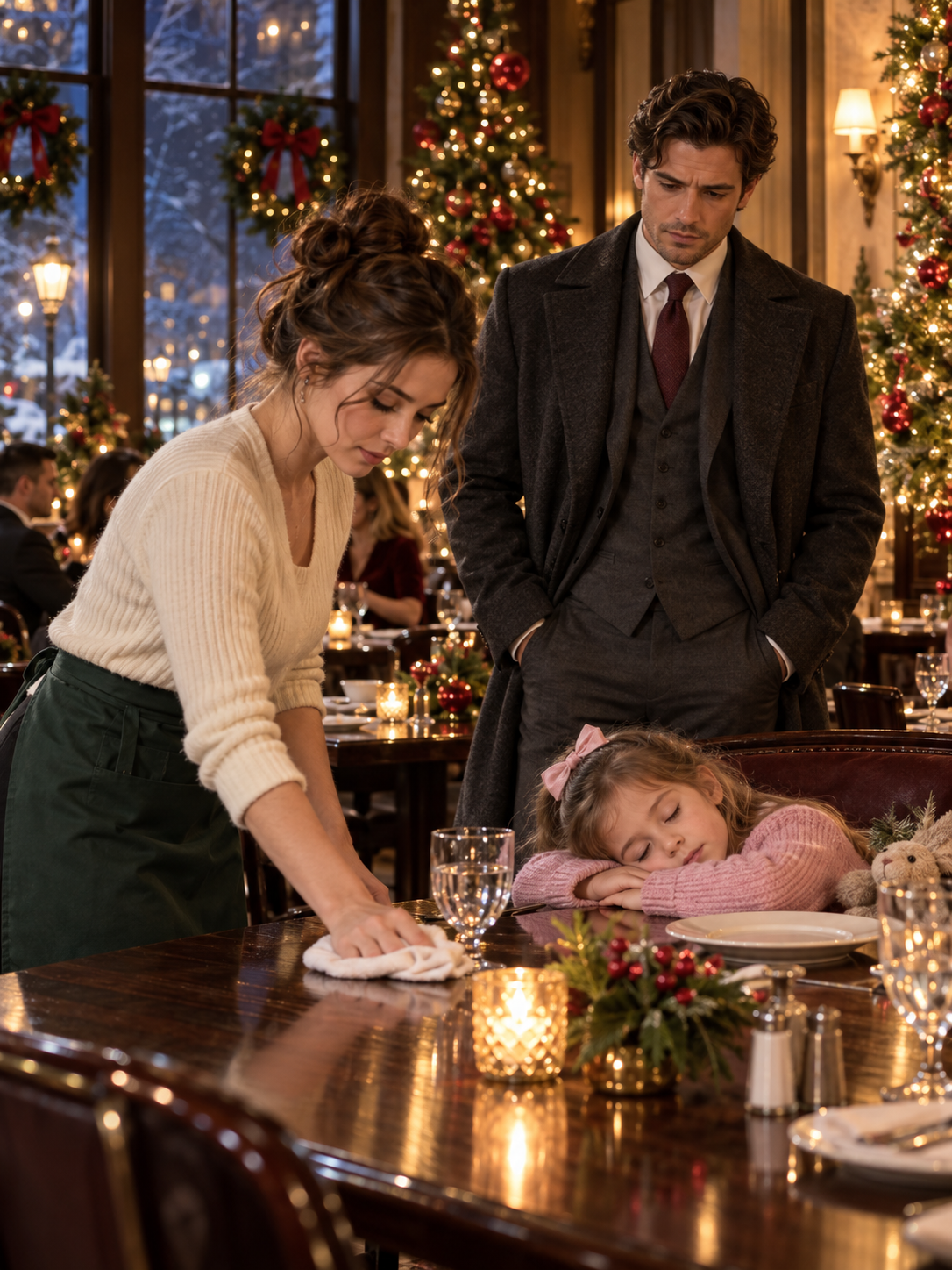
James appeared in the doorway carrying three plates.
He had left his jacket somewhere in the kitchen, rolled up his sleeves, and loosened his tie. For the first time since I had started working at his restaurant, he didn’t look like the distant owner I occasionally passed between meetings.
He simply looked like a man who had prepared dinner.
“It’s nothing special,” he said.
Chloe stared at her plate in amazement: roast chicken, potatoes, vegetables, and warm bread.
“All of this is for us?”
James smiled. “Yes.”
I stood up immediately. “Mr. Whitmore, you didn’t have to do this.”
“I know.”
There was no arrogance in his voice. If anything, he seemed to want me to understand that I owed him nothing.
Then he went back for his own plate.
“I haven’t had dinner either,” he said. “If you’ll accept my company…”
That changed everything.
Accepting charity made me uncomfortable.
Sharing a meal did not.
I sat down again.
A few minutes later, Chloe tasted the potatoes and looked at me with complete seriousness.
“Mom… James’s potatoes are better than yours.”
I was speechless.
James turned his face away to hide his smile.
“Traitor,” I whispered.
Chloe burst out laughing.
And suddenly, the Christmas Eve that had begun with worry almost felt like a real celebration.
Outside, the snow was slowly growing thicker on the sidewalks.
After dinner, James offered Chloe a small piece of cake. Of course, she accepted.
From the kitchen, I heard her asking him one question after another. Then she asked:
“Does your mom come to your house for Christmas?”
The silence lasted one second too long.
“No,” James answered. “She died a long time ago.”
Chloe’s voice immediately softened.
“Do you miss her?”
“A lot.”
“Even when it isn’t Christmas?”
James was quiet for a moment.
“Especially when I wish I could tell her something.”
I lowered my eyes to my cup. I understood that feeling exactly.
My own mother had died three years earlier.
There were still days when my first instinct was to call her.
James returned with coffee for himself and tea for me.
I frowned. “How did you know I prefer tea?”
“You make it almost every night before you clean the offices.”
The answer unsettled me.
I had spent so much time believing I was invisible.
James seemed to understand my expression.
“I notice a lot of things around here,” he said. “My mother used to work in hotel housekeeping.”
I looked up sharply.
That detail did not fit the image I had of him at all.
James was known for his upscale restaurants and luxury businesses. I had always assumed he came from privilege.
“We had almost nothing when I was a child,” he added. “My mother worked constantly. My father left when I was nine.”
Chloe came back with her cake and asked with the disarming innocence of a six-year-old, “Were you poor?”
“Chloe!”
James laughed.
“Yes.”
She thought about it.
“And now you have several restaurants?”
“Yes.”
“Then you worked very hard.”
James looked at me.
“Your daughter sums up my biography much better than business magazines do.”
I smiled despite myself.
But a few minutes later, the conversation took an unexpected turn.
James asked how long I had worked there.
“Eight months.”
He frowned slightly.
“Who hired you?”
“Daniel Bennett.”
His operations manager.
James’s expression changed.
“He interviewed you personally?”
“Yes. Why?”
He hesitated.
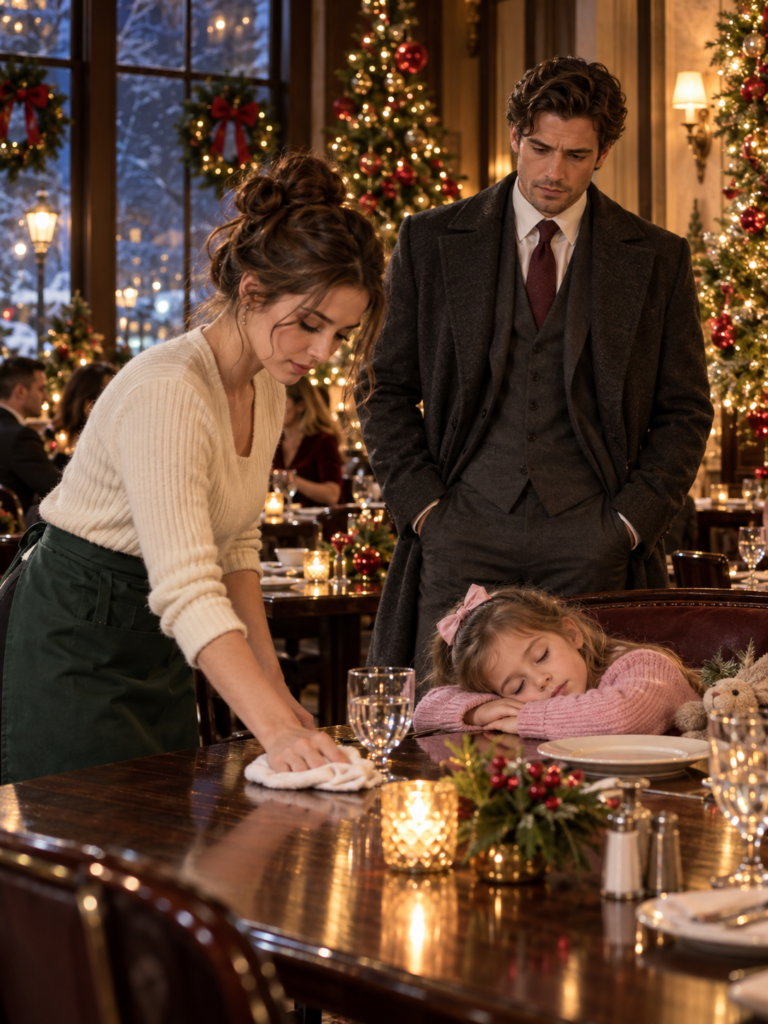
I immediately stiffened. “What is it?”
“Nothing. Maybe. During the interview, did he ask you personal questions?”
I thought about it.
Bennett had asked where I grew up. Then he had asked for my mother’s name.
At the time, I had thought it was ordinary conversation.
“Millbrook,” I said. “I told him I grew up in Millbrook.”
James became completely still.
“And your mother?”
“Margaret Miller. Before she got married, Margaret Dawson.”
He stared at me.
This time, I knew something was wrong.
“Why does that name matter to you?”
James stood up. “Wait here.”
He disappeared into the offices.
Chloe gently tugged at my sleeve.
“Mom, did we do something bad?”
“No, sweetheart. Absolutely not.”
But I was no longer sure.
Ten minutes later, James returned with my employee file. Among the routine forms was a page I had never seen before.
It was an internal note mentioning my name, my mother’s name, and Millbrook.
It simply said that my application should be evaluated normally if I was qualified.
Underneath was one strange sentence:
Do not mention the former family connection unless directly asked.
I read the words again.
“What family connection?”
James shook his head.
“I don’t know.”
“It’s your company.”
“Yes. But I didn’t know about this note.”
I wanted to believe him.
And that made me almost as uneasy as the document itself.
The snow had disrupted transportation that night.
James offered to drive us home, but when I refused, he didn’t push. Instead, the restaurant arranged a ride for us.
Before I left, he gave me copies of the documents involving me.
“I’ll speak to Bennett,” he promised.
“And if you don’t like his answer?”
“I’ll still tell you.”
I held his gaze.
“Okay.”
Chloe wished him a merry Christmas before we left. Then, without warning, she gave him a quick hug.
James looked surprised before gently patting her shoulder.
In the car, Chloe fell asleep against me almost immediately.
I kept the file on my lap.
That was when I found an old photocopy tucked behind my application.
It was a newspaper article.
The photograph showed two young women at a charity drive in Millbrook almost thirty years earlier. I recognized one of them from photographs I had seen of James’s mother.
Evelyn Whitmore.
The second woman took my breath away.
My mother.
Margaret.
According to the article, they had grown up together and organized aid for several families in the area during an especially difficult winter.
They had been friends.
Real friends.
And my mother had never told me.
At the bottom of the page was a handwritten sentence:
Margaret kept her promise. Now it is our turn to keep ours.
I sat in my small kitchen for a long time.
What promise?
And why did it involve James and me?
On Christmas morning, my phone rang.
It was James.
“I spoke to Bennett,” he said.
I sat up immediately. “And?”
“He says he owes both of us an explanation.”
We agreed to meet the next day.
Before hanging up, James added, “I also found several of my mother’s journals. Margaret’s name appears in them often.”
My heart tightened.
“Did you read them?”
“Only a few passages. I think we should discover the rest together.”
James didn’t fully understand his own past either.
The next day, Bennett was waiting for us in James’s office.
He looked nervous.
“Grace, I owe you an apology,” he began.
“For what exactly?”
He took a deep breath.
“Your mother contacted me about three years before you came here. She was already ill.”
My throat tightened.
“Why you?”
“She was looking for a way to reach the Whitmore family.”
James leaned forward.
“Why didn’t anyone tell me?”
Bennett placed both hands on the table.
“Because Margaret didn’t want Grace to receive special treatment.”
Then he told us the story.
Our mothers had been inseparable when they were young.
Evelyn’s family had gone through a difficult period. Margaret and her relatives had quietly helped them so Evelyn could continue her education.
A few years later, Evelyn had found stability.
Margaret, meanwhile, had given up her own plans to help her family after her father became ill.
Before their lives took them in different directions, they had made a promise.
If one of them ever found stability, she would always leave a door open for the other woman’s family in case of real need.
Not a fortune.
Not a debt.
A possibility.
“My mother probably refused any direct help,” I whispered.
Bennett gave a sad smile.
“Every time.”
It sounded so much like her that I almost laughed.
Then Bennett opened one of Evelyn’s journals.
One passage mentioned me directly.
Margaret had asked her friend for only one thing: if Grace ever needed to find her path, no one should decide it for her.
No rescue.
No secret favor.
Only a door that I would be free to open—or not.
I had to look away.
That was why Bennett had recognized my name when he hired me.
“Did you give me this job because of her?”
“No,” he answered immediately.
He showed us the hiring records.
I had been selected through the normal process after another candidate withdrew.
Bennett’s only involvement had been making sure I was neither favored nor rejected because of the family connection.
Strangely, that answer relieved me.
I had earned my job myself.
The promise had not opened the door for me.
It had simply kept anyone from closing it.
Then I showed Bennett the handwritten sentence from the newspaper article.
He went pale.
“I’ve never seen that note.”
James studied it for a long time. Then he stood up and returned with an old card written by his mother.
We compared the handwriting.
It was the same.
Evelyn had written the sentence.
We began reading through her journals.
They contained decades of friendship.
Arguments.
Jokes.
Birthdays.
Updates about my school years that my mother had sent Evelyn.
She had even sent her a story I had written when I was seventeen.
“You wanted to write?” James asked.
I shrugged.
“Once.”
He looked at me for several seconds.
“I don’t think some things ever truly become ‘once.’”
I didn’t have time to answer.
A passage had caught his attention.
It was dated several years earlier.
Evelyn mentioned a man named Robert.
James went silent.
“Robert was my father.”
We continued reading.
The journal mentioned a letter my mother had found.
An old misunderstanding.
A truth Evelyn regretted not explaining sooner.
But none of the entries clearly revealed what had happened.
“Something is missing,” I whispered.
Bennett hesitated.
Then he mentioned Millbrook.
My mother had kept a small storage space there containing family belongings.
I had no idea it existed.
“Is it still there?”
“Yes.”
I knew immediately that I had to go.
James offered to come with me.
This time, I didn’t refuse.
Two days later, we arrived in Millbrook.
The town looked smaller than I remembered.
My grandfather’s shop had been gone for years.
Behind the old building stood a row of small garages.
Inside one of them, I found an entire piece of my childhood.
Boxes.
Books.
Christmas decorations.
An old lamp.
And, most of all, my mother’s desk.
I immediately recognized a scratch in the wood.
I had done my homework at that desk as a child.
I ran my fingers over it.
“I thought she sold it.”
James stayed at a respectful distance. He didn’t try to fill the silence.
We opened several boxes.
Then I noticed a small envelope attached beneath one of the desk drawers.
My name was written on it.
GRACE.
Inside was a key.
It opened the drawer.
I held my breath.
There were three bundles of letters inside.
The first had Margaret’s name on it.
The second had Evelyn’s.
The third had Robert’s.
James slowly sat down.
“My father.”
Above the letters was an envelope addressed to my mother.
The sender was Robert Whitmore.
I looked at James.
“Do you want me to open it?”
He nodded.
I carefully unfolded the letter.
The first lines changed everything we thought we knew.
Robert explained that Evelyn had blamed herself for his leaving for years.
Margaret also seemed to carry guilt that did not belong to her.
But Robert insisted that the decision had been his.
No one had forced him to leave.
Later in the letter, he asked Margaret to give James a message one day, if James ever came searching for answers.
He wanted his son to know one thing.
Despite his absence, he had loved him.
James lowered his eyes.
For several seconds, he said nothing.
All his life, he had believed his father had simply left without looking back.
The letter fixed nothing.
It did not erase his absence.
But it suggested that a vital part of the story had been hidden.
“Why didn’t your mother ever give James this letter?” I asked quietly.
He looked up at me.
“That is exactly what I want to know.”
We looked at the other envelopes.
Dozens of letters were still sealed.
Somewhere in that box might be the explanation.
Why Robert had left.
Why Evelyn had stayed silent.
Why my mother had agreed to protect the secret.
And most of all, why two women who had promised always to leave a door open for each other’s children had decided that one truth should remain locked away for almost thirty years.
James slowly picked up the first bundle.
Then he stopped.
“Grace…”
“Yes?”
He showed me an envelope tucked at the very back of the drawer.
It was addressed to neither Evelyn nor Margaret.
Two words were written on it:
For James.
And underneath:
Open only if he discovers the truth about Robert.
James looked at me.
In the silent garage, I could almost hear my own heart beating.
We had come to Millbrook to understand our mothers’ past.
But that envelope had revealed something far more unsettling.
They had always known that one day James might discover the truth.
The only question was what they had wanted to hide from him so desperately.