After my father’s funeral, I thought I understood every reason I’d resented him for so long.
Then I opened an old cardboard box.
What I found changed the way I saw our family—and everything I thought I knew about my father.
My name is Ethan. For five years, I paid him $250 a month to keep living under his roof. I worked hard, often went without things I wanted, and gradually began to believe he saw me as a burden.
Now he was gone.
Frank, my father’s longtime friend, handed me a box he’d kept in his garage. Inside was a brand-new pair of blue sneakers.
I recognized them immediately.
When I was fourteen, I’d begged my father to buy them for me. My old shoes were so worn that rain soaked through them. He’d refused.
Beneath the sneakers was a small notebook. It held sixty entries, one for each monthly rent payment I’d made.
The total came to $15,000.
“He really kept all of it?” I asked.
Frank nodded.
“He added his own savings, too. He wanted to help you buy your first home.”
He showed me a statement with more than $60,000 in the account.
I couldn’t speak. For years, I’d believed my father took that money because he didn’t want me in his house anymore.
Instead, he’d been saving it for me.
But the discovery didn’t erase the hurt.
“Why didn’t he ever tell me?”
Frank lowered his eyes.
“Your father was afraid of a lot of things. He never knew how to put his feelings into words.”
Then I found a letter. In it, my father admitted he’d made mistakes. He’d confused being strict with being responsible, and he regretted making me feel I had to earn my place in his home.
At the bottom, he’d written:
“My son, you never owed me anything. I should have given you more. I’m sorry I couldn’t be the father you needed.”
I broke down. I would have given anything to hear those words from him while he was still alive.
But Frank wasn’t finished. He pulled a folder of old documents from the box.
“Ethan, there’s something you need to know about your mother’s family.”
My mother, Mary, had come from a wealthy family. Her father owned land and investments, and after his death, a significant part of the estate was supposed to come to me. But a relative named Richard challenged the inheritance, and the dispute dragged on for years.
My father had tried to protect my interests without telling me.
“He was afraid the whole matter would hurt you,” Frank explained.
“So he thought hiding the truth would protect me?”
“He believed he was doing what was best.”
I shook my head. Even a secret born out of fear can tear a family apart.
Among the papers was a photograph of my mother, smiling in front of a small white house. I was nine when I was told she had died in a car accident. Since then, I’d been left with only a few memories of her voice.
Frank handed me another envelope. It held information my father had gathered over the years. According to the documents, some details about the accident had never been fully explained. My father suspected that people connected to the family dispute might know more, but he had no proof against anyone.
“Why did he keep looking into it?” I asked.
“He wanted to know what had really happened.”
Before Frank left, he placed a small key in my hand.
“Your father left something in a storage unit. He asked me to give you this after you’d read his letters.”
The next morning, I went to the storage facility. Inside a metal locker, I found a black briefcase. It contained several photographs, a small recorder, and an envelope with my name on it.
The first photograph showed a gray-haired woman standing in front of a cottage.
My breath caught. She looked exactly like my mother.
A recent date was written on the back.
I switched on the recorder. After a few seconds, a woman’s voice came through.
“Ethan, it’s Mary. I know what you’re about to hear will be hard to accept.”
I sat down. Her voice continued:
“For many years, you believed I was dead. The truth is, I survived. But after the accident, I went through a very difficult time and made choices I deeply regret.”
I couldn’t move.
My mother was alive?
“Your father only learned the truth recently,” she went on. “We were trying to figure out how to explain everything to you.”
Then she said a name: Frank.
According to her, my father’s closest friend knew details about the story that he’d never fully shared. That didn’t prove he’d done anything wrong, but it raised new questions.
Just then, my phone rang. It was Frank. I let it go to voicemail and continued searching through the briefcase.
Under a stack of papers, I found another photograph. My father stood beside Mary, with a teenage girl between them.
Someone had written on the back: “Lily, summer 2025.”
I stared at the picture, stunned. If it was genuine, my father had found my mother before he died.
But who was the girl? A relative? A daughter I’d never known about?
My thoughts raced. Then a message arrived from an unknown number:
“Ethan, it’s Mary. Please don’t make any decisions before you’ve heard the whole truth.”
I heard footsteps in the hallway. Through the glass door, I saw Frank approaching with an older man. I recognized Richard from the photographs in the folder.
My heart began to pound. I picked up the last envelope in the briefcase. It contained another letter from my father.
I opened it.
“Ethan, if you’re reading this, you’ve discovered that your mother is alive. I’m asking you to hear Frank out, too. Nothing we believed for all those years was exactly as it seemed.”
When I looked up, Frank was standing at the door.
“Ethan, we need to talk.”
I decided I wouldn’t face that conversation alone. With help from an independent lawyer, I met with Mary, Frank, and Richard separately over the next few days.
The truth emerged little by little.
Mary had survived the accident, but she’d spent years dealing with medical care and personal struggles. Some information about her situation had been passed along incorrectly, leading to years of silence and misunderstanding.
Frank had kept some of the family’s correspondence because he believed he was honoring the wishes entrusted to him. Richard had been involved in the inheritance dispute, but there was no evidence connecting him to the accident.
As for Lily, she was a young relative Mary had welcomed into her family. She wasn’t my sister. The photograph showed a family gathering from the previous year, when my father had finally reunited with Mary.
My first meeting with my mother was difficult. We didn’t rush into each other’s arms. I had too many questions and too many years of grief behind me.
She cried as she tried to explain the choices she’d made.
“I’m not asking you to forgive me right away,” she whispered. “I just hope you’ll give me the chance to get to know you again.”
I told her it would take time. For the first time in my life, no one tried to make that decision for me.
Over the following months, the inheritance matter began to move toward a legal resolution. But the most important change had nothing to do with money.
It was something that changed inside me.
I finally understood that my father had loved me, even though his silence had hurt me deeply.
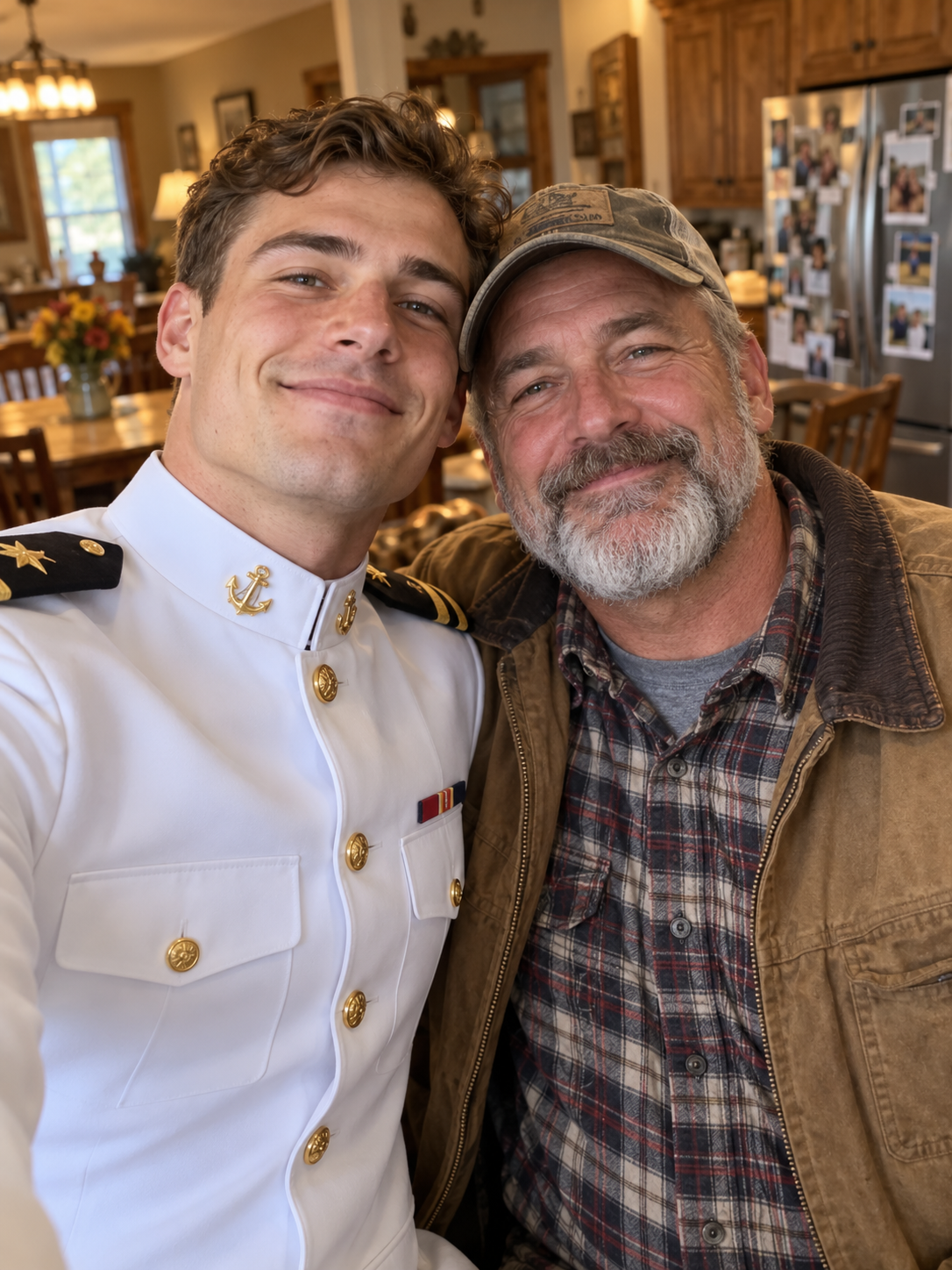
One evening, I returned to our old house. I took the blue sneakers out of the box and placed them beside a photograph of the two of us.
“Dad,” I whispered, “I would have traded some of those secrets for more time with you.”
Then I smiled through my tears.
I couldn’t change the past, but I could choose not to repeat the same mistakes. The greatest inheritance my father left me wasn’t a fortune. It was the understanding that love should be spoken while there’s still time for someone to hear it.
If this story moved you, write “YES” in the comments and leave a like.